

World Bank approves $200 million for climate-resilient rural infrastructure in Pakistan’s northwest

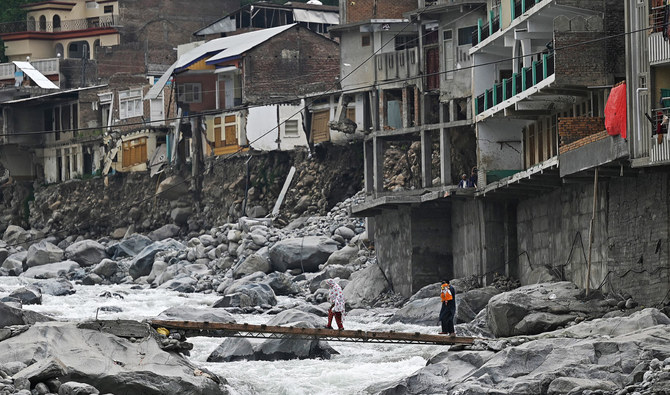
In this picture taken on May 4, 2023, residents cross a temporary bridge near empty hotels and houses those were damaged by flash floods on the banks of river Swat last summer in 2022 in Bahrain town of Swat valley in Khyber Pakhtunkhwa province. (AFAP/File)
Short Url
Updated 14 June 2023
Follow

World Bank approves $200 million for climate-resilient rural infrastructure in Pakistan’s northwest

  • The project will primarily focus on the newly merged tribal districts of Khyber Pakhtunkhwa province
  • It will provide conditional grants to village councils to finance local community’s infrastructure priorities

ISLAMABAD: The World Bank has approved $200 million for Pakistan to strengthen its capacity to deliver basic services and climate-resilient rural infrastructure in the newly merged tribal districts of Khyber Pakhtunkhwa (KP) province, according to a statement released by the international financial institution on Wednesday.

Pakistan’s northwestern tribal districts are among its least developed regions, where people even lack basic livelihood opportunities. The area also suffered due to monsoon rains and unprecedented floods last year, which submerged about a third of the country’s landmass and resulted in losses of about $38 billion.

According to the details, the World Bank will adopt a multiphase programmatic approach and launch the Khyber Pakhtunkhwa Rural Investment and Institutional Support Project (KPRIISP) in the first phase. The project aims to increase access to resilient and reliable basic services for rural households in the area and facilitate citizen-driven service delivery. Additionally, it will rehabilitate infrastructure affected by the devastating floods last year.

“KPRIISP aims to address development gaps in rural areas that are among the poorest in the country, directly benefiting around 5.5 million people by extending public service delivery systems, investing in basic infrastructure like water supply and sanitation, and boosting agricultural productivity and livelihood opportunities,” said Najy Benhassine, World Bank Country Director for Pakistan.

“It will also support post-floods reconstruction and rehabilitation, while strengthening resilience to such climate-related shocks, particularly in the Newly Merged Districts of the Province,” he continued.

The statement added the project aimed to support emergency reconstruction and rehabilitation of flood protection infrastructure damaged by the 2022 floods. Infrastructure investments in water supply and sanitation, rural roads, agriculture, and irrigation will be done to strengthen climate resilience in the face of increasing frequency and severity of extreme weather events in Pakistan.

“In addition to investments in critical infrastructure, this new project will provide conditional grants to village councils to finance local infrastructure priorities in line with community preferences and women’s priorities,” Anna O’Donnell, task team leader of the project, said. “It will also ensure that communities are involved in participatory planning, budgeting, monitoring, and improving social accountability systems, while focusing on institutional strengthening and capacity building of village councils.”

Pakistan has been a member of the World Bank since 1950 and has received $40 billion in assistance until now. The bank’s current portfolio includes 58 projects and a total commitment of $14.8 billion.


Pakistan reviews austerity measures amid Middle East crisis, urges strict nationwide implementation

Updated 11 March 2026
Follow

Pakistan reviews austerity measures amid Middle East crisis, urges strict nationwide implementation

  • Deputy Prime Minister Ishaq Dar chairs review meeting of austerity steps
  • Officials briefed on salary cuts, school closures, four‑day week, petrol conservation

ISLAMABAD: Pakistan’s government on Wednesday assessed progress on a sweeping set of austerity measures introduced to mitigate the country’s economic strain from sharply rising global oil prices and supply disruptions linked to the ongoing war in the Middle East.

Prime Minister Shehbaz Sharif this week announced a series of austerity steps, including a four‑day work week for government offices, requiring 50  percent of staff to work from home, cutting fuel allowances for official vehicles by half, grounding up to 60  percent of the government fleet and closing all schools for two weeks to conserve fuel amid the global oil crisis.

The measures were unveiled in response to global oil market volatility triggered by the conflict involving the United States, Israel and Iran, which has disrupted supply routes such as the Strait of Hormuz and pushed crude prices sharply higher, straining Pakistan’s heavily import‑dependent energy sector.

“The meeting stressed the importance of strict and transparent adherence to the austerity measures, promoting fiscal responsibility and prudent use of public resources,” Deputy Prime Minister and Foreign Minister Senator Mohammad Ishaq Dar said in a statement.

He was chairing a meeting of the Committee for Monitoring and Implementation of Conservation and Additional Austerity Measures, constituted under the directions of the PM, bringing together federal and provincial officials to review execution of the broad cost‑cutting plan. 

Dar emphasized the government’s commitment to enforcing the PM’s austerity steps nationwide. The committee’s review also covered reductions in departmental expenditure, deductions from salaries of senior officials earning over Rs. 300,000 ($1,120), and coordination with provincial administrations to ensure uniform implementation of the plan.

Participants at the meeting reiterated that all ministries and divisions must continue strict monitoring and reporting, with transparent oversight mechanisms, as Pakistan navigates the economic pressures from the prolonged Middle East crisis and its fallout on global energy and trade markets.