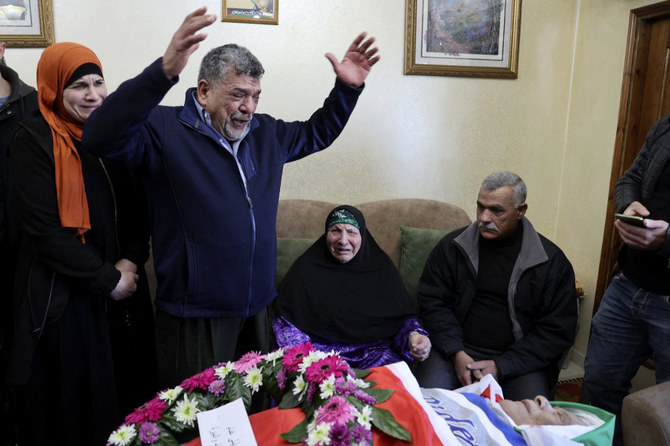
RAMALLAH: The lawyer for the family of an elderly Palestinian-American who died after being subjected to the Israeli army’s violence in January 2022 has announced that he will appeal against the Israeli decision to close the investigation into the “murder” of the elderly man.
Omar Asaad, 80, died at dawn on Jan. 12, 2022. According to witnesses, the Israeli soldiers dragged Asaad — handcuffed and blindfolded— a long distance, and he was left in the yard of a house under construction for several hours in the extreme cold, where he died.
Hassan Al-Khatib, the lawyer for the Asaad family, from the village of Jilyjlia, north of Ramallah, said that if the Israeli prosecution refused to accept the appeal, a petition would be submitted to the Israeli Supreme Court.
Al-Khatib said the Israeli public prosecution had announced in January this year that it would file an indictment against the soldiers who committed the crime. After the arrival of the new far-right government, however, the decision was aborted by political orders.
Al-Khatib stressed that legal procedures would continue until justice was delivered for the man who was killed.
According to Israeli sources, the force responsible for Asaad’s death was the Nitzah Yehuda battalion, which includes extremist settlers, some of whom live in outposts in the West Bank and whose soldiers carry out attacks against Palestinians.
The sources say that members of this army division regularly stop Palestinian vehicles, remove their passengers and abuse them.
Shawan Jabarin, director of the Ramallah-based human rights group Al-Haq, told Arab News that the Israeli army’s admission that the soldiers’ conduct was inappropriate and subsequent disciplinary measures against them indicate that they were indeed responsible for causing Asaad’s death. Closing the investigation, however, meant that the Israeli authorities were absolved of responsibility, he said.
While the army officers’ abuse of the elderly man led to punitive measures as well as financial compensation to Asaad’s family, “Israel always follows a policy of impunity.”
The military unit’s commander escaped with a reprimand and demotion, two officers were dismissed.
The Israeli public prosecution office justified the closure of the case by saying that the Palestinian Authority did not provide Israel with Asaad’s autopsy report and that his family did not supply his medical file.
“The victim is not required to prove that he is a victim; the investigation system has to prove that. The Israeli authorities did not investigate Asaad’s death seriously. They just conducted a formal investigation based on the American request in this regard,” Jabarin said.
An Israeli institution close to the Israeli army reported that Asaad deserved to die because he “shouted loudly” against the soldiers.
The Palestinian Ministry of Foreign Affairs condemned the Israeli decision to close the investigation.
It said that the closure of the file intends to mislead “global public opinion” and “give the impression that there are Israeli investigations into the ongoing crimes committed by the Israeli army,” which often end “with the acquittal of the perpetrators, the concealment of evidence, and the provision of escape doors for political and military officials as well, who give instructions to facilitate the killing of Palestinians.”
Jabarin said this case proved once again that the judicial system in Israel formed an integral part of the occupation system itself, as most crimes are ignored and no investigations are conducted that are appropriate to the circumstances.
The Palestinian Foreign Ministry called on the US administration to investigate this crime, as Asaad was an American citizen, stressing that the Palestinian Authority was fully prepared to cooperate to uncover the killers.
It also called on the International Criminal Court to quickly complete its investigations into Israeli crimes and hold Israeli war criminals accountable for their actions.

Family rejects Israeli decision to close case of elderly Palestinian-American’s torture death
Short Url
https://arab.news/ne6ep
Family rejects Israeli decision to close case of elderly Palestinian-American’s torture death
- Israeli soldiers dragged Asaad — handcuffed and blindfolded— a long distance, and he was left in the yard of a house under construction for hours in the extreme cold
- Hassan Al-Khatib, the lawyer for the Asaad family, said that if the Israeli prosecution refused to accept the appeal, a petition would be submitted to the Israeli Supreme Court
Turkiye to forge on with tight economic policy, some fine-tuning, VP Yilmaz says
ISTANBUL: Turkiye is committed to carrying on its tight economic policies in order to cool inflation, and though it may fine-tune the program it will not change course, Vice President Cevdet Yilmaz said in comments embargoed to Friday.
“There is no plan to pause our program,” Yilmaz said at a briefing with reporters in Istanbul on Thursday. “All programs are dynamic, and adjustments can always be made.”
Yilmaz, who plays a key role overseeing economic policy at the presidency, said any such adjustments would aim to support production, investment and exports while moderating consumption.
Turkiye has pursued tight monetary and fiscal policies for more than two years in order to reduce price pressure, leading to high financing and borrowing costs that have weighed on businesses and households. Inflation has eased slowly but steadily over the last year but remains elevated at 31 percent annually.
Last month, Is Bank CEO Hakan Aran warned that focusing solely on one target — inflation — could create side effects, suggesting a “pause and restart” might be healthy once the program achieves certain targets.
Yılmaz said the government expects improvements in inflation in the first quarter, which should reflect to market expectations for year-end inflation around 23 percent. The government projects inflation to dip as far as 16 percent by year end, within a 13-19 percent range, and falling to 9 percent in 2027. The central bank forecasts inflation between 13-19 percent by end-2026.
Yilmaz noted inflation fell by nearly 45 points despite pressure from elevated food prices, hit by agricultural frost and drought.
The agricultural sector is expected to support growth and help ease price rises this year, which could help achieve official inflation targets, he said.
Yilmaz said the government wants to avoid a rapid drop in inflation that could hurt economic growth, jobs and social stability.
Turkiye’s economic program was established in 2023 after years of unorthodox easy money that aimed to stoke growth but that sent inflation soaring and the lira plunging. The program aims to dislodge high inflation expectations while boosting production and exports, in order to address long-standing current account deficits.
The central bank, having raised interest rates as high as 50 percent in 2024, eased policy through most of last year, bringing the key rate down to 38 percent.
Asked whether lower rates could trigger an exit from the lira currency, Yilmaz said: “What matters is real interest rates. Lowering rates as inflation falls does not affect real rates, so we do not expect such an impact.”
He added that the government will strengthen mechanisms that selectively support companies while improving overall financial conditions.
“There is no plan to pause our program,” Yilmaz said at a briefing with reporters in Istanbul on Thursday. “All programs are dynamic, and adjustments can always be made.”
Yilmaz, who plays a key role overseeing economic policy at the presidency, said any such adjustments would aim to support production, investment and exports while moderating consumption.
Turkiye has pursued tight monetary and fiscal policies for more than two years in order to reduce price pressure, leading to high financing and borrowing costs that have weighed on businesses and households. Inflation has eased slowly but steadily over the last year but remains elevated at 31 percent annually.
Last month, Is Bank CEO Hakan Aran warned that focusing solely on one target — inflation — could create side effects, suggesting a “pause and restart” might be healthy once the program achieves certain targets.
Yılmaz said the government expects improvements in inflation in the first quarter, which should reflect to market expectations for year-end inflation around 23 percent. The government projects inflation to dip as far as 16 percent by year end, within a 13-19 percent range, and falling to 9 percent in 2027. The central bank forecasts inflation between 13-19 percent by end-2026.
Yilmaz noted inflation fell by nearly 45 points despite pressure from elevated food prices, hit by agricultural frost and drought.
The agricultural sector is expected to support growth and help ease price rises this year, which could help achieve official inflation targets, he said.
Yilmaz said the government wants to avoid a rapid drop in inflation that could hurt economic growth, jobs and social stability.
Turkiye’s economic program was established in 2023 after years of unorthodox easy money that aimed to stoke growth but that sent inflation soaring and the lira plunging. The program aims to dislodge high inflation expectations while boosting production and exports, in order to address long-standing current account deficits.
The central bank, having raised interest rates as high as 50 percent in 2024, eased policy through most of last year, bringing the key rate down to 38 percent.
Asked whether lower rates could trigger an exit from the lira currency, Yilmaz said: “What matters is real interest rates. Lowering rates as inflation falls does not affect real rates, so we do not expect such an impact.”
He added that the government will strengthen mechanisms that selectively support companies while improving overall financial conditions.
© 2026 SAUDI RESEARCH & PUBLISHING COMPANY, All Rights Reserved And subject to Terms of Use Agreement.


