

Egypt’s grand imam to highlight Islam’s peace message at UN session

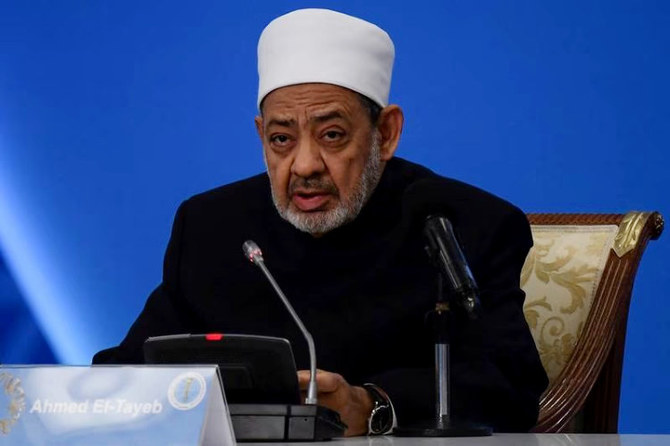
Egypt’s Grand Imam of Al-Azhar mosque, Sheikh Ahmed Al-Tayyeb. (AFP)
Short Url
Updated 13 June 2023
Follow

Egypt’s grand imam to highlight Islam’s peace message at UN session

  • It will be the first time the UN Security Council has hosted such a session involving elite decision-makers, political leaders, and top religious figures, including Al-Tayeb, and Pope Francis

CAIRO: The head of Egypt’s top religious authority will on Wednesday highlight the importance of fraternity, tolerance, and mutual respect in achieving world peace during an address at the UN Security Council.

Sheikh Ahmed Al-Tayyeb, grand imam of Al-Azhar, will speak during a panel discussion on ways to promote and sustain global peace.

In his speech, Al-Tayyeb, chairman of the Muslim Council of Elders, will focus on the significance of promoting the values and their role in spreading the peace message.

In a statement, Al-Azhar Al-Sharif, Sunni Islam’s oldest and foremost seat of learning, described the meeting as a “historic and unique opportunity” to highlight the prominent role played by religious leaders in consolidating the values of human friendship and mutual support.

It will be the first time the UN Security Council has hosted such a session involving elite decision-makers, political leaders, and top religious figures, including Al-Tayeb, and Pope Francis.

In 2019, the leader of the Roman Catholic Church and the grand imam of Al-Azhar signed the Human Fraternity Document in Abu Dhabi.

Separately, Egypt’s mufti, Shawki Allam, president of the Supreme Council of the General Secretariat for Fatwa Authorities Worldwide, will participate in the activities of the Forum for Building Bridges Between East and West.

The event was due to be held on Wednesday at the Trusteeship Council Chamber at the UN headquarters in New York.

Ibrahim Negm, senior adviser to Allam, said: “This four-day visit is an extension of the international tours conducted by Egypt’s mufti in light of the strategy adopted by Egypt’s Dar Al-Ifta as one of Egypt’s soft power sources in religious communication and reaching out to the world.”

The mufti’s visit, he added, would include meetings with several UN leaders “to strengthen communication and cooperation and establish common goals and programs to enhance the culture of communication, understanding, and knowledge-sharing. This is a step to correct the image of Islam in the West and confront waves of Islamophobia, hate speech, and extremism.”


Jordan begins implementing Royal directives to modernize Arab Army

Updated 11 sec ago
Follow

Jordan begins implementing Royal directives to modernize Arab Army

  • On Saturday, it was reported that King Abdullah had announced the strategy

AMMAN: Jordan’s Armed Forces have begun implementing royal directives from King Abdullah II aimed at restructuring and modernizing the Arab Army to strengthen its operational readiness and ability to meet evolving security challenges, it was announced on Sunday.

The overhaul is designed to sharpen combat capabilities and establish a streamlined, flexible force equipped to operate across varied environments, while adapting to the demands of modern and unconventional warfare, the Jordan News Agency reported.

The directives called for closer alignment between organizational structures and operational needs, alongside upgrades to command, control and communications systems. 

They also urged stronger integration across military branches and units, as well as expanded use of advanced technologies, including unmanned systems and cyber capabilities.

Plans also include reinforcing reserve forces, improving logistics to ensure reliable supply chains, and supporting Jordan’s defense industries to enhance self-sufficiency and efficiency.

In a statement, the Jordanian Armed Forces said they were fully committed to carrying out the royal directives as part of a broader strategic vision to raise professionalism and preparedness.

On Saturday, it was reported that King Abdullah had announced a strategy “to achieve a structural transformation in the armed forces over the course of the next three years,” Petra said.

In a letter to the Chairman of the Joint Chiefs of Staff, the King wrote: “Our Arab Army is a national institution that every Jordanian is proud of.”

“We must examine the requirements for modernizing and developing our Armed Forces, while restructuring them to keep pace with combat demands within various environments of operation,” the king wrote. 

The king also said the army must have sufficient reserve forces reinforced with the necessary capabilities.

“Our Armed Forces must have sufficient reserve forces, equipped with the various needed capabilities to execute their operations efficiently.”