

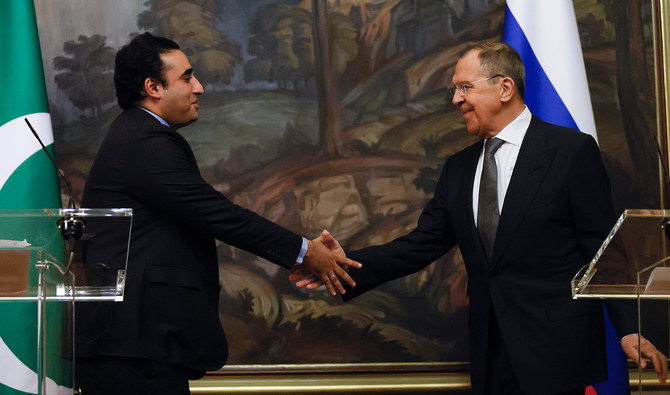

ISLAMABAD: Russian Foreign Minister Sergey Lavrov has said Moscow was interested in “expanding cooperation” with Pakistan and wanted to work with Islamabad to shape a “more just and democratic multipolar world order.”
Lavrov made the remarks in a video message to Pakistan on Monday on the occasion of the 75th anniversary of diplomatic relations between the two countries and days after the first cargo of discounted Russian crude oil arranged under a deal struck between Islamabad and Moscow arrived in Karachi.
“Our relations are advanced and based on trust,” Lavrov said. “They are founded on the concurrence or proximity of approaches to the key issues of the international agenda. Together with our Pakistani partners, we stand for shaping a more just and democratic multipolar world order.”
“There have been different periods in our relations over the past three quarters of a century. However, Russia has always been interested in expanding cooperation with Pakistan, and under no circumstances has abandoned its commitments.”
Lavrov spoke about the participation of Soviet specialists in the construction of the largest steel mill in Karachi, now called Pakistan Steel Mills, in the 1980s, despite the conflict raging in Afghanistan at the time, as well as the Guddu Thermal Power Plant, then the largest in Pakistan, which was also commissioned then.
The Russian foreign minister said the two countries had also in recent years succeeded in making significant progress in bilateral trade.
“Russia has become a major supplier of wheat to Pakistan, with shipments exceeding one million tons last year,” Lavrov said.
“Negotiations on launching a cooperation project in the oil sector are at their final stage. Together with our Pakistani partners, we stand for shaping a more just and democratic multipolar world order. We respect the cultural and civilizational diversity of peoples and their right to determine the avenues of their political, social and economic development themselves.”
Lavrov said Moscow considered Pakistan a key international partner in joint efforts to combat common security challenges and threats, including transborder crime and terrorism.
On Sunday, Pakistan celebrated the first Russian discounted crude oil cargo arriving in Karachi, which Prime Minister Shehbaz Sharif described as the “beginning of a new relationship between Pakistan and Russian Federation.”
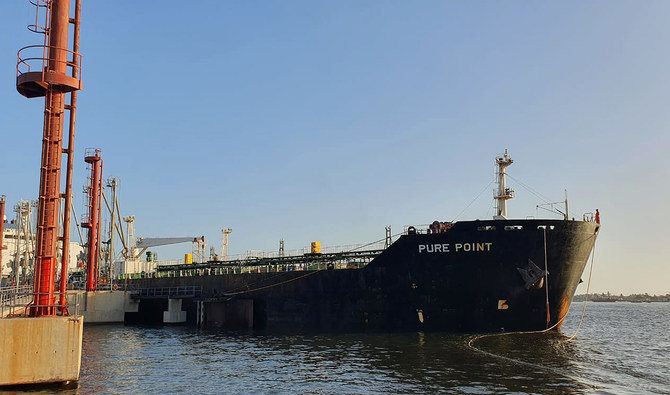
This handout photograph, taken and released by Karachi Port Trust, shows a Russian ship, Pure Point, anchored at the OP2 in Karachi on June 11, 2023, carrying 45,000 metric tons of crude oil. (Photo courtesy: KPT)
The discounted crude offers relief to Pakistan, which is facing a payments crisis and is at risk of defaulting on its debt.
Pakistan's purchase also gives Moscow a new outlet to add to growing sales to India and China, as it redirects oil from Western markets because of the Ukraine conflict.
Despite being a long-standing Western ally and the arch-rival of neighbouring India, which historically is closer to Moscow, analysts say the crude deal presents a new avenue for Pakistan at a time when its financing needs are great.
Islamabad earlier this month also outlined a process to open barter trade with Russia, Afghanistan and Iran, another sign of the South Asian economy seeking avenues to buy and sell commodities without trading in dollars, which analysts say could be a shift from West to East.


