

Pakistan says has no plans to freeze foreign currency accounts

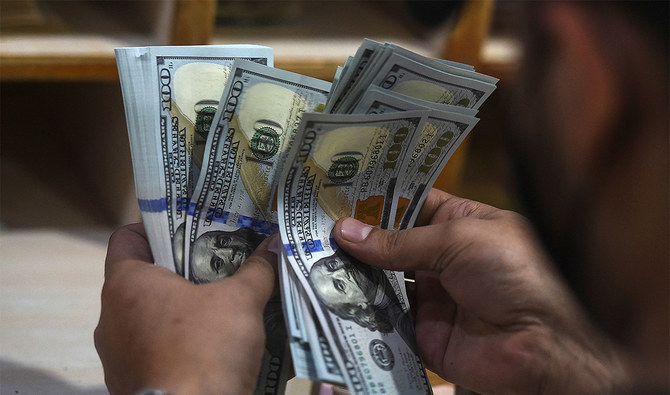
In this picture taken on January 11, 2022, a foreign currency dealer counts US dollar notes at a shop in Karachi. (AFP/File)
Short Url
Updated 12 June 2023
Follow

Pakistan says has no plans to freeze foreign currency accounts

  • Country's reserves have dwindled to barely $3.9 billion, enough to cover less than a month’s worth of imports
  • Then PM Nawaz Sharif froze foreign currency accounts in 1998 as foreign exchange reserves fell to critical levels

ISLAMABAD: Pakistan’s State Minister for Finance Dr Aisha Ghaus Pasha said on Monday the government was not considering freezing foreign currency accounts as reserves held with the central bank have dwindled to barely $3.9 billion, enough to cover less than a month’s worth of imports.

Pakistan is currently going through its most daunting economic crisis to date, with record-high inflation and a rapidly depreciating currency. The government has been pursuing the International Monetary Fund (IMF) for the revival of a stalled $6.5 billion bailout program to receive a tranche of $1.1 billion to stave off a balance of payments crisis but has been unable to reach a staff-level agreements after months of talks.

The economic crisis has reminded of May 1998, when the government of Prime Minister Nawaz Sharif froze all foreign currency accounts as reserves fell to a critical level after the country tested nuclear weapons, leading to international sanctions.

“We do not plan on freezing foreign currency accounts,” the state minister told media in Islamabad. “There have been no proposals to take such an action.”

Pasha said all budget plans had been shared with the IMF and Pakistan was now pushing the lender to complete the ninth review of the bailout program at the earliest.

The government last week presented a Rs14.46 trillion ($50.4 billion) budget for the next fiscal year, setting a tax collection target of Rs9.2 trillion ($32 billion), 23 percent higher than last year, and envisioning a 3.5 percent GDP growth.

“We have asked the IMF to complete the ninth review at the earliest,” the minister said, adding that “friendly countries” had already given assurances to the IMF to bridge external financing gaps.

Saudi Arabia and the UAE have sent their assurances of $2 billion and $1 billion respectively to the IMF as financial support to Pakistan to revive the bailout program which remains suspended since November last year.

Pakistan cabinet reviews private Hajj policy as mandatory pilgrim training enforced

Updated 10 sec ago
Follow

Pakistan cabinet reviews private Hajj policy as mandatory pilgrim training enforced

  • Cabinet sends draft Private Hajj Policy 2027–2030 to committee for further review
  • Religion minister warns pilgrims who skip mandatory training will be barred from Hajj

ISLAMABAD: Pakistan’s federal cabinet on Wednesday reviewed proposals for stricter oversight of private Hajj operators, as authorities separately warned that pilgrims who failed to complete mandatory training would be barred from performing Hajj next year.

The cabinet, chaired by Prime Minister Shehbaz Sharif, was briefed on a draft Private Hajj Policy for 2027–2030, which includes third-party registration and scrutiny of private Hajj operator companies, according to a statement from the Prime Minister’s Office.

“The Federal Cabinet directed that the draft Private Hajj Policy 2027–2030, presented by the Ministry of Religious Affairs and Interfaith Harmony regarding third-party registration and scrutiny of private Hajj operators’ companies, be referred to the Hajj Policy Committee for further deliberation in light of the views of Cabinet members,” the prime minister’s office said in a statement.

The development comes as Religious Affairs Minister Sardar Muhammad Yousaf said on Wednesday pilgrims who failed to attend both phases of mandatory Hajj training would not be allowed to perform the pilgrimage.

“Pilgrims who do not complete mandatory Hajj training will be barred from performing Hajj,” the ministry quoted Yousaf as saying during a training workshop in Islamabad.

Around 120,000 pilgrims are currently undergoing training at 200 locations nationwide, with the second phase scheduled to begin after Ramadan. The training aims to familiarize pilgrims with Saudi laws, Hajj rituals and safety protocols to prevent accidents in crowded areas.

Saudi Arabia has allocated 179,210 pilgrims to Pakistan for Hajj 2026, including about 118,000 seats under the government scheme, while the remainder will be handled by private tour operators.

Under Pakistan’s government Hajj package, the estimated cost ranges from Rs1.15 million to Rs1.25 million ($4,049.93 to $4,236), subject to final agreements with service providers.