

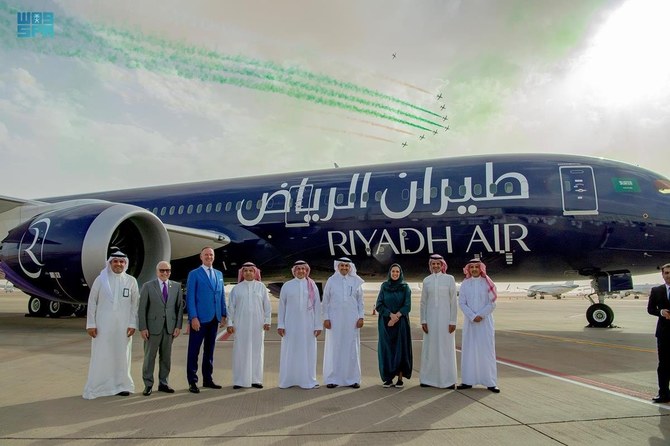
PIF-owned Riyadh Air showcases its livery ahead of debut at Paris Air Show

Riyadh Air makes an appearance with its remarkable livery at the King Khaled International Airport in the Saudi capital on Monday. (SPA)
Short Url
Updated 12 September 2024
Follow

PIF-owned Riyadh Air showcases its livery ahead of debut at Paris Air Show

  • Aircraft livery design and colors reflects Saudi warmth and hospitality in a fresh, modern design

RIYADH: The latest player in the global aviation industry, Riyadh Air, made an appearance with its remarkable livery at the King Khaled International Airport in the Saudi capital on Monday.

A Boeing 787-9 Dreamliner painted aircraft flew at low altitude over several notable landmarks in the Riyadh skyline, including King Abdullah Financial District, Boulevard City, and some of the iconic main towers, thrilling residents with a glimpse of the Public Investment Fund-owned airline ahead of its public debut at the 54th Paris Air Show on June 19.

A ceremony was organized to mark the beginning of a new era in the Kingdom’s aviation industry. Top officials and notable personalities attended the event.

“Today is the beginning of a new dawn in the aviation sector. This is the first step of many yet to come,” Saleh Al-Jasser, minister of transport and logistics, said. 

Riyadh Air will build connectivity from the Saudi capital to over 100 destinations around the world due to its convenient location with over 60 percent of the world’s population within eight hours of flying time.

Prince Haifa bint Mohammed Al-Saud, vice minister of tourism, expressed her happiness over the development and praised the speed with which the airline is moving forward.

“The speed at which we managed to put an aircraft in the sky shows reflects our ambitions,” she said. 

The airline aims to be significantly innovative in providing travel services in the sector while being instrumental in delivering the Kingdom’s National Transport and Logistics Strategy and the National Tourism Strategy by leveraging the Kingdom’s strategic location connecting the three continents of Asia, Africa, and Europe. 

Talking to Arab News, Riyadh Air CEO Tony Douglas said it is an “important day for all of us and a special moment in history.”

He said the company plans to reveal its second livery later during 2023.
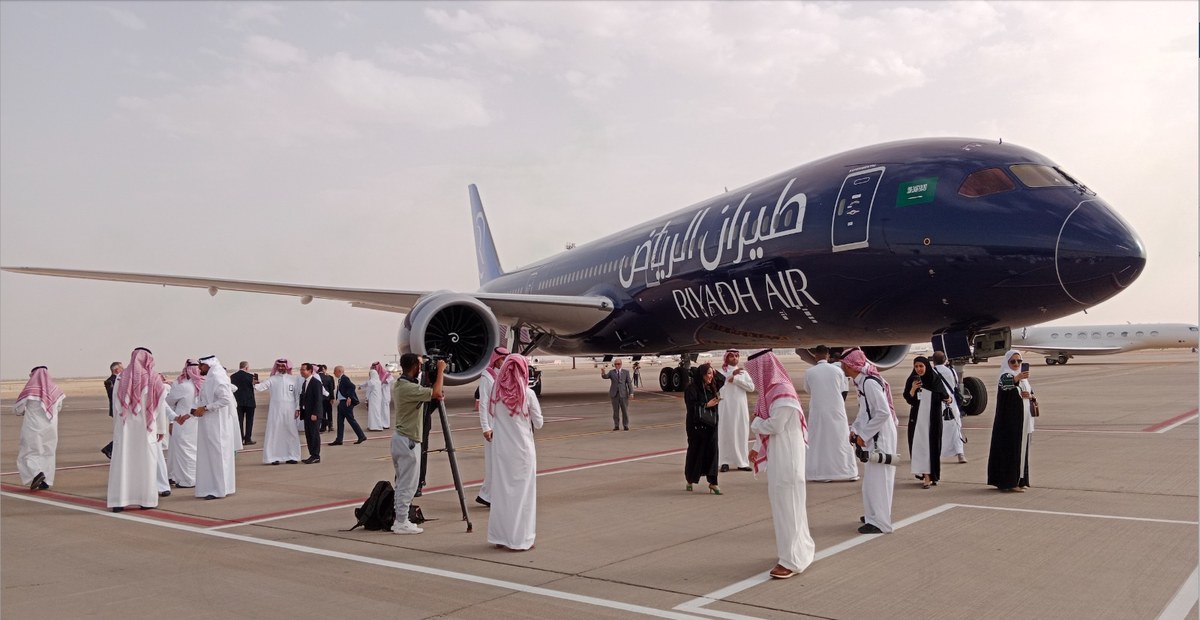


A Riyadh Air aircraft made an appearance with its remarkable livery at the King Khaled International Airport in Riyadh on Monday. AN photo

Earlier this month, the PIF-owned airline obtained “RX” as the airline designator code. It aims to facilitate 100 million visits to Saudi Arabia by 2030 by welcoming travelers from around the world. The establishment of Riyadh Air is part of PIF’s strategy to unlock the capabilities of promising sectors that can help drive the diversification of the local economy, adding $20 billion to non-oil gross domestic product and creating more than 200,000 direct and indirect jobs. 

The new national airline represents PIF’s latest investment in the sector, along with the recently announced King Salman International Airport masterplan, enabling a more financially resilient aviation ecosystem in Saudi Arabia, and supporting the industry’s global competitiveness in line with Vision 2030.

According to a press release, the brand identity of Riyadh Air reflects the modern and forward-thinking theme of the Kingdom. “It is inspired by the warmth and hospitality of the Kingdom and the vibrant lavender colors that carpet the desert in the spring, the beautiful livery is one of a series that will continue to push boundaries in aviation. It has been designed to incorporate visual references to the Kingdom and the city which include the sweeping curves of Arabic script with the global campaign tagline ‘The Future Takes Flight.’” 

Riyadh Air CEO said: “It has been deliberately designed so, because when it is parked at international airports in megacities across the world, this will instantly be noticed, and will be (an) international projection of brand Riyadh.”

Talking about the official launch of operations, Douglas said the first delivery of aircraft from Boeing is expected in early 2025. “As soon as we start receiving aircraft, we will start operations as quickly as we can in 2025, and it will be a very special year for Riyadh Air.”


Saudi investment pipeline active as reforms advance, says Pakistan minister

Updated 09 February 2026
Follow

Saudi investment pipeline active as reforms advance, says Pakistan minister

ALULA: Pakistan’s Finance Minister Mohammed Aurangzeb described Saudi Arabia as a “longstanding partner” and emphasized the importance of sustainable, mutually beneficial cooperation, particularly in key economic sectors.

Speaking to Arab News on the sidelines of the AlUla Conference for Emerging Market Economies, Aurangzeb said the relationship between Pakistan and Saudi Arabia remains resilient despite global geopolitical tensions.

“The Kingdom has been a longstanding partner of Pakistan for the longest time, and we are very grateful for how we have been supported through thick and thin, through rough patches and, even now that we have achieved macroeconomic stability, I think we are now well positioned for growth.”

Aurangzeb said the partnership has facilitated investment across several sectors, including minerals and mining, information technology, agriculture, and tourism. He cited an active pipeline of Saudi investments, including Wafi’s entry into Pakistan’s downstream oil and gas sector.

“The Kingdom has been very public about their appetite for the country, and the sectors are minerals and mining, IT, agriculture, tourism; and there are already investments which have come in. For example, Wafi came in (in terms of downstream oil and gas stations). There’s a very active pipeline.”

He said private sector activity is driving growth in these areas, while government-to-government cooperation is focused mainly on infrastructure development.

Acknowledging longstanding investor concerns related to bureaucracy and delays, Aurangzeb said Pakistan has made progress over the past two years through structural reforms and fiscal discipline, alongside efforts to improve the business environment.

“The last two years we have worked very hard in terms of structural reforms, in terms of what I call getting the basic hygiene right, in terms of the fiscal situation, the current economic situation (…) in terms of all those areas of getting the basic hygiene in a good place.”

Aurangzeb highlighted mining and refining as key areas of engagement, including discussions around the Reko Diq project, while stressing that talks with Saudi investors extend beyond individual ventures.

“From my perspective, it’s not just about one mine, the discussions will continue with the Saudi investors on a number of these areas.”

He also pointed to growing cooperation in the IT sector, particularly in artificial intelligence, noting that several Pakistani tech firms are already in discussions with Saudi counterparts or have established offices in the Kingdom.

Referring to recent talks with Saudi Minister of Economy and Planning Faisal Alibrahim, Aurangzeb said Pakistan’s large freelance workforce presents opportunities for deeper collaboration, provided skills development keeps pace with demand.

“I was just with (Saudi) minister of economy and planning, and he was specifically referring to the Pakistani tech talent, and he is absolutely right. We have the third-largest freelancer population in the world, and what we need to do is to ensure that we upscale, rescale, upgrade them.”

Aurangzeb also cited opportunities to benefit from Saudi Arabia’s experience in the energy sector and noted continued cooperation in defense production.

Looking ahead, he said Pakistan aims to recalibrate its relationship with Saudi Arabia toward trade and investment rather than reliance on aid.

“Our prime minister has been very clear that we want to move this entire discussion as we go forward from aid and support to trade and investment.”