

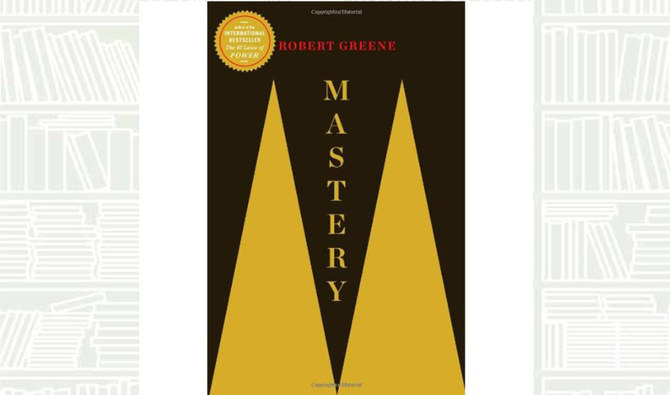
What We Are Reading Today: ‘Mastery’

Photo/Supplied
Short Url
Updated 11 June 2023
Follow

What We Are Reading Today: ‘Mastery’

RIYADH: By delving into the lives of historical figures and contemporary masters and exploring their strategies one can set oneself up for success.

“Mastery,” published in 2012, is a collection of insights and actionable advice written by American author Robert Greene.

It explores the process of becoming a master in a chosen field. The book not only simplifies the lives of successful leaders but also acts as a step-by-step guide. It provides the reader with real-life examples, strategies and philosophies that help them master their own lives.

Chapter one, “Discover Your Calling: The Life’s Task,” teaches how to embrace your natural inclinations and interests and identify your true passions through self-reflection and experimentation.

Chapter three, “Absorb the Master’s Power: The Mentor Dynamic,” advises that one must find a mentor who can guide and teach. It discusses developing a strong relationship with your mentor for mutual benefit and learning by observing their habits, skills and thought processes.

Another remarkable chapter, “Advance Through Trial and Error: The Evolutionary Path,” encourages embracing failure as an opportunity to learn and grow.

Chapter seven also advises iterating on your ideas and projects through experimentation and continuously refining your skills and knowledge through trial and error.

“See People as They Are: Social Intelligence” is another chapter that assesses an important aspect of developing social intelligence to navigate complex interpersonal situations. It talks about understanding people’s motivations, emotions and weaknesses, practicing empathy and adapting your behavior according to others’ needs.

Overall, “Mastery” reveals the path to achieving greatness in any field by discovering your passions, learning from masters, developing social intelligence, cultivating creativity and embracing trial and error.

“Mastery” is a nonfiction, self-help book that works on the principles of power and strategies. Greene argues that anyone can achieve mastery and unlock their full potential.

The author has also published books that explore the topics of power, war and society: “The 48 Laws of Power” (1998), “The Art of Seduction” (2001), “The 33 Strategies of War” (2006), “The 50th Law” (2009), “The Laws of Human Nature” (2018) and “The Daily Laws” (2021).


‘Maghras’ carries Al-Ahsa’s experimental farm from oasis to page

Updated 19 February 2026
Follow

‘Maghras’ carries Al-Ahsa’s experimental farm from oasis to page

AL-AHSA: Beneath a full moon and swaying palm trees, “Maghras: A Farm for Experimentation” was launched this month in Al-Ahsa, drawing a full crowd to Al-Sbakh Farm — the very landscape that inspired it.

Al-Ahsa, in Saudi Arabia’s Eastern Province, is home to 2.5 million date palms and is officially the largest palm oasis in the world, according to the Guinness Book of Records.

That agricultural abundance forms the foundation of Maghras, a project founded in 2024 by longtime friends Lulu Almana and Sara Al-Omran, who both grew up in the Eastern Province. Conceived as a space for experimentation, research and dialogue, Maghras centers on Al-Ahsa’s agricultural and cultural heritage.

The farm that hosts the project, Al-Sbakh, was established by the late Noura Al-Mousa, who worked alongside farmers and craftspeople for decades. Today, it is managed by her son’s Abdulmohsen Al-Rashed Humanitarian Foundation, alongside Dar Noura Al-Mousa for Culture and Arts, housed in her former home.

Earlier this year, Maghras traveled beyond the oasis. Curated by Almana and Al-Omran with US-based creative director Alejandro Stein, the project was presented at the Triennale di Milano from May 13 to Nov. 9, 2025 — marking the Kingdom’s inaugural participation. Commissioned by the Architecture and Design Commission under the Ministry of Culture, the pavilion took the form of a transplanted maghras, a traditional land unit defined by four palm trees.

The newly launched book, edited by Almana and Al-Omran alongside longtime collaborator Latifa Al-Khayat, extends that journey. Divided into five chapters — Water, Land, Infrastructure, Proximities and Lineages — it weaves imagery and text to document the farm’s evolving agro-ecosystems and seasonal harvest.

Featuring illustrations by Nada Al-Mulla and maps by Hayes Buchanan, and printed by Grafiche Mariano, Italy, and published by Kaph Books, the bilingual volume can be read in English or Arabic with identical wording.

Prince Nawaf bin Ayyaf, CEO of the Architecture and Design Commission, delivered opening remarks at the launch and is featured throughout the publication and the project’s journey.

The book is not a catalogue of the Milan activation. Instead, it captures the spirit of the experimental farm, including commissioned works by Leen Ajlan, Sawtasura (Tara Al-Dughaither), and Mohammad Al-Faraj. Developed through research and workshops circling the central maghras, the publication brings together insights, origin stories and first-person essays.

With attendees crossing from neighboring Bahrain and generations of Hasawi elders and emerging voices gathered under the palms, the launch underscored Maghras’s central premise: rooted in Al-Ahsa, yet reaching far beyond it.