

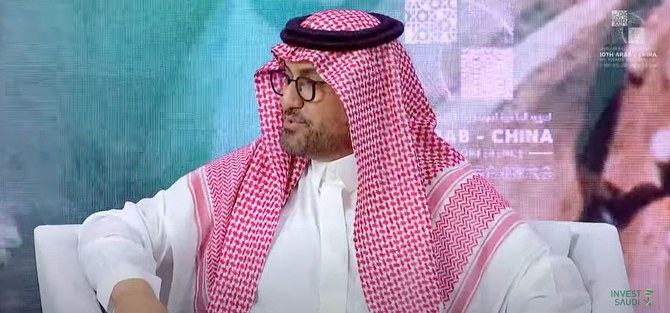
Digitization is the cornerstone of success in Saudi tourism strategy: top official

Fahd Hamidaddin, CEO of Saudi Tourism Authority
Short Url
Updated 11 June 2023
Follow

Digitization is the cornerstone of success in Saudi tourism strategy: top official

RIYADH: Highlighting the fast-growing digital landscape of Saudi Arabia, the chief of the Saudi Tourism Authority said the introduction of the latest technology will ensure a seamless and authentic cultural experience for visitors to Saudi Arabia.

Fahd Hamidaddin was speaking at a panel titled “Tourism and Entertainment for Diversification” on the first day of the 10th Arab-China Business Conference in Riyadh on Sunday.

The official said digitization is the cornerstone of the Kingdom’s tourism sector. Saudi Arabia’s e-visa was recognized as the best digital platform, the CEO said.

“We usually say digitize the expected and humanize the unexpected. So, while digitizing services that provide seamless experience and journey, we need to remain true to Arabia, uniquely Saudi, and authentically local in every destination,” Hamidaddin said.

“Today, we have 26 agreements in place with online travel agencies from China; so, throughout the value chain, we take digital-first,” the CEO added.

During the same panel, Amr Al-Madani, the CEO of the Royal Commission for AlUla, talked about how investors need people to de-risk their investments.

He said that domestic tourism is forecast to account for around 75 percent of the Gulf country’s gross domestic product.

Investment opportunities, economic growth, and closer trade relations are on the agenda at the 10th Arab-China Business Conference, concluding in Riyadh on Monday.   

The two-day event explores synergies in technology, artificial intelligence, renewable energy, agriculture, real estate, and strategic minerals.   

Organized by the Saudi Ministry of Investment in partnership with the Chinese Council for the Promotion of International Trade and a host of other regional associations, the conference will welcome more than 2,000 private sector leaders and government officials.


Islamic banks’ market share in Turkiye rises to 9.2%: Fitch Ratings

Updated 18 February 2026
Follow

Islamic banks’ market share in Turkiye rises to 9.2%: Fitch Ratings

RIYADH: Islamic banks in Turkiye lifted their asset market share to 9.2 percent in 2025 from 8.1 percent a year earlier, as financing and deposits outpaced the broader banking sector, a new analysis showed. 

In its latest report, Fitch Ratings said financing and deposit market shares rose to 7.9 percent and 10.4 percent, respectively, by the end of 2025, compared with 7.3 percent and 9.4 percent in 2024.

The agency noted that new digital Islamic banks are emerging in the country, with investment from Gulf Cooperation Council countries expected to continue. 

Turkiye’s strong ties with Islamic countries across the Balkans, Africa and the Middle East support the development of its Islamic banking sector, attracting investors and contributing to the industry’s growth.

In its latest report, Fitch stated: “Three recently established private Islamic banks (two digital) grew rapidly in the first nine months of 2025. Investment in digital participation banking from the Gulf Cooperation Council countries underscores the potential for further investment from the region.” 

It added: “Planned establishment of new participation banks, and rapid growth of recently established banks – albeit from small bases – means that the segment landscape may be reshaped in 2026.” 

Dubai Islamic Bank PJSC’s investment in digital bank TOM underscores the potential for further GCC investment. 

Turkish regulators have approved the establishment of Halk Katilim Bankasi A.S. and Adil Katilim Bankasi A.S. (digital), while BIM Birlesik Magazalar A.S.’s application is pending. 

Fitch added that state-owned participation banks may merge or pursue initial public offerings, potentially reshaping the banking landscape. 

The report predicts Islamic banks’ market share will rise further in 2026, supported by strong internal capital generation and growth appetite. However, the non-performing financing ratio may increase moderately due to high inflows. 

“The segment’s non-performing financings ratio deteriorated to 2 percent at end-2025 compared to 1.2 percent in 2024 but remained below the sector average of 2.5 percent,” said Fitch. 

It added: “We expect pressure to persist given still-high financing rates, high but declining inflation, and the sensitivity of unsecured retail (lower share than conventional banks) and SME segments to economic cycles. We forecast a moderate increase in the segment NPF ratio in 2026.”