

Pakistan’s religious affairs ministry teams up with Saudi bank for Hajj pilgrims’ animal sacrifice

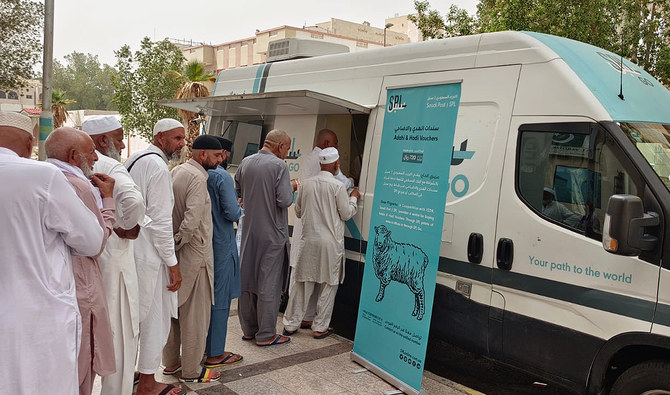
Pakistani pilgrims purchase tokens for animal sacrifice in Makkah, Saudi Arabia, on June 11, 2023, ahead of annual Islamic Hajj pilgrimage which will take place later this month. (Photo courtesy: Pakistani Hajj Mission)
Short Url
Updated 11 June 2023
Follow

Pakistan’s religious affairs ministry teams up with Saudi bank for Hajj pilgrims’ animal sacrifice

  • The government facility aims to assist those pilgrims who were unable to make the ritual payment earlier
  • Pilgrims can buy the sacrifice token from a mobile van parked near their Makkah residence for 720 Riyals

ISLAMABAD: Pakistan’s Ministry of Religious Affairs has announced its partnership with a bank in Saudi Arabia to facilitate the sacrifice of animals by pilgrims at the conclusion of the annual Islamic Hajj pilgrimage, scheduled to take place later this month.

The country will be sending 179,210 pilgrims to the kingdom, as the Saudi authorities restored Pakistan’s pre-pandemic Hajj quota in January and removed the upper age limit of 65. Around 80,000 individuals will embark on the spiritual journey through the government scheme, while the remaining pilgrims will be accommodated by private tour operators.

Many pilgrims have already made payments for the animal sacrifice when purchasing their Hajj packages. However, the newly introduced government facility aims to assist those who were unable to make the ritual payment earlier.

“The government of Pakistan has arranged the sacrifice for Hajj pilgrims with the support of a Saudi bank,” Abdul Wahab Soomro, the director-general of Hajj, said in a statement circulated by the ministry. “Pilgrims will receive the sacrifice token from a booth or mobile van located near their residence, and they can purchase the token by depositing 720 Riyals.”

He further mentioned that pilgrims will also be notified of the designated time for the sacrifice upon acquiring the token.

According to the state-owned Associated Press of Pakistan (APP) news agency, mobile vans operated by the Saudi Post and the Islamic Development Bank were observed selling tokens for sacrificial animals in Makkah’s Al-Azizia neighborhood on Sunday.

Many pilgrims lined up to deposit the required amount and avail themselves of the service.

Hajj is an obligatory religious ritual for physically and financially capable adult Muslims. It entails visiting the holy cities of Makkah and Madinah at least once in a lifetime and occurs during the last month of the lunar Islamic calendar, known as Dhu Al-Hijjah.


At ECO meeting, Pakistan proposes ‘Regional Innovation Hub’ to curb natural disasters

Updated 21 January 2026
Follow

At ECO meeting, Pakistan proposes ‘Regional Innovation Hub’ to curb natural disasters

  • Pakistan hosts high-level 10th ECO Ministerial Meeting on Disaster Risk Reduction in Islamabad
  • Innovation hub to focus on early warning technologies, risk informed infrastructure planning

ISLAMABAD: Pakistan has proposed to set up a “Regional Innovation Hub on Disaster Risk Reduction” that focuses on early warning technologies and risk informed infrastructure planning, the Press Information Department (PID) said on Wednesday, as Islamabad hosts a high-level meeting of the Economic Cooperation Organization (ECO).

The ECO’s 10th Ministerial Meeting on Disaster Risk Reduction (DRR) is being held from Jan. 21-22 at the headquarters of the National Disaster Management Authority (NDMA) in Pakistan’s capital. 

The high-level regional forum brings together ministers, and senior officials from ECO member states, representatives of the ECO Secretariat and regional and international partner organizations. The event is aimed to strengthen collective efforts toward enhancing disaster resilience across the ECO region, the PID said. 

“Key agenda items include regional cooperation on early warning systems, disaster risk information management, landslide hazard zoning, inclusive disaster preparedness initiatives, and Pakistan’s proposal to establish a Regional Innovation Hub on Disaster Risk Reduction, focusing on early warning technologies, satellite data utilization, and risk-informed infrastructure planning,” the statement said. 

The meeting was attended by delegations from ECO member states including Pakistan, Türkiye, Azerbaijan, Iran, Kyrgyzstan, Tajikistan, Turkmenistan and Uzbekistan. Representatives of regional and international organizations and development partners were also in attendance.

Discussions focused on enhancing regional coordination, harmonizing disaster risk reduction frameworks, and strengthening collective preparedness against transboundary and climate-induced hazards impacting the ECO region, the PID said. 

ECO members states such as Pakistan, Türkiye, Afghanistan and others have faced natural calamities such as floods and earthquakes in recent years that have killed tens of thousands of people. 

Heavy rains triggered catastrophic floods in Pakistan in 2022 and 2025 that killed thousands of people and caused damages to critical infrastructure, inflicting losses worth billions of dollars. 

Islamabad has since then called on regional countries to join hands to cooperate to avert future climate disasters and promote early warning systems to avoid calamities in future.