

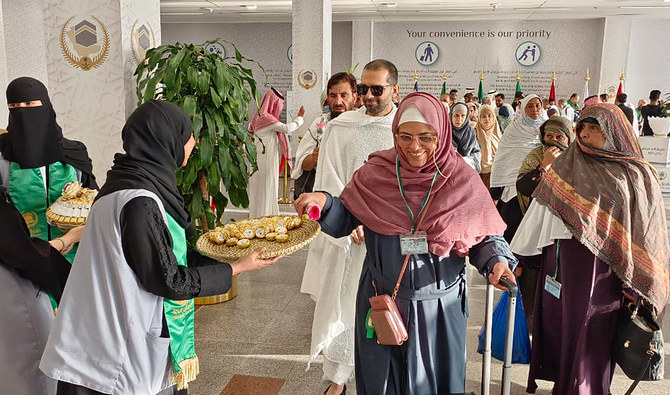

ISLAMABAD: Pakistan has deployed more than 40 women with its Hajj mission in Saudi Arabia, with many of them in leadership roles, to serve pilgrims, a religious affairs ministry official said on Saturday, as more than 50,000 pilgrims arrived in the kingdom from the South Asian country.
The Saudi authorities have reinstated the country’s pre-pandemic Hajj quota, allowing 179,210 Pakistani pilgrims to participate in this year’s pilgrimage while removing the upper age limit of 65 years. Around 80,000 of them will perform Hajj under the government scheme, while the rest will be facilitated by private tour operators.
According to Pakistan’s religious affairs ministry, over 50,000 Pakistanis have so far arrived in the kingdom for the annual Islamic pilgrimage since the government launched a special flight operation on May 21.
“Currently, over 40 women are working shoulder to shoulder with men in the Hajj mission in Makkah and Madinah, and approximately 15 more are expected to arrive in the coming days,” Muhammad Umer Butt, a ministry spokesperson, told Arab News over the phone from the kingdom.
“These women are serving in various sections, and some of them are even leading different departments,” he continued, adding that some lady doctors and female paramedics were also contributing to the country’s Hajj medical mission.
Nadia Razzaq, serving as the information technology (IT) in-charge in Makkah, said numerous women were playing crucial roles within the Hajj mission.
“More than 40 women have already arrived in Saudi Arabia to fulfill various responsibilities across different sectors, such as food, accommodation, and transportation,” she told Arab News in a video statement from Makkah.
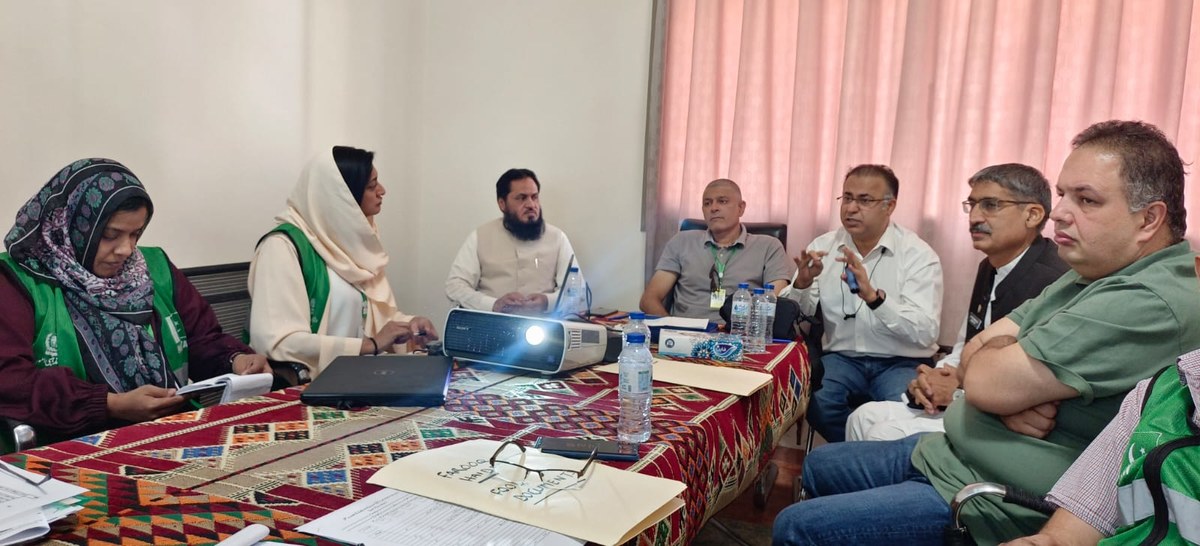
In this picture, provided with the courtesy of the Hajj Ministry, Pakistani women facilitators attend a Hajj mission meeting in Makkah. (Photo courtesy: Hajj Ministry)
She said that, in addition to their primary responsibilities, women were also performing field duties as required.
“Women are making valuable contributions to every sector of the Hajj operations, showcasing their best efforts,” Razzaq added.
Another woman, Ayesha Ijaz, who is responsible for monitoring the Hajj mission in Makkah, said her role involved overseeing the arrangements made by private tour operators for pilgrims who have arrived in Saudi Arabia.
“This includes addressing their issues and ensuring the provision of the facilities promised to them in Makkah, Madinah, and other locations during the Hajj,” she told Arab News.
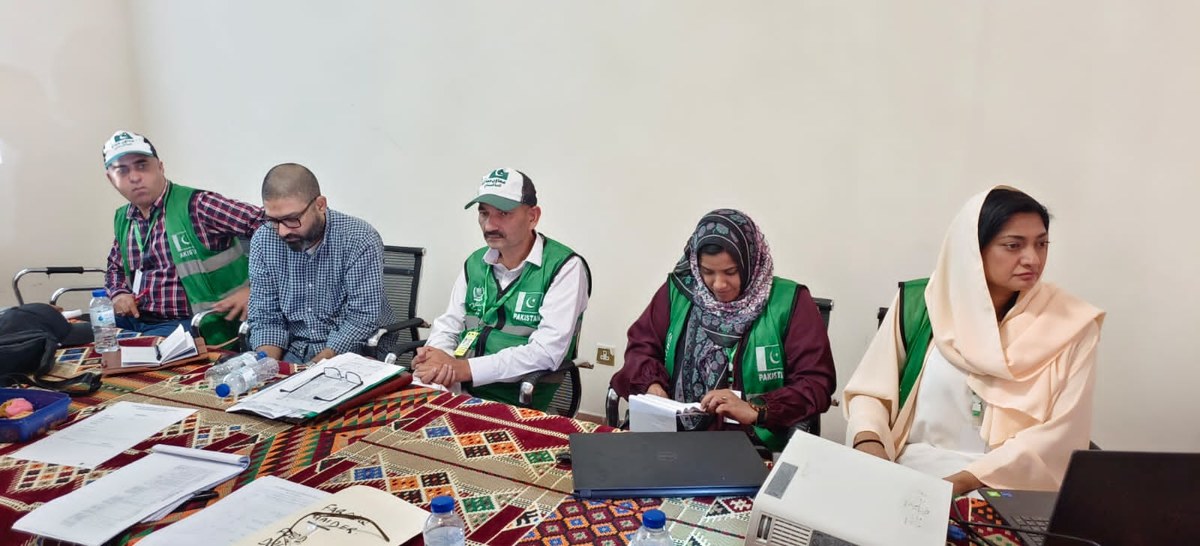
In this picture, provided with the courtesy of the Hajj Ministry, Pakistani women facilitators attend a Hajj mission meeting in Makkah. (Photo courtesy: Hajj Ministry)
Since a large number of female pilgrims arrive in Saudi Arabia for Hajj every year, Ijaz said their problems were usually resolved by women volunteers.
“Women staff also hold crucial positions in the Hajj mission, which greatly contributes to our smooth operations,” she added.
Beenish Ashraf, the call center in-charge at Makkah’s main control office, said her department tried to ensure the resolution of pilgrims’ complaints at the earliest by forwarding them to the relevant departments.
“We have employed call agents who handle pilgrims’ calls round the clock,” she told Arab News.
“As soon as we receive these calls, we promptly enter the details into our [online] system, notify the respective sector commander, and contact the relevant department to expedite the resolution of pilgrims’ complaints,” she added.
Furthermore, the call center actively gathered feedback from the pilgrims by conducting follow-up calls and collaborating with other departments to ensure a comprehensive assessment, Ashraf informed.
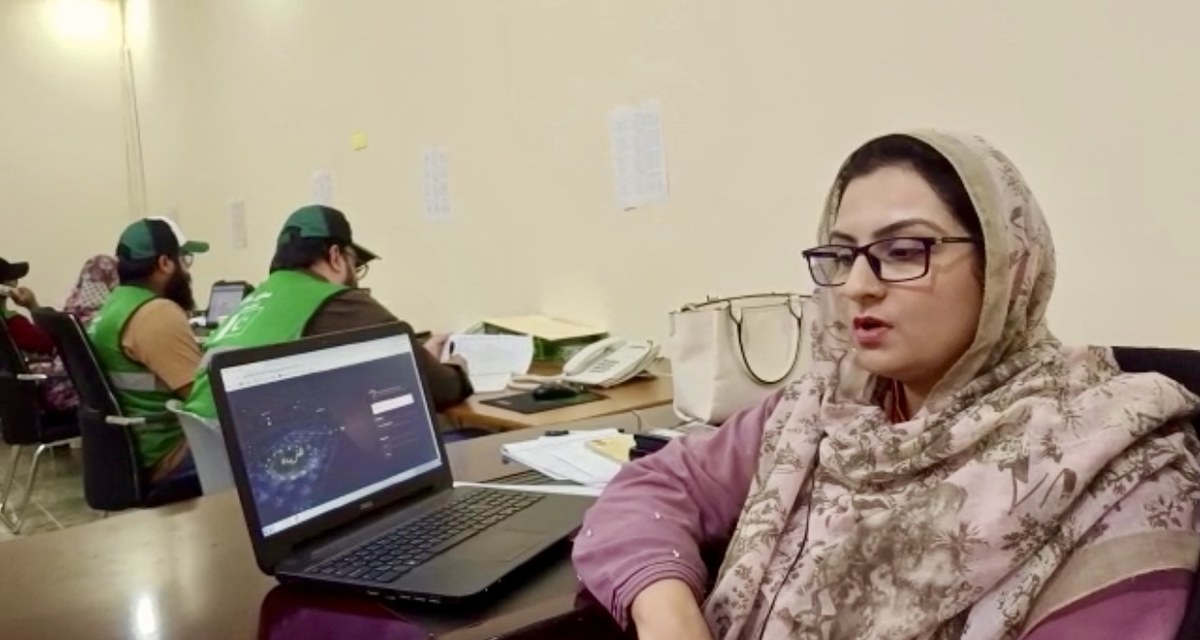
In this picture, provided with the courtesy of the Hajj Ministry, Pakistani woman officer, Beenish Ashraf leads a call centre of Pakistan's Hajj mission in Makkah, Saudi Arabia on June 10, 2023. (Courtesy: Pakistan's religious affairs ministry)


