

Donald Trump described Pentagon plan of attack and shared classified map, indictment says

1 / 5
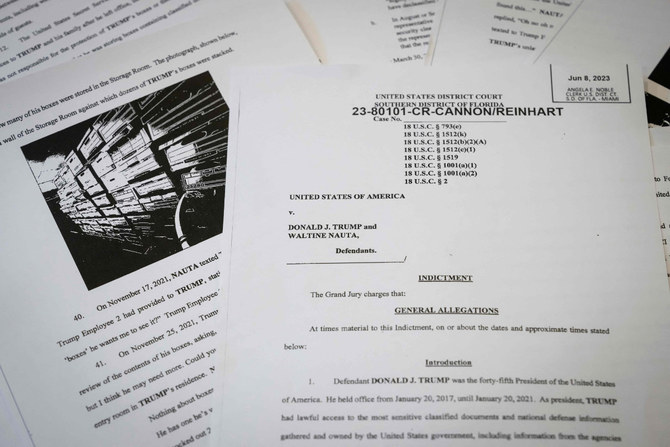
In this photo illustration, pages are viewed from the unsealed federal indictment of former US President Donald Trump on June 9, 2023 in Washington, DC. (Getty Images North America / AFP)
2 / 5
In this photo illustration, pages are viewed from the unsealed federal indictment of former US President Donald Trump on June 9, 2023 in Washington, DC. (Getty Images North America / AFP)
3 / 5
In this photo illustration, pages are viewed from the unsealed federal indictment of former US President Donald Trump on June 9, 2023 in Washington, DC. (Getty Images North America / AFP)
4 / 5
In this photo illustration, pages are viewed from the unsealed federal indictment of former US President Donald Trump on June 9, 2023 in Washington, DC. (Getty Images North America / AFP)
5 / 5
In this photo illustration, pages are viewed from the unsealed federal indictment of former US President Donald Trump on June 9, 2023 in Washington, DC. (Getty Images North America / AFP)
Short Url
Updated 10 June 2023
Follow

Donald Trump described Pentagon plan of attack and shared classified map, indictment says

  • Indictment paints an unmistakably damning portrait of Trump’s treatment of sensitive information
  • Says Trump not only intentionally possessed classified documents but also boastfully showed them off to visitors

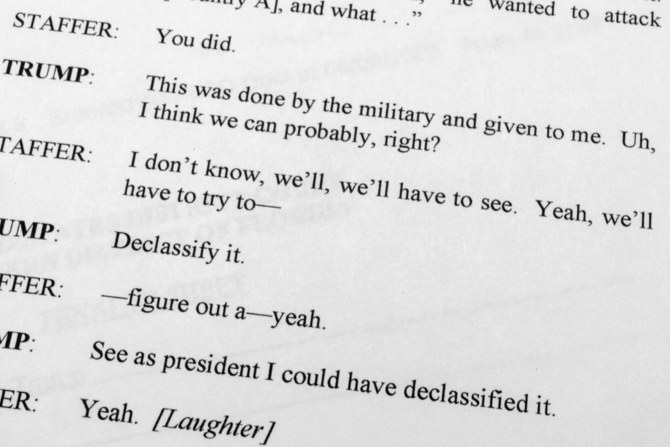
MIAMI: Former President Donald Trump described a Pentagon “plan of attack” and shared a classified map related to a military operation, according to a sweeping 37-count felony indictment related to the mishandling of classified documents that was unsealed Friday and that could instantly reshape the 2024 presidential race.

The indictment paints an unmistakably damning portrait of Trump’s treatment of sensitive information, accusing him of willfully defying Justice Department demands to return documents he had taken from the White House to Mar-a-Lago, enlisting aides in his efforts to hide the records and even telling his lawyers that we wanted to defy a subpoena for the materials stored in his estate.
“I don’t want anybody looking through my boxes,” one of Trump’s lawyers described the former president saying, according to the indictment. He also asked if it would be better “if we just told them we don’t have anything here,” the indictment says.
Noting the “tens of thousands of members and guests” who visited the “active social club” of Mar-a-Lago between the end of Trump’s presidency in January 2021 through the August 2022 search, prosecutors argued that Trump had “nevertheless” stored the documents there, “including in a ballroom, a bathroom and shower, and office space, his bedroom, and a storage room.”
The indictment arrives at a time when Trump is continuing to dominate the Republican presidential primary and one day before a scheduled campaign trip to North Carolina. Though other candidates have largely attacked the Justice Department, rather than Trump, for the investigation, the indictment’s breadth of allegations and startling scope will be harder for Republicans to rail against than an earlier New York criminal case that many legal analysts had derided as weak.
The 49-page charging document, alleging that Trump not only intentionally possessed classified documents but also cavalierly and boastfully showed them off to visitors, is startling in scope and in the breadth of allegations. The indictment is built on Trump’s own words and actions as recounted to prosecutors by lawyers, close aides and other witnesses, with prosecutors even using against Trump his own words as a candidate and president professing to respect and know procedures related to the handling of classified information.
The indictment includes 37 counts — 31 of which pertain to the willful retention of national defense information, with the balance relating to alleged conspiracy, obstruction and false statements — that taken together could result in a yearslong prison sentence.
Trump is due to make his first court appearance Tuesday in federal court in Miami, where the case was filed. He was charged alongside Walt Nauta, an aide and close adviser to Trump who prosecutors say brought boxes from a storage room to Trump’s residence for him to review and later lied to investigators about the movement. A photograph included in the indictment shows several dozen file boxes stacked in a storage area.
The case adds to deepening legal jeopardy for Trump, who has already been indicted in New York and faces additional investigations in Washington and Atlanta that also could lead to criminal charges. But among the various investigations he has faced, legal experts — as well as Trump’s own aides — had long seen the Mar-a-Lago probe as the most perilous threat and the one most ripe for prosecution. Campaign aides had been bracing for the fallout since Trump’s attorneys were notified that he was the target of the investigation, assuming it was not a matter of if charges would be brought, but when.
Enumerating the defense and foreign intelligence-related information included in the documents, prosecutors wrote that their “unauthorized disclosure ... could put at risk the national security of the United States, foreign relations, the safety of the United States military, and human sources and the continued viability of sensitive intelligence collection methods.”


Russian minister visits Cuba as Trump ramps up pressure on Havana

Updated 21 January 2026
Follow

Russian minister visits Cuba as Trump ramps up pressure on Havana

  • The Russian embassy in Havana said the minister would “hold a series of bilateral meetings” while in Cuba

HAVANA: Russia’s interior minister began a visit to ally Cuba on Tuesday, a show of solidarity after US President Donald Trump warned that the island’s longtime communist government “is ready to fall.”
Trump this month warned Havana to “make a deal,” the nature of which he did not divulge, or pay a price similar to Venezuela, whose leader Nicolas Maduro was ousted by US forces in a January 3 bombing raid that killed dozens of people.
Venezuela was a key ally of Cuba and a critical supplier of oil and money, which Trump has vowed to cut off.
“We in Russia regard this as an act of unprovoked armed aggression against Venezuela,” Russia’s Interior Minister Vladimir Kolokoltsev told Russian state TV Rossiya-1 of the US actions after landing in Cuba.
“This act cannot be justified in any way and once again proves the need to increase vigilance and consolidate all efforts to counter external factors,” he added.
The Russian embassy in Havana said the minister would “hold a series of bilateral meetings” while in Cuba.
Russia and Cuba, both under Western sanctions, have intensified their relations since 2022, with an isolated Moscow seeking new friends and trading partners since its invasion of Ukraine.
Cuba needs all the help it can get as it grapples with its worst economic crisis in decades and now added pressure from Washington.
Trump has warned that acting President Delcy Rodriguez will pay “a very big price” if she does not toe Washington’s line — specifically on access to Venezuela’s oil and loosening ties with US foes Cuba, Russia, China and Iran.
On Tuesday, Russia’s ambassador to Havana, Victor Koronelli, wrote on X that Kolokoltsev was in Cuba “to strengthen bilateral cooperation and the fight against crime.”
The US chief of mission in Cuba, Mike Hammer, meanwhile, met the head of the US Southern Command in Miami on Tuesday “to discuss the situation in Cuba and the Caribbean,” the embassy said on X.
The command is responsible for American forces operating in Central and South America that have carried out seizures of tankers transporting Venezuelan oil and strikes on alleged drug-trafficking boats.

- Soldiers killed -

Cuba has been a thorn in the side of the United States since the revolution that swept communist Fidel Castro to power in 1959.
Havana and Moscow were close communist allies during the Cold War, but that cooperation was abruptly halted in 1991 with the dissolution of the Soviet bloc.
The deployment of Soviet nuclear missile sites on the island triggered the Cuban Missile Crisis of 1962, when Washington and Moscow came close to war.
During his first presidential term, Trump walked back a detente with Cuba launched by his predecessor Barack Obama.
Thirty-two Cuban soldiers, some of them assigned to Maduro’s security detail, were killed in the US strikes that saw the Venezuelan strongman whisked away in cuffs to stand trial in New York.
Kolokoltsev attended a memorial for the fallen men on Tuesday.