UN aid chief says Ukraine faces ‘hugely worse’ humanitarian situation after the dam rupture

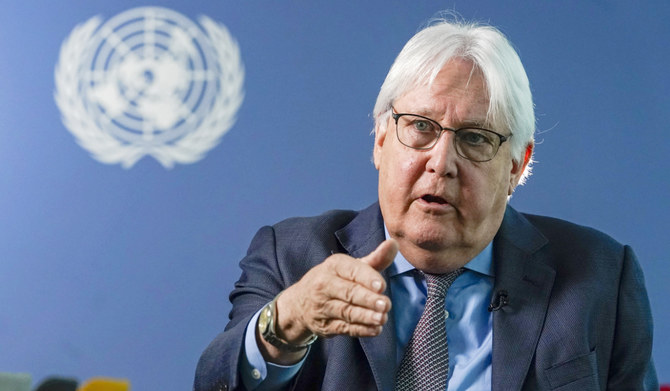
Martin Griffiths, the United Nations humanitarian chief, speaks during an interview with The Associated Press on Tuesday, Sept. 28, 2021, at U.N. headquarters. (AP)
Short Url
Updated 10 June 2023
Follow

UN aid chief says Ukraine faces ‘hugely worse’ humanitarian situation after the dam rupture

  • Ukraine holds the Dnieper’s western bank, while Russian troops control the low-lying eastern side, which is more vulnerable to flooding.

UNITED NATIONS: The humanitarian situation in Ukraine is “hugely worse” than before the Kakhovka dam collapsed, the U.N.'s top aid official warned Friday.
Undersecretary-General Martin Griffiths said an “extraordinary” 700,000 people are in need of drinking water and warned that the ravages of flooding in one of the world’s most important breadbaskets will almost inevitably lead to lower grain exports, higher food prices around the world, and less to eat for millions in need
“This is a viral problem,” he said in an interview with The Associated Press. “But the truth is this is only the beginning of seeing the consequences of this act.”
The rupture of the Kakhovka hydroelectric dam and emptying of its reservoir on the Dnieper River on Wednesday added to the misery in a region that has suffered for more than a year from artillery and missile attacks.
Ukraine holds the Dnieper’s western bank, while Russian troops control the low-lying eastern side, which is more vulnerable to flooding. The dam and reservoir, essential for fresh water and irrigation in southern Ukraine, lies in the Kherson region that Moscow illegally annexed in September and has occupied for the past year.
Griffiths said the United Nations, working mainly through Ukrainian aid groups, has reached 30,000 people in flooded areas under Ukrainian control. He said that so far Russia has not given access to areas it controls for the U.N. to help flood victims.
Griffiths said he met with Russia’s U.N. ambassador, Vassily Nebenzia, on Wednesday to ask Russian authorities “for access for our teams in Ukraine to go across the front lines to give aid, to provide support for … Ukrainians in those areas.” He added, “I hope that will come through.”
The emergency response is essential to save lives, he said, “but behind that you’ve got a huge, looming problem of a lack of proper drinking water for those 700,000 people” on both the Ukrainian-controlled and Russian-controlled sides of the river.
There is also the flooding of important agricultural land and a looming problem of providing cooling water for the Zaporizhzhia nuclear power plant, Europe’s largest, which had been supplied from the dam, he added.
In addition, Griffiths noted that waters also have rushed over areas with land mines from the war “and what we are bound to be seeing are those mines floating in places where people don’t expect them,” threatening adults and especially children.
“So it’s a cascade of problems, starting with allowing people to survive today, and then giving them some kind of prospects for tomorrow,” he said.
Griffiths said that because of the wide-ranging consequences “it’s almost inevitable” that the United Nations will launch a special appeal for more aid funds for Ukraine to deal with “a whole new order of magnitude” from the dam’s rupture. But he said he wants to wait a few weeks to see the economic, health and environmental consequences before announcing the appeal.
Griffiths said he and U.N. trade chief Rebeca Grynspan are also working to ensure the extension of the Black Sea Grain Initiative, which Turkey and the U.N. brokered with Ukraine and Russia last July to open three Black Sea ports in Ukraine for its grain exports.
Part of that deal was a memorandum signed by Russia and the U.N. aimed at overcoming obstacles to Russian food and fertilizer shipments that Moscow has repeatedly complained are not being fulfilled.
A key Russian demand has been the reopening of a pipeline between the Russian port of Togliatti on the Volga River to the Black Sea, which has been shut down since Russia’s Feb. 24, 2022, invasion of Ukraine. It carried ammonia, a key ingredient of fertilizer.
“Opening that pipeline and delivering ammonia across the Black Sea to the global south is a priority for all of us,” Griffiths said. “Ammonia is an essential ingredient for global food security.”
A rupture in the pipeline was reported from shelling late Tuesday, but Griffiths said the U.N. couldn’t confirm it because the pipeline is in the middle of a war zone.
“We, of course, are very, very strongly of the view that we need that repaired as quickly as possible,” he said. “So let’s hope it’s not too badly damaged.”


Court ruling jeopardizes freedom for pro-Palestinian activist Mahmoud Khalil

Updated 10 sec ago
Follow

Court ruling jeopardizes freedom for pro-Palestinian activist Mahmoud Khalil

  • The panel ruled a federal judge in New Jersey didn’t have jurisdiction to decide the matter at this time
  • The law bars Khalil “from attacking his detention and removal in a habeas petition,” the panel added

WASHINGTON: A federal appeals panel on Thursday reversed a lower court decision that released former Columbia University graduate student Mahmoud Khalil from an immigration jail, bringing the government one step closer to detaining and ultimately deporting the Palestinian activist.
The three-judge panel of the 3rd US Circuit Court of Appeals didn’t decide the key issue in Khalil’s case: whether the Trump administration’s effort to throw Khalil out of the US over his campus activism and criticism of Israel is unconstitutional.
But in its 2-1 decision, the panel ruled a federal judge in New Jersey didn’t have jurisdiction to decide the matter at this time. Federal law requires the case to fully move through the immigration courts first, before Khalil can challenge the decision, they wrote.
“That scheme ensures that petitioners get just one bite at the apple — not zero or two,” the panel wrote. “But it also means that some petitioners, like Khalil, will have to wait to seek relief for allegedly unlawful government conduct.”
The law bars Khalil “from attacking his detention and removal in a habeas petition,” the panel added.
Ruling won’t result in immediate detention
It was not clear whether the government would seek to detain Khalil, a legal permanent resident, again while his legal challenges continue.
Thursday’s decision marked a major win for the Trump administration’s sweeping campaign to detain and deport noncitizens who joined protests against Israel.
In a statement distributed by the American Civil Liberties Union, Khalil said the appeals ruling was “deeply disappointing, but it does not break our resolve.”
He added: “The door may have been opened for potential re-detainment down the line, but it has not closed our commitment to Palestine and to justice and accountability. I will continue to fight, through every legal avenue and with every ounce of determination, until my rights, and the rights of others like me, are fully protected.”
Baher Azmy, one of Khalil’s lawyers, said the ruling was “contrary to rulings of other federal courts.” He noted the panel’s finding concerned a “hypertechnical jurisdictional matter,” rather than the legality of the Trump administration’s policy.
“Our legal options are by no means concluded, and we will fight with every available avenue,” he added, saying Khalil would remain free pending the full resolution of all appeals, which could take months or longer.
The ACLU said the Trump administration cannot lawfully re-detain Khalil until the order takes formal effect, which won’t happen while he can still immediately appeal.
Khalil has multiple options to appeal
Khalil’s lawyers can request the active judges on the 3rd Circuit hear an appeal, or they can go to the US Supreme Court.
An outspoken leader of the pro-Palestinian movement at Columbia, Khalil was arrested on March 8, 2025. He then spent three months detained in a Louisiana immigration jail, missing the birth of his firstborn.
Federal officials have accused Khalil of leading activities “aligned to Hamas,” though they have not presented evidence to support the claim and have not accused him of criminal conduct. They have also accused Khalil, 30, of failing to disclose information on his green card application.
The government has justified the arrest under a seldom-used statute that allows for the expulsion of noncitizens whose beliefs are deemed to pose a threat to US foreign policy interests.
In June, a federal judge in New Jersey ruled that justification would likely be declared unconstitutional and ordered Khalil released.
President Donald Trump’s administration appealed that ruling, arguing the deportation decision should fall to an immigration judge, rather than a federal court.
Khalil has dismissed the allegations as “baseless and ridiculous,” framing his arrest and detention as a “direct consequence of exercising my right to free speech as I advocated for a free Palestine and an end to the genocide in Gaza.”
Dissenting judge says Khalil has right to fight detention

Judge Arianna Freeman dissented Thursday, writing that her colleagues were holding Khalil to the wrong legal standard. Khalil, she wrote, is raising “now-or-never claims” that can be handled at the district court level. He does not have a final order of removal, which would permit a challenge in an appellate court, she wrote.
Both judges who ruled against Khalil, Thomas Hardiman and Stephanos Bibas, were Republican appointees. President George W. Bush appointed Hardiman to the 3rd Circuit, while Trump appointed Bibas. President Joe Biden, a Democrat, appointed Freeman.
The majority opinion noted Freeman worried the ruling would leave Khalil with no remedy for unconstitutional immigration detention, even if he later can appeal.
“But our legal system routinely forces petitioners — even those with meritorious claims — to wait to raise their arguments, the judges wrote. “To be sure, the immigration judge’s order of removal is not yet final; the Board has not affirmed her ruling and has held the parties’ briefing deadlines in abeyance pending this opinion. But if the Board ultimately affirms, Khalil can get meaningful review.”
The decision comes as an appeals board in the immigration court system weighs a previous order that found Khalil could be deported. His attorneys have argued that the federal order should take precedence.
That judge has suggested Khalil could be deported to Algeria, where he maintains citizenship through a distant relative, or Syria, where he was born in a refugee camp to a Palestinian family.
His attorneys have said he faces mortal danger if forced to return to either country.