

Pakistan targeting fiscal deficit of 6.54% next fiscal year

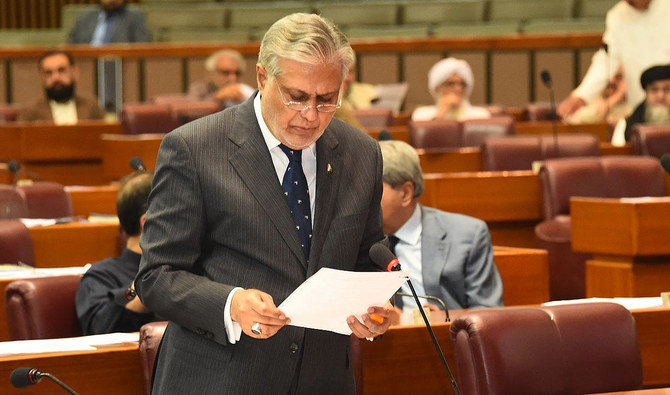
In this handout photograph, taken on April 13, 2023, Pakistan Finance Minister Ishaq Dar gestures during his address at the National Assembly in Islamabad. (Photo courtesy: Twitter/NAofPakistan)
Short Url
Updated 09 June 2023
Follow

Pakistan targeting fiscal deficit of 6.54% next fiscal year

  • The budget needs to satisfy the IMF to secure the release of stuck bailout money
  • Government targeting primary surplus at 0.4% of GDP, finance minister says

ISLAMABAD: Pakistan's government is targeting a fiscal deficit of 6.54% of GDP for the 2023-24 fiscal year, the finance minister said in his budget speech on Friday, much wider than the current year's original estimate of 4.9%.

The budget needs to satisfy the IMF to secure the release of stuck bailout money for the crisis-struck country, which is due to hold a general election by November.

The government was targeting primary surplus at 0.4% of GDP, the finance minister said. 

"This is not an election budget. This budget is for the success of the country, it has no political elements in it," Ishaq Dar said on the floor of the house.

For the next year, GDP growth had been budgeted at 3.5 per cent, Dar said, calling it a “modest target.”

The country’s economy has suffered record high inflation and an economic slowdown compounded by devastating floods last year and a failure so far to unlock crucial finances from the International Monetary Fund. The IMF had demanded a number of prior actions from Pakistan, including reversing subsidies, a hike in energy and fuel prices, jacking up its key policy rate, a market-based exchange rate, arranging for external financing and raising over 170 billion rupees ($613 million) in new taxation.

“Owing to the depreciating value of the rupee and the rapid increase in interest rates, the economic woes of the country increased but the government adopted the policy of saving the state instead of saving political interests,” Dar said in his budget speech. 

Pakistan's Prime Minister Shehbaz Sharif in a televised address to his cabinet on Friday reiterated that he was hopeful that the agreement with the IMF would go to its board for approval this month.

He added that the United Arab Emirates, Saudi Arabia and China had been "very helpful" in recent months in providing funding to Pakistan.

The IMF said earlier this week that it was discussing the budget with Pakistan's government. Sharif's government is hoping to persuade the IMF to unlock at least some of the $2.5 billion left in a $6.5 billion programme that Pakistan entered in 2019 and which expires at the end of this month.


Pakistan stock market sees 41% rise in investors in 18 months

Updated 09 January 2026
Follow

Pakistan stock market sees 41% rise in investors in 18 months

  • Pakistan’s stock market has gained momentum at start of year on broad-based institutional buying
  • The rise in the stock market reflects global investors’ confidence in the country, state media says

ISLAMABAD: The Pakistan Stock Exchange has witnessed a 41% increase in the number of investors over the past 18 months, Pakistani state broadcaster reported on Friday.

Pakistani stock market has gained momentum in recent months as broad-based institutional buying across key sectors has reinforced investor confidence even as the country continues to navigate economic reforms under international lending programs.

Around 135,000 new investors have joined the PSX over the last 18 months, the Radio Pakistan broadcaster reported.

“Pakistan’s stock market has emerged as the second-best performing market globally,” the report said. “The rise in the stock market reflects global investors’ confidence in Pakistan’s improved investment environment.”

The development came as the PSX shed a little more than 1,000 points as it closed the weekend session at 184,519 points.

The report said coordinated efforts by Pakistan’s Special Investment Facilitation Council (SIFC) have helped stabilize the country’s economy and investment market, elevating it to prominence at the global level.

“Pakistan’s macroeconomic environment has become an attractive and reliable destination for investment,” it quoted Finance Adviser Khurram Schehzad as saying.

On Wednesday, Pakistani stocks climbed to a fresh all-time high with the benchmark KSE-100 Index crossing the 186,000-point mark for the first time as potential foreign inflows upheld the positive sentiment.