

PM Sharif expects gas pipeline from Central Asia to usher in era of regional prosperity

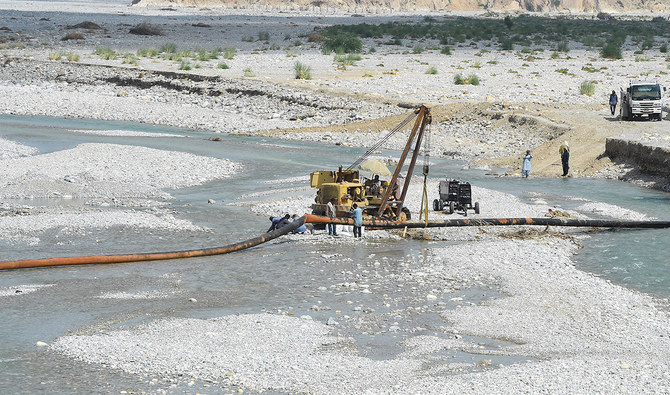
In this picture taken on September 1, 2022, workers repair a gas pipeline damaged by flood waters in the town of Mach, southeast of Quetta, Balochistan province. (AFP/File)
Short Url
Updated 08 June 2023
Follow

PM Sharif expects gas pipeline from Central Asia to usher in era of regional prosperity

  • The construction of Turkmenistan-Afghanistan-Pakistan-India pipeline has remained stalled for years
  • The prime minister says the project will help the region secure natural gas with concrete assurances

ISLAMABAD: Prime Minister Shehbaz Sharif said on Thursday a gas pipeline from Central Asia would usher in a new era of regional development, cooperation and prosperity, according to an official statement released by his office.

The government decided to appoint a senior official on Wednesday to resolve issues related to the Turkmenistan-Afghanistan-Pakistan-India (TAPI) pipeline project, whose construction has remained stalled for years due to differences over price review and delivery points.

The proposed pipeline is expected to carry 33 billion cubic meters (bcm) of natural gas each year along a route stretching over 1,800 kilometers from the world’s second-largest gas field of Galkynysh to the Indian city of Fazilka.

Sharif expressed his optimism about the project after attending an event related to it.

“Addressing the signing ceremony of the TAPI Joint Implementation Plan, the prime minister said the project was of utmost importance for the development of all four countries and the region,” said the official statement.

He added the project would help the region secure natural gas with concrete assurances and mutually agreed terms and conditions.

The prime minister mentioned that in view of the global situation, access to energy had become a real challenge.

“For a developing country like Pakistan, there is a need to take speedy actions to explore energy options,” he said.

Sharif directed his team to do everything to pace up the planning and execution of the TAPI project, adding that Pakistan and Turkmenistan would expand their relations in diverse areas and boost bilateral cooperation.


Pakistan urges developed nations, global institutions to expand role in climate financing

Updated 07 December 2025
Follow

Pakistan urges developed nations, global institutions to expand role in climate financing

  • Pakistan is recognized among countries worldwide most affected by climate-induced disasters
  • Planning minister stresses redesigning global financial system on principles of responsibility, equity

ISLAMABAD: Pakistan’s Planning Minister Ahsan Iqbal this week called on developed nations and international financial institutions to play a greater role in helping developing countries adopt green technologies at lower costs, state-run media reported. 

Pakistan has suffered frequent climate change-induced disasters over the past couple of years, ranging from floods, droughts, heatwaves, cyclones and other irregular weather patterns. 

This year the South Asian country reported over 1,000 deaths from floods and landslides triggered by heavy rains and the melting of glaciers. 

“He [Iqbal] said Pakistan has urged developed countries and international financial institutions to expand their role in climate financing to enable developing nations to adopt green technologies at lower costs,” state-run Associated Press of Pakistan (APP) reported on Saturday. 

The minister was speaking at the Second Asia Energy Transition Summit held at Pakistani university LUMS on Saturday. 

Iqbal warned that climate change is intensifying emergencies and increasing economic burdens on vulnerable countries, adding that financial incentives and concessional financing have become indispensable for sustainable climate action.

“He further emphasized the need to redesign the global financial system based on the principles of collective responsibility and equity,” APP said. 

The minister noted that Pakistan has been introducing comprehensive reforms in its development agenda to promote renewable energy, solar power and green technological solutions. 

The country, he said, possesses “strong solar potential,” a robust renewable energy market, a wide talent pool in engineering and science and an enabling environment for green innovation.

Pakistan has regularly urged developed countries to fulfill past pledges and provide easy access to climate funding without attaching conditions, especially at Conference of Parties (COP30) climate summits. 

Islamabad was instrumental in getting the Fund for Responding to Loss and Damage (FRLD) established at the COP27 climate summit in Egypt in 2022. The Loss and Damage Fund aims to help developing and least developed countries cope with both economic and non-economic impacts of climate change, such as extreme weather events and slow-onset crises like sea-level rise and droughts.