

Google’s flagship Marketing Live event comes to Saudi Arabia for first time

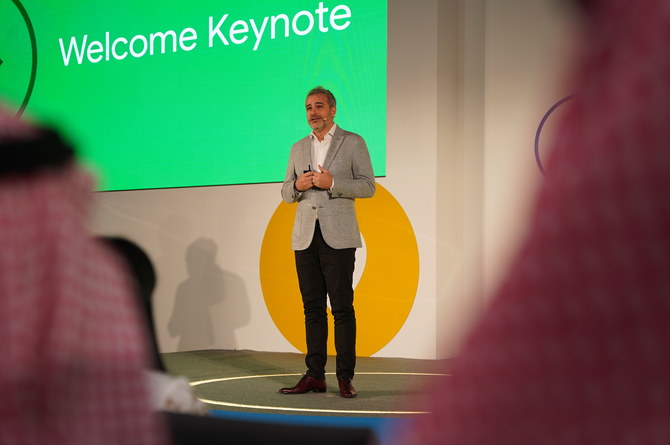
Google hosts flagship event, Google Marketing Live, in Saudi Arabia for the first time. (Supplied)
Short Url
Updated 07 June 2023
Follow

Google’s flagship Marketing Live event comes to Saudi Arabia for first time

  • Executives from the company’s regional and global operations told business and marketing experts from the region about its latest consumer insights, products and solutions

DUBAI: Google announced new consumer insights, products and solutions on Wednesday in Riyadh, as the company’s flagship global advertising and commerce event, Google Marketing Live, took place in Saudi Arabia for the first time.

Executives from Google’s regional and global operations joined business and marketing experts from the region at the event to discuss the future of artificial intelligence in the business world.

“We’re excited to host Google Marketing Live in Riyadh for the first time,” said Anthony Nakache, the managing director of Google MENA.

“Google’s presence here today is a testament to our commitment to supporting businesses in the Kingdom and their digital growth.”

The company showcased its latest advertising products and new features on Google Search and Maps, along with a range of AI features and products that will be available in Saudi Arabia. It said the innovations include an enhanced experience on PerformanceMax, Automatically Created Assets, and Merchant Center Next.

PerformanceMax, which allows advertisers to access all of their Google Ads inventory from a single campaign, will now use generative media models and large language learning models to generate “professional grade creatives” across YouTube, Display and Search with minimal information, the company said.

Automatically Created Assets will enable advertisers to generate and adapt their adverts in real time, so that they are more relevant to customers, it added.

In addition, Google said, businesses of all sizes can now manage online and offline product and business information through Merchant Center Next, which includes a simplified process for onboarding and product upload and management, together with improved ad integration and comprehensive reporting.

“AI has long been the cornerstone of Google’s products and services and we’re excited to announce new AI-powered features, such as AI in PerformanceMax and Automatically Created Assets, for businesses in Saudi Arabia to help drive better performance and reach more customers,” said Nakache.

Google Marketing Live is an annual event during which the company showcases its latest advertising and product offerings.



Transparency is key to trust, says CNNIC exec

Updated 58 min 50 sec ago
Follow

Transparency is key to trust, says CNNIC exec

  • Cathy Ibal outlines CNN’s multi-platform strategy and approach to AI amid shifting audience habits

DUBAI: Overall trust in news has stayed stable for the third year in a row at 40 percent, according to the Reuters Institute’s Digital News Report 2025.

Yet the news industry is growing more fragmented as engagement with traditional media sources such as TV and print declines and audiences turn to social media and video platforms for news, the same report found.

In this environment, Arab News spoke to Cathy Ibal, senior vice-president of CNN International Commercial, about the evolving nature of the news, particularly broadcast, industry.

CNN recognizes the shift in “the way that people access, consume and engage with news media,” and has adapted as a network to be present across various channels including TV, digital, mobile, and social media, among others, she said.

While CNN is synonymous with “breaking news,” “which is when we have our largest audience spikes and interest,” she said that it is part of the network’s mission “to be essential to people every day” through content across varied topics including business, technology, and health.

Cathy Ibal, senior vice-president,
CNN International Commercial

In the Middle East region, CNN audiences are 1.5 times more likely than the global average to engage with the network via social media and mobile apps, according to research by Differentology.

They are also 1.5 times more likely to rely on user-generated content as a primary news source compared with the global average.

CNN is “acutely aware of the dynamic nature of content consumption in the Middle East,” where a significant proportion of the population is under the age of 30, resulting in “an accelerated take-up of new technology, and therefore ways of consuming news media,” Ibal said.

“To that end, we have a considerable content offering for and about the region,” she added, referring to shows such as “Connect the World” with Becky Anderson and “CNN Creators,” as well as CNN Arabic. 

Despite changing audience behavior, Ibal believes there is something “uniquely powerful” about traditional TV, from both an audience and advertiser perspective. Ultimately, a multi-platform approach allows the network and advertisers to connect with more diverse audiences in different ways.

One of the key focuses of the network’s branded content studio, Create, for example, is content strategy. “The same piece of content cannot simply be created for one platform and reused on others,” Ibal said.

“We always say that powerful storytelling must be at the heart of a well-performing campaign. The role of content strategy is to determine how to best tell that story in different native environments.”  

Artificial intelligence is increasingly becoming more commonplace in the newsroom, with approximately 81 percent of journalists using AI tools in their work regularly, according to a 2025 global study.

Still, audiences remain skeptical about the use of AI in news. Only 12 percent of respondents are comfortable with fully AI-generated news, rising to 43 percent when a human being leads with some AI help, and 62 percent for entirely human-made news, according to the same study.

The key to earning and maintaining trust, according to Ibal, is transparency.

Commercially, CNN has used automation and machine learning for many years, specifically for audience targeting and personalization, as well as to automate time-consuming tasks in its branded studio and to analyze large data sets for audience insight and campaign evaluation.  

Editorially, the network’s approach to using AI is “rooted in responsibility and transparency,” Ibal said. With major global events, such as elections, coming up, CNN is investing in areas such as AI-driven fact-checking and misinformation detection tools that identify manipulated images, deepfakes, and misleading content before it reaches audiences, she added.

Ibal said: “Any use of AI across CNN — whether for commercial, editorial or product development — must adhere to our standards and practices and strict AI guidelines to ensure our audiences and brand partners can always trust our work in this area.”