

Libya’s rival factions agree on terms for elections

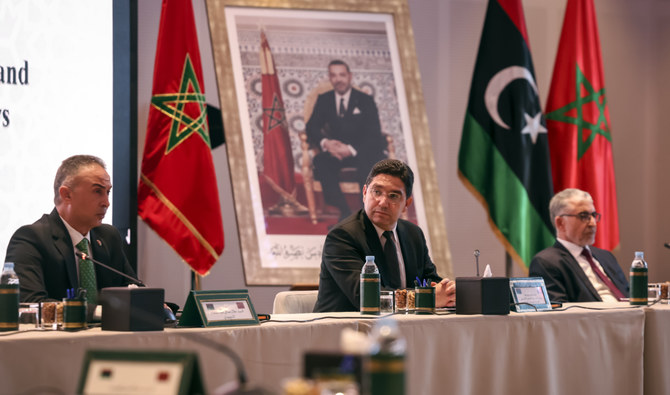
Libyan head of representative delegation to the House of Representatives Jalal Salah Abd Assalam (L), Moroccan Minister of Foreign Affairs Nasser Bourita and Libyan head of the representative delegation of the Supreme Council of the State Omar Mohamed Aboulifa (R), attend a meeting of the joint committee of the Libyan house of representatives, early on June 7 , 2023 in Bouznika. (AFP)
Short Url
Updated 07 June 2023
Follow

Libya’s rival factions agree on terms for elections

BOUZNIKA, Morocco: Envoys of rival Libyan factions have agreed on the legal steps to hold much delayed presidential and legislative elections in the conflict-scarred nation, both sides said early on Wednesday.

Election were due to be held in December 2021 but were never organized as differences persisted on key issues including who should run in the polls.

Libya has been torn by more than a decade of stop-start conflict since a 2011 revolt toppled strongman Muammar Qaddafi, with a myriad of militias forming opposing alliances backed by foreign powers.

The country remains split between a nominally interim government in Tripoli in the west, and another in the east backed by military strongman Khalifa Haftar.

After more than two weeks of talks in Morocco, representatives from both sides struck a deal but stopped short of inking any agreement so far in a sign some differences may still need to be resolved.

No date has yet been named for when the vote may take place.

“The members ... have agreed the laws for presidential and legislative elections,” Jalal Chouehdi, who represents the east-based parliament, told reporters in the southern Moroccan city of Bouznika.

“All that is left is for parliament to ratify” the texts of the accord, added Omar Boulifa, representative for the High State Council aligned with the Tripoli-based administration.

Morocco’s Foreign Minister Nasser Bourita said the agreements would be signed “in the coming days” by Aguila Saleh, speaker of Libya’s east-based parliament, and Khaled Al-Mechri who heads the HSC.

Presidential and legislative elections have been repeatedly delayed over issues including their legal basis and the participation of controversial candidates including Haftar.

The talks in Bouznika, the latest attempt by both sides to reach a deal, had been underway since May 22.

In mid-March, UN envoy Abdoulaye Bathily had called on rival administrations to agree terms for elections “by mid-June.”


Algeria inaugurates strategic railway to giant Sahara mine

President Tebboune attended an inauguration ceremony in Bechar. (AFP file photo)
Updated 02 February 2026
Follow

Algeria inaugurates strategic railway to giant Sahara mine

  • The mine is expected to produce 4 million tons per year during the initial phase, with production projected to triple to 12 million tons per year by 2030
  • The project is financed by the Algerian state and partly built by a Chinese consortium

ALGEIRS: Algerian President Abdelmadjid Tebboune on Sunday inaugurated a nearly 1,000-kilometer (621-mile) desert railway to transport iron ore from a giant mine, a project he called one of the biggest in the country’s history.
The line will bring iron ore from the Gara Djebilet deposit in the south to the city of Bechar located 950 kilometers north, to be taken to a steel production plant near Oran further north.
The project is financed by the Algerian state and partly built by a Chinese consortium.
During the inauguration, Tebboune described it as “one of the largest strategic projects in the history of independent Algeria.”
This project aims to increase Algeria’s iron ore extraction capacity, as the country aspires to become one of Africa’s leading steel producers.
The iron ore deposit is also seen as a key driver of Algeria’s economic diversification as it seeks to reduce its reliance on hydrocarbons, according to experts.
President Tebboune attended an inauguration ceremony in Bechar, welcoming the first passenger train from Tindouf in southern Algeria and sending toward the north a first charge of iron ore, according to footage broadcast on national television.
The mine is expected to produce 4 million tons per year during the initial phase, with production projected to triple to 12 million tons per year by 2030, according to estimates by the state-owned Feraal Group, which manages the site.
It is then expected to reach 50 million tons per year in the long term, it said.
The start of operations at the mine will allow Algeria to drastically reduce its iron ore imports and save $1.2 billion per year, according to Algerian media.