Philippine court denies bail request for staunch Duterte critic in drugs case

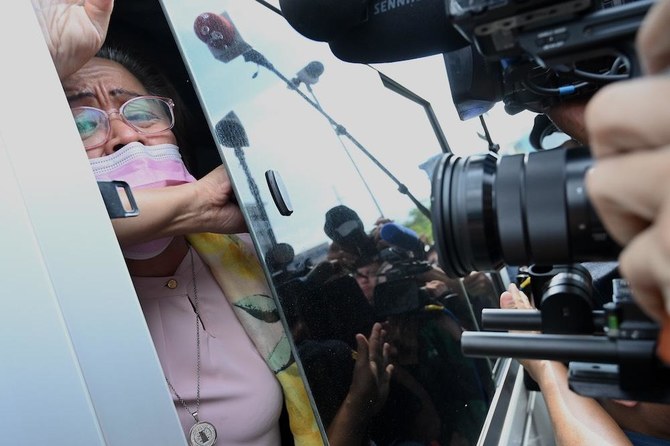
Former Philippine senator Leila de Lima leaves after her hearing at the Muntinlupa Trial Court in Manila on June 5, 2023. (AFP)
Short Url
Updated 07 June 2023
Follow

Philippine court denies bail request for staunch Duterte critic in drugs case

  • Petition was for a drug case that saw Leila de Lima accused of conspiring to commit illegal narcotics trade in a Philippine prison

MANILA: A Philippine court has denied a bail request from Leila de Lima, a former senator and staunch critic of ex-President Rodrigo Duterte’s war on drugs, the defendant’s lawyer said on Wednesday, thereby prolonging her detention.
“Sad to inform you that the court denied Senator Leila’s bail application,” Filibon Tacardon, her legal counsel, told reporters.
The petition was for a drug case that saw de Lima accused of conspiring to commit illegal narcotics trade in a Philippine prison.
De Lima was arrested in 2017, just a few months after she launched a senate investigation into Duterte’s anti-narcotics campaign during which thousands of users and dealers were killed, many by police or in mysterious circumstances. She has been in police detention ever since.
A Philippine court in 2021 dismissed a drug case against de Lima, 63, while another court in May acquitted her from a charge that she received drug money from prison inmates.


Millions of Indian girls out of school as efforts to keep them enrolled falter

Updated 7 sec ago
Follow

Millions of Indian girls out of school as efforts to keep them enrolled falter

  • Government data shows 6.57 million Indian children dropped out from school between 2019 and 2025
  • For girls, main reasons are child marriage, family migration and inadequate infrastructure, experts say

NEW DELHI: Priyanka Sau was sure that after completing secondary school she would enroll in a computer course in her hometown in Uttar Pradesh.

But neither the course nor her graduation could materialize as two years ago her father lost his job at a brick kiln and the family moved to Delhi in search of work. The 15-year-old now works as a cleaner in a housing complex, supplementing her parents’ income and helping support her three younger sisters.

Her marriage arrangement has been finalized, too.

“Very soon it will be formalized,” she told Arab News.

“For me, there was no option but to follow my parents to Delhi and start earning to make a living ... I miss my school and dream to enroll in a computer course to get modern skills.”

Priyanka is one of the 6.57 million Indian children who dropped out from school between 2019 and 2025, according to data presented in parliament in December by Women and Child Development Minister Savitri Thakur.

Nearly 3 million of the whole dropout group were adolescent girls, with the highest rates recorded in the most populous states. In Uttar Pradesh, girls accounted for more than half of nearly 100,000 school dropouts in the 2025–26 academic year alone.

Dr. Kriti Bharati, founder of Saarthi Trust, which works for child rights and rescues victims of child marriage, said the government data was “alarming” and required immediate intervention.

“The education department should go deep into it. They should find out where these thousands of girls who dropped out have gone ... The schoolteachers, when they come to know that some girls or kids have dropped, they should find out why they are dropping out. This is their social responsibility,” she said.

“A developed society is called developed not because it has better roads or it can send missions to the moon. It has to ensure education for its people, it has to ensure proper care for its poor citizens.”

The government data showed that social protection systems were failing to adapt to local realities, as dropout rates rise due to pressures such as domestic responsibilities, work, early marriage and poverty.

According to Dr. Bharati, the main reasons forcing girls to leave school were child marriage and labor migration, which has increased since the COVID pandemic.

“Poor people move from one place to another. After COVID, many things have changed as far as jobs are concerned. People are moving for jobs outside their villages,” she said.

“The third reason is child labor — these girls become a source of income for their family. They supplement the income.”

For Dr. Purujit Praharaj, director of India Child Protection, the main reasons enabling the increase in dropout rates, especially among girls, were systemic: inadequate infrastructure and legal guarantees.

The Right to Education Act makes free and compulsory education a fundamental right only for children aged 6 to 14, while access-wise, secondary schools in rural areas are often far, especially in India’s poorer, eastern states.

“All girls below 18 should be given free and compulsory education and proper infrastructure. If the schools are not located nearby, then hostel facilities should be provided,” Dr. Praharaj said.

“There is a safety issue and concern among the parents to send their girls to a different location to school ... Residential schools need to be built for these girls so that they can go there. If you can ensure continuous education for them, girls will not get married before 18.”