Philippines rejects European Parliament’s call on detained senator

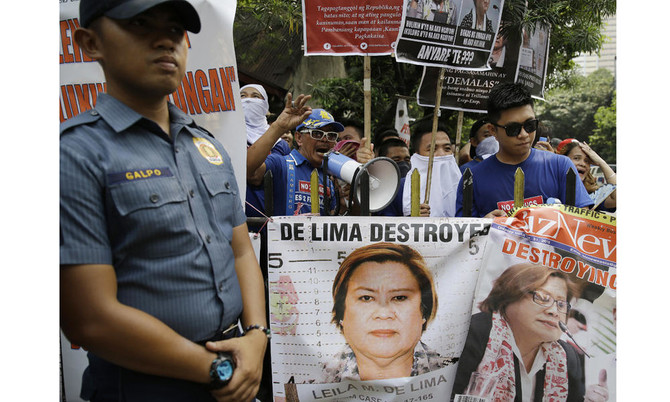
Protesters against detained Philippine Sen. Leila de Lima shout slogans during a rally outside the Supreme Court in Manila on March 14, 2017. De Lima, a leading critic of President Rodrigo Duterte's deadly crackdown on illegal drugs, petitioned the Supreme Court to nullify a Philippine court's arrest warrant against her for drug charges and order her release from detention at a police camp. (AP Photo/Aaron Favila)
Updated 18 March 2017
Follow

Philippines rejects European Parliament’s call on detained senator

MANILA, Philippines: The Philippine government on Friday rejected a call by the European Parliament for the release of Sen. Leila de Lima, a leading critic of the president who has been detained on drug charges, and told the international community to refrain from influencing her case.
The Department of Foreign Affairs said a European Parliament resolution calling for de Lima’s release “casts aspersion on Philippine legal processes, its judicial system.”
“The pillars of the criminal justice system remain to be effective and well-functioning in the Philippines, not only for Senator de Lima but for all,” it said in a statement. “The case is pending before the proper Philippine courts and the Philippine government will allow the legal process to proceed accordingly.”
De Lima said she was elated “that the international community is closely monitoring the trumped-up charges brought up against me.” She called on President Rodrigo Duterte’s administration to heed the call.
De Lima is a former top human rights official and vocal critic of Duterte’s brutal crackdown on illegal drugs. She was arrested last month on charges she received bribes from detained drug lords when she served as justice secretary under Duterte’s predecessor.
She has vehemently denied the charges, which she said are part of efforts by Duterte and his officials to muzzle critics of his anti-drug crackdown, which has left thousands of mostly poor drug suspects dead. Western governments, along with EU and UN officials, have expressed alarm over the crackdown.
When de Lima headed the government’s Commission on Human Rights, she tried unsuccessfully to have Duterte prosecuted when he was mayor of Davao city for unlawful deaths in a similar crackdown on illegal drugs he had launched there. However, no witnesses came forward to testify against him.
Duterte expanded the crackdown nationwide after becoming president last June, and de Lima continued to criticize him after winning a Senate seat last year. Duterte has denied condoning extrajudicial killings, although he has repeatedly threatened drug suspects with death in public speeches.
The European Parliament strongly condemned “the many extrajudicial killings” under Duterte’s crackdown and urged his government “to prioritize the fight against trafficking networks and drug barons over tracking down small-scale consumers.”


South Africa defends naval drills with Iran, Russia as ‘essential’

Updated 4 sec ago
Follow

South Africa defends naval drills with Iran, Russia as ‘essential’

  • The drills — led by China — were more than a military exercise, Captain Thamaha said
  • “It is a demonstration of our collective resolve to work together“

SIMON’S TOWN, South Africa: South Africa on Saturday began naval drills with Russia, Iran and China, describing the maneuvers off its coast as not merely a show of force but a vital response to rising maritime tensions.
The weeklong ‘Will for Peace 2026’ exercises come just days after the United States seized a Russian-flagged oil tanker in the North Atlantic, saying it carried crude bound for Venezuela, Russia and Iran in violation of Western sanctions.
The seizure followed an American raid that toppled Moscow’s ally Nicolas Maduro in Caracas.
The drills — led by China — were more than a military exercise and a statement of intent among the BRICS group of emerging nations, Captain Nndwakhulu Thomas Thamaha, South Africa’s joint taskforce commander, told the opening Ceremony.
“It is a demonstration of our collective resolve to work together,” he said.
BRICS, originally made up of Brazil, Russia, India, China and South Africa, has expanded to include Egypt, Ethiopia, Iran, Saudi Arabia, the United Arab Emirates and, more recently, Indonesia.
China and Iran deployed destroyer warships, while Russia and the United Arab Emirates sent corvette vessels. Host South Africa dispatched a frigate.
Indonesia, Ethiopia and Brazil joined as observers.
“In an increasingly complex maritime environment, cooperation such as this is not an option, it is essential,” said Thamaha.
The exercises were to “ensure the safety of shipping lanes and maritime economic activities,” he said.
Previously known as Exercise Mosi, the drills were initially scheduled for last November but postponed due to a clash with the G20 summit in Johannesburg, boycotted by the United States.
Washington has accused South Africa and the BRICS bloc of ‘anti?American’ policies and warned members they could face an additional 10 percent tariff on top of existing duties already applied worldwide.
South Africa has also drawn US criticism for its close ties with Russia and a range of other policies, including its decision to bring a genocide case against Washington ally Israel at the International Court of Justice over the Gaza war.
South Africa drew criticism for hosting naval drills with Russia and China in 2023, coinciding with the first anniversary of Moscow’s invasion of Ukraine.
The three nations first conducted joint naval drills in 2019.