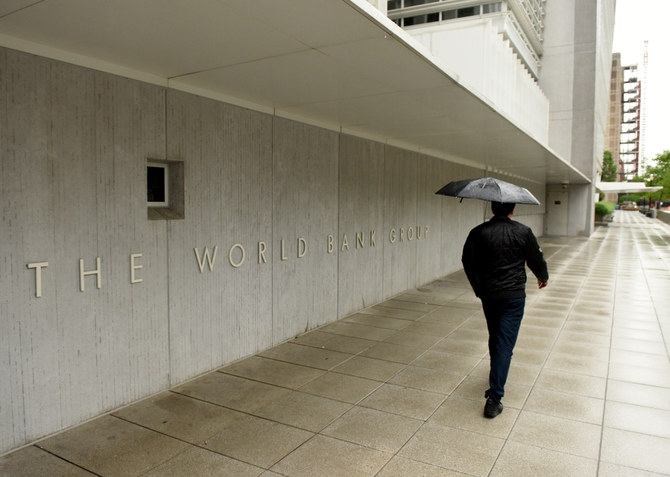
World Bank offers dim outlook for the global economy in face of higher interest rates

Real global GDP is set to climb 2.1% this year, the World Bank said. That's up from a 1.7% forecast issued in January but well below the 2022 growth rate of 3.1%. Photo/ Shutterstock
Short Url
Updated 07 June 2023
Follow

World Bank offers dim outlook for the global economy in face of higher interest rates

WASHINGTON: The global economy is likely slowing sharply this year, hobbled by high interest rates, the repercussions of Russia’s invasion of Ukraine and the lingering effects of the coronavirus pandemic.
That’s the latest outlook of the World Bank, a 189-country anti-poverty agency, which estimates that the international economy will expand just 2.1 percent in 2023 after growing 3.1 percent in 2022.
Speaking to reporters Tuesday, Indermit Gill, the World Bank’s chief economist, called the latest findings “another gloomy report.” The bank, he said, expects “last year’s sharp and synchronized slowdown to continue to this year into a sharp slowdown.”
“By the end of next year, a third of the developing world will not meet the per-capita income level that they had at the end of 2019,” he said.
Still, the bank’s latest Global Economic Prospects report marks an upgrade from its previous forecast in January. That estimate had envisioned worldwide growth of just 1.7 percent this year.
The Federal Reserve and other major central banks have been aggressively raising interest rates to combat a resurgence of inflation, set off by a stronger-than-expected rebound from the pandemic recession, persistent supply shortages and energy and food price shocks caused by the Ukraine war.
But the global economy has proved surprisingly resilient in the face of higher borrowing costs, and the World Bank predicts that growth will accelerate to 2.4 percent in 2024.
The United States has continued to generate unexpectedly robust job gains — employers added 339,000 workers in May, far more than economists had forecast — even though the Fed has raised its benchmark rate 10 times in the past 15 months. In its report Tuesday, the World Bank upgraded its forecast for US economic growth this year to 1.1 percent. Though weak, that is more than double the growth the World Bank had envisioned in January.
The eurozone, which represents the 20 countries that share the euro currency, is expected to post collective growth of 0.4 percent this year. That, too, marks a slight upgrade: In January, the World Bank had expected no growth at all for the eurozone this year. Europe, struggling with higher energy prices caused by the Ukraine war, enjoyed relief from a surprisingly warm winter, which reduced demand for heat.
The World Bank upgraded its 2023 outlook for China after Beijing late last year relaxed its draconian zero-COVID policies, which had restricted travel and hammered its economy. The world’s second-biggest economy is now expected to grow 5.6 percent in 2023, up from 3 percent last year. The World Bank envisions Japan’s growth decelerating to 0.8 percent this year from 1 percent in 2022. It foresees India’s growth slowing to a still-strong 6.3 percent from 7.2 percent last year.
The bank predicts that global trade will slow markedly this year. It foresees a sharp drop in the price of energy and other commodities this year and next.


Gulf-EU value chain integration signals shift toward long-term economic partnership: GCC secretary general

Updated 03 February 2026
Follow

Gulf-EU value chain integration signals shift toward long-term economic partnership: GCC secretary general

RIYADH: Value chains between the Gulf and Europe are poised to become deeper and more resilient as economic ties shift beyond traditional trade toward long-term industrial and investment integration, according to the secretary general of the Gulf Cooperation Council.

Speaking on the sidelines of the World Governments Summit 2026 in Dubai, Jasem Al-Budaiwi said Gulf-European economic relations are shifting from simple commodity trade toward the joint development of sustainable value chains, reflecting a more strategic and lasting partnership.

His remarks were made during a dialogue session titled “The next investment and trade race,” held with Luigi Di Maio, the EU’s special representative for external affairs.

Al-Budaiwi said relations between the GCC and the EU are among the bloc’s most established partnerships, built on decades of institutional collaboration that began with the signing of the 1988 cooperation agreement.

He noted that the deal laid a solid foundation for political and economic dialogue and opened broad avenues for collaboration in trade, investment, and energy, as well as development and education.

The secretary general added that the partnership has undergone a qualitative shift in recent years, particularly following the adoption of the joint action program for the 2022–2027 period and the convening of the Gulf–European summit in Brussels.

Subsequent ministerial meetings, he said, have focused on implementing agreed outcomes, enhancing trade and investment cooperation, improving market access, and supporting supply chains and sustainable development.

According to Al-Budaiwi, merchandise trade between the two sides has reached around $197 billion, positioning the EU as one of the GCC’s most important trading partners.

He also pointed to the continued growth of European foreign direct investment into Gulf countries, which he said reflects the depth of economic interdependence and rising confidence in the Gulf business environment.

Looking ahead, Al-Budaiwi emphasized that the economic transformation across GCC states, driven by ambitious national visions, is creating broad opportunities for expanded cooperation with Europe. 

He highlighted clean energy, green hydrogen, and digital transformation, as well as artificial intelligence, smart infrastructure, and cybersecurity, as priority areas for future partnership.

He added that the success of Gulf-European cooperation should not be measured solely by trade volumes or investment flows, but by its ability to evolve into an integrated model based on trust, risk-sharing, and the joint creation of economic value, contributing to stability and growth in the global economy.

GCC–EU plans to build shared value chains look well-timed as trade policy volatility rises.

In recent weeks, Washington’s renewed push over Greenland has been tied to tariff threats against European countries, prompting the EU to keep a €93 billion ($109.7 billion) retaliation package on standby. 

At the same time, tighter US sanctions on Iran are increasing compliance risks for energy and shipping-related finance. Meanwhile, the World Trade Organization and UNCTAD warn that higher tariffs and ongoing uncertainty could weaken trade and investment across both regions in 2026.