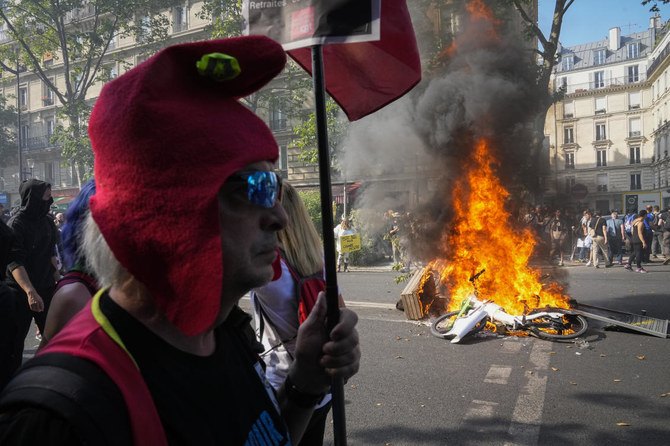
PARIS: French union activists marched on the headquarters of the Paris Olympics and slowed traffic at the capital’s Orly Airport with strikes Tuesday as they sought to reignite resistance to a higher retirement age.
But the last-ditch effort drew fewer followers than at the height of the movement earlier this year, and even some union leaders seemed ready to move on.
President Emmanuel Macron’s move to raise the retirement age from 62 to 64 — and force the measure through parliament without a vote — inflamed public emotions and triggered some of France’s biggest demonstrations in years. But the intensity of anger over the pension reform has ebbed since the last big protests on May 1, which more than 500,000 people attended in Paris alone, and since the measure became law in April.
As part of Tuesday’s actions, a third of flights were canceled at Paris’ Orly Airport because of strikes, and about 10 percent of trains around France were disrupted. Around 250 marches, rallies and other actions were planned around the country to mark the 14th day of national protest since January over the pension reform.
A small group of activists with the hard-left CGT union pushed their way into the headquarters of the 2024 Olympics in the Paris suburb of Saint-Denis, chanting anti-Macron slogans.
In Paris, mild tensions flared near a restaurant in the Left Bank as individuals engaged in minor vandalism of bus shelters and threw objects at police. Police quickly dispersed the crowds.
Thousands gathered along the embankments of the Seine River near the gold-domed Invalides monument before setting off on their march to southeast Paris. The peaceful crowd waved union flags, banged drums and chanted to demand the withdrawal of the pension law and a lower retirement age.
In the western city of Rennes, union activists marched on train tracks before being turned back by police, according to local public broadcaster France Bleu.
Macron says the pension reform was needed to finance the pension system as the population ages. Unions and left-wing opponents say the changes hurt poorer workers and have argued for higher taxes on the wealthy and employers instead.
The outgoing head of the moderate CFDT union, Laurent Berger, said that after Tuesday’s actions, “we will continue to contest the retirement reform, but it will take on a different form.”
CGT chief Sophie Binet told reporters at the Paris march that other protests are ‘’probable,” but she too said it was time to talk about other issues such as working conditions or tax fraud by companies.
Organizers of Tuesday’s protests hope to rally support before a possible parliamentary debate on Thursday on a bill that is seeking to repeal the new retirement age.
Legislators from centrist opposition group LIOT proposed the bill to put back the retirement age to 62. But it has already met challenges before it reaches the parliamentary floor. While Macron’s centrist party doesn’t have a majority in the National Assembly, it has allied with the conservative Republicans party to push back the opposition’s efforts.


Protests in France as unions make last-ditch bid to resist higher retirement age
https://arab.news/gw3sx
Protests in France as unions make last-ditch bid to resist higher retirement age

- French union activists seek to reignite resistance to a higher retirement age
- President Emmanuel Macron says pension reform needed to finance the pension system as the population ages


UK pays Guantanamo detainee ‘substantial’ compensation over US torture questions
- Abu Zubaydah has been held at Guantanamo Bay without charge for 20 years
- British security services knew he was subjected to ‘enhanced interrogation’ but failed to raise concerns for 4 years
LONDON: A Saudi-born Palestinian being held without trial by the US has received a “substantial” compensation payment from the UK government, the BBC reported.
Abu Zubaydah has been imprisoned at Guantanamo Bay in Cuba for almost 20 years following his capture in Pakistan in 2002, and was subjected to “enhanced interrogation” techniques by the CIA.
He was accused of being a senior member of Al-Qaeda in the aftermath of the Sept. 11 terror attacks on the US. The allegations were later dropped but he remains in detention.
The compensation follows revelations that UK security services submitted questions to the US to be put to Abu Zubaydah by their US counterparts despite knowledge of his mistreatment.
He alleged that MI5 and MI6 had been “complicit” in torture, leading to a legal case and the subsequent compensation.
Dominic Grieve, the UK’s former attorney general, chaired a panel reviewing Abu Zubaydah’s case.
He described the compensation as “very unusual” but said the treatment of Abu Zubaydah had been “plainly” wrong, the BBC reported.
Grieve added that the security services had evidence that the “Americans were behaving in a way that should have given us cause for real concern,” and that “we (UK authorities) should have raised it with the US and, if necessary, closed down co-operation, but we failed to do that for a considerable period of time.”
Abu Zubaydah’s international legal counsel, Prof. Helen Duffy, said: “The compensation is important, it’s significant, but it’s insufficient.”
She added that more needs to be done to secure his release, stating: “These violations of his rights are not historic, they are ongoing.”
Duffy said Abu Zubaydah would continue to fight for his freedom, adding: “I am hopeful that the payment of the substantial sums will enable him to do that and to support himself when he’s in the outside world.”
He is one of 15 people still being held at Guantanamo, many without charge. Following his initial detention, he arrived at the prison camp having been the first person to be taken to a so-called CIA “black site.”
He spent time at six such locations, including in Lithuania and Poland, outside of US legal jurisdiction.
Internal MI6 messages revealed that the “enhanced interrogation” techniques he was subjected to would have “broken” the resolve of an estimated 98 percent of US special forces members had they been subjected to them.
CIA officers later decided he would be permanently cut off from the outside world, with then-President George W. Bush publicly saying Abu Zubaydah had been “plotting and planning murder.”
However, the US has since withdrawn the allegations and no longer says he was a member of Al-Qaeda.
A report by the US Senate Select Committee on Intelligence said Abu Zubaydah had been waterboarded at least 83 times, was locked in a coffin-like box for extended periods, and had been regularly assaulted. Much of his treatment would be considered torture under UK law.
Despite knowledge of his treatment, it was four years before British security services raised concerns with their American counterparts, and their submission of questions within that period had “created a market” for the torture of detainees, Duffy said.
A 2018 report by the UK Parliament’s Intelligence and Security Committee was deeply critical of the behavior of MI5 and MI6 in relation to Abu Zubaydah.
It also criticized conduct relating to Guantanamo detainee Khalid Sheikh Mohammed, widely regarded as a key architect of the Sept. 11 attacks, warning that the precedent set by Abu Zubaydah’s legal action could be used by Mohammed to bring a separate case against the UK.
MI5 and MI6 failed to comment on Abu Zubaydah’s case. Neither the UK government nor Mohammed’s legal team would comment on a possible case over his treatment.


