

Pakistani PM says energy reforms to be part of annual budget this year

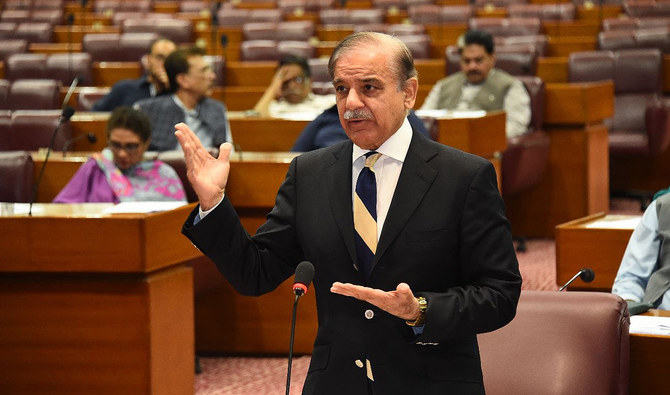
Pakistan Prime Minister Shehbaz Sharif speaks on the floor of the National Assembly in Islamabad on May 22, 2023. (Photo courtesy: Twitter/NAofPakistan)
Short Url
Updated 07 June 2023
Follow

Pakistani PM says energy reforms to be part of annual budget this year

  • South Asian nation seeking to reduce value of fuel imports, protect itself from geopolitical shocks
  • Grid failure this year plunged 220 million people into darkness for a day, disrupted commercial activity

ISLAMABAD: Pakistani Prime Minister Shehbaz Sharif said on Tuesday energy reforms would be part of the annual budget for fiscal year 2023-24, due to be presented on June 9.

The South Asian nation, which is battling a wrenching economic crisis and is in dire need of funds, is seeking to reduce the value of its fuel imports and protect itself from geopolitical shocks.

Power outages remain common in Pakistan, with a grid problem earlier this year plunging 220 million people into darkness for a whole day and disrupting commercial activity. Excess fossil fuel energy capacity also is boosting electricity costs — and raising questions about whether the country will now manage to achieve its climate change goals, with scientists saying coal needs to rapidly disappear from the world’s energy mix to prevent the worst impacts of climate change.

“The Prime Minister decided to make energy reforms part of the budget,” state-run Radio Pakistan reported after Sharif chaired a meeting on budget proposals.

“He said that renewable energy projects should be started by reducing reliance on the expensive imported fuel in a gradual manner … effective measures should be proposed in the next budget in order to control line losses and electricity theft.”

Sharif said wind and solar energy projects should be included in the upcoming budget and ongoing solarization projects in the country should be expedited.

“Emphasizing the importance of an efficient transmission system, he said power transmission projects should be completed at the earliest … transformer metering should be made part of the next budget for the elimination of line losses and the pilferage of electricity,” Radio Pakistan said.

In 2020, then Prime Minister Imran Khan promised Pakistan by 2030 would produce 60 percent of its electrical power from renewable sources.

Currently the country gets 64 percent of its electricity from fossil fuels, with another 27 percent from hydropower, 5 percent from nuclear power and just 4 percent from renewables such as solar and wind.


Pakistani students stuck in Afghanistan permitted to go home

Updated 12 January 2026
Follow

Pakistani students stuck in Afghanistan permitted to go home

  • The border between the countries has been shut since Oct. 12
  • Worries remain for students about return after the winter break

JALALABAD: After three months, some Pakistani university students who were stuck in Afghanistan due to deadly clashes between the neighboring countries were “permitted to go back home,” Afghan border police said Monday.

“The students from Khyber Pakhtunkhwa (northwest Pakistan) who were stuck on this side of the border, only they were permitted to cross and go to their homes,” said Abdullah Farooqi, Afghan border police spokesman.

The border has “not reopened” for other people, he said.

The land border has been shut since October 12, leaving many people with no affordable option of making it home.

“I am happy with the steps the Afghan government has taken to open the road for us, so that my friends and I will be able to return to our homes” during the winter break, Anees Afridi, a Pakistani medical student in eastern Afghanistan’s Nangarhar province, told AFP.

However, worries remain for the hundreds of students about returning to Afghanistan after the break ends.

“If the road is still closed from that side (Pakistan), we will be forced to return to Afghanistan for our studies by air.”

Flights are prohibitively expensive for most, and smuggling routes also come at great risk.

Anees hopes that by the time they return for their studies “the road will be open on both sides through talks between the two governments.”