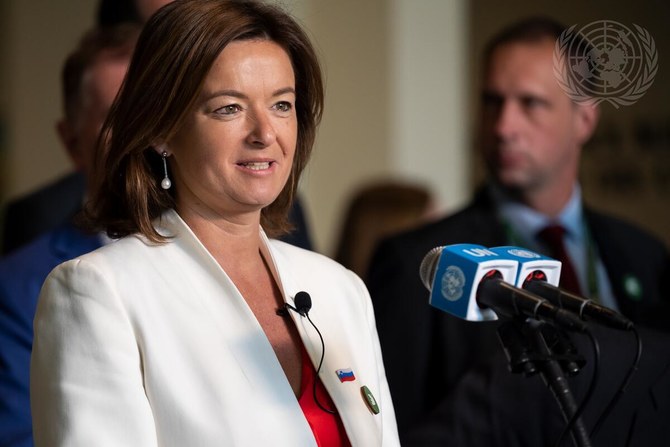

NEW YORK CITY: Any negotiations about UN Security Council reforms must include discussions about permanent seats for the African Union and the Arab League, Slovenia’s deputy prime minister and minister for foreign affairs told Arab News on Tuesday.
Tanja Fajon was speaking at the UN headquarters in New York following a General Assembly vote that elected her country as one of five new non-permanent members of the council, the UN body tasked with maintaining global peace and security.
She said one of her country’s priorities is to work on making the UN a more effective organization.
“Just the pure fact that we have 80 percent of the agenda” in the Security Council on African issues without the continent having a permanent seat there is “an important message” that speaks to the necessity of “finding compromises” and taking steps to “reform the council to make it more effective.”
Discussions and debates at the UN have intensified in recent months, especially since the start of the war in Ukraine, about the need for significant reforms of the council to take into account the changing needs of global governance in terms of peace and security, including growing calls from the Global South for a more effective presence at the table.
Potential reforms could include increases in the numbers of permanent and non-permanent members to help better address the complex and evolving challenges to international peace and security.
In addition to the many challenges in Africa that are on the council’s agenda, there are several significant Arab issues in which little progress has been made in recent years, with some facing stalemate, including Syria, Yemen and the conflict between the Palestinians and Israelis.
Asked by Arab News whether this might mean that in addition to the African Union, the Arab League deserves a permanent Security Council seat, and whether she would advocate for such a move when Slovenia’s tenure as a non-permanent member begins in January 2024, Fajon said: “Yes, if we talk about enlargement we have to speak about enlargement in both categories.” She added that “this is something where we have to find compromise.”
She reiterated that her country is determined to pursue reforms of the UN’s most powerful body and added: “We have good expertise and know how to move ahead (and we) will continue to even strengthen the dialogue with our partners.
“We have to make this organization more effective. I am aware of the challenges. I spoke with many colleagues on the need for the reform. So we will work in that regard to find compromises on how to reform the Security Council to make it more effective.”
Slovenia, which is a member of the EU and NATO received 153 votes in the General Assembly, comfortably defeating Belarus, which received 38 votes in the secret ballot. They were competing for the council seat allotted to Eastern Europe.
The other countries elected to serve a two-year council term were Guyana (which received 191 votes), Sierra Leone (188), Algeria (184) and South Korea (180). Their terms will begin on Jan. 1, replacing Albania, Brazil, Gabon, Ghana and the UAE, whose two-year terms end on Dec. 31.
Asked whether Slovenia, as a member of NATO, would be influenced in the Security Council by the position of the US, Fajon said: “Let me put it simply: Give us a chance to prove that we are capable of working with everyone, that we are very self confident with our foreign policy, and that we will work hard to understand everyone and (their) needs.”
She added that in her role as foreign minister she met in the past year with more than 150 representatives of world governments, and Slovenians “have enough self confidence and we have a strong diplomacy network that we will do what we believe is best, not only for Slovenia and our region but for the world.”