

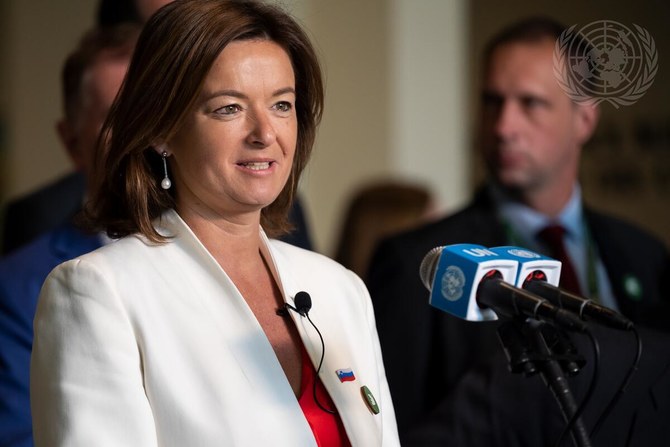
Slovenian foreign minister calls for permanent UN Security Council seats for Arabs and Africans

(UN Photo)
Short Url
Updated 07 June 2023
Follow

Slovenian foreign minister calls for permanent UN Security Council seats for Arabs and Africans

  • Tanja Fajon told Arab News the council is faced with too many African and Arab issues for these groups not to be granted their own place at the table
  • Slovenia was elected by the General Assembly on Tuesday as non-permanent member of the council, along with Algeria, Guyana, South Korea, and Sierra Leone

NEW YORK CITY: Any negotiations about UN Security Council reforms must include discussions about permanent seats for the African Union and the Arab League, Slovenia’s deputy prime minister and minister for foreign affairs told Arab News on Tuesday.

Tanja Fajon was speaking at the UN headquarters in New York following a General Assembly vote that elected her country as one of five new non-permanent members of the council, the UN body tasked with maintaining global peace and security.

She said one of her country’s priorities is to work on making the UN a more effective organization.

“Just the pure fact that we have 80 percent of the agenda” in the Security Council on African issues without the continent having a permanent seat there is “an important message” that speaks to the necessity of “finding compromises” and taking steps to “reform the council to make it more effective.”

Discussions and debates at the UN have intensified in recent months, especially since the start of the war in Ukraine, about the need for significant reforms of the council to take into account the changing needs of global governance in terms of peace and security, including growing calls from the Global South for a more effective presence at the table.

Potential reforms could include increases in the numbers of permanent and non-permanent members to help better address the complex and evolving challenges to international peace and security.

In addition to the many challenges in Africa that are on the council’s agenda, there are several significant Arab issues in which little progress has been made in recent years, with some facing stalemate, including Syria, Yemen and the conflict between the Palestinians and Israelis.

Asked by Arab News whether this might mean that in addition to the African Union, the Arab League deserves a permanent Security Council seat, and whether she would advocate for such a move when Slovenia’s tenure as a non-permanent member begins in January 2024, Fajon said: “Yes, if we talk about enlargement we have to speak about enlargement in both categories.” She added that “this is something where we have to find compromise.”

She reiterated that her country is determined to pursue reforms of the UN’s most powerful body and added: “We have good expertise and know how to move ahead (and we) will continue to even strengthen the dialogue with our partners.

“We have to make this organization more effective. I am aware of the challenges. I spoke with many colleagues on the need for the reform. So we will work in that regard to find compromises on how to reform the Security Council to make it more effective.”

Slovenia, which is a member of the EU and NATO received 153 votes in the General Assembly, comfortably defeating Belarus, which received 38 votes in the secret ballot. They were competing for the council seat allotted to Eastern Europe.

The other countries elected to serve a two-year council term were Guyana (which received 191 votes), Sierra Leone (188), Algeria (184) and South Korea (180). Their terms will begin on Jan. 1, replacing Albania, Brazil, Gabon, Ghana and the UAE, whose two-year terms end on Dec. 31.

Asked whether Slovenia, as a member of NATO, would be influenced in the Security Council by the position of the US, Fajon said: “Let me put it simply: Give us a chance to prove that we are capable of working with everyone, that we are very self confident with our foreign policy, and that we will work hard to understand everyone and (their) needs.”

She added that in her role as foreign minister she met in the past year with more than 150 representatives of world governments, and Slovenians “have enough self confidence and we have a strong diplomacy network that we will do what we believe is best, not only for Slovenia and our region but for the world.”


National security trial for Hong Kong’s Tiananmen vigil organizers to open

Updated 4 sec ago
Follow

National security trial for Hong Kong’s Tiananmen vigil organizers to open

  • Three government-vetted judges will preside over the trial, which is expected to last 75 days

HONG KONG: Two pro-democracy activists behind a group that for decades organized a vigil that commemorated people killed in Beijing’s Tiananmen Square crackdown in 1989 will stand trial on Thursday, in another landmark case brought under a China-imposed national security law that has practically crushed protests in the semiautonomous Chinese city.
Critics say their case shows that Beijing’s promise to keep the city’s Western-style civil liberties intact for 50 years when the former British colony returned to Chinese rule in 1997 has weakened over time. But the city’s government said its law enforcement actions were evidence-based and strictly in accordance with the law.
Chow Hang-tung and Lee Cheuk-yan, former leaders of the Hong Kong Alliance in Support of Patriotic Democratic Movements of China, were charged with incitement to subversion in September 2021 under the law. They are accused of inciting others to organize, plan or act through unlawful means with a view to subvert state power, and if convicted, they face a maximum penalty of 10 years in prison.
A third leader of the group, Albert Ho, is expected to plead guilty, his lawyer said previously. This might result in a sentence reduction.
Before sunrise, dozens of people were in line outside the court building to secure a seat in the public gallery under a cold-weather warning.
Tang Ngok-kwan, a former core member of the alliance, has been queuing since Monday afternoon. He said he wanted to show support for his former colleagues in detention.
“They use their freedom to exchange for a dignified defense,” he said. “It’s about being accountable to history.”
Former pro-democracy district councilor Chan Kim-kam, a former vigil-goer and also Chow’s friend, stayed awake the whole night outside the building.
“We need to witness this, regardless of the results,” she said.
Trial expected to last 75 days
Three government-vetted judges will preside over the trial, which is expected to last 75 days. Videos related to the alliance’s years of work will be part of the prosecution evidence.
Chow, also a lawyer defending herself, tried to throw out her case in November, arguing the prosecution had not specified what “unlawful means” were involved. But the judges rejected her bid.
The judges explained their decision on Wednesday, saying the prosecution made it clear that “unlawful means” meant ending the Chinese Communist Party’s rule and violating the Chinese constitution. The prosecution accused the defendants of promoting the call of “ending one-party rule” by inciting people’s hatred of and disgust over the state’s power, the judges said.
The prosecution, they said, had pointed to the defendants’ media interviews and public speeches related to the alliance to sustain the group’s operation and promote that call to others after the security law took effect in June 2020. Although the scope of the charge was relatively wide, the prosecutors had provided sufficient details for the defendants, they added.
The court will not allow the trial to become a tool of political suppression in the name of law, the judges said.
Prosecutors are expected to detail their case this week.
Urania Chiu, lecturer in law at Oxford Brookes University, said the case goes to the heart of freedom of expression.
“The prosecution case hinges on the argument that the Alliance’s general call for ‘bringing the one-party rule to an end’ constitutes subversion without more, which amounts to criminalizing an idea, a political ideal that is very far from being actualized,” she said.
Sarah Brooks, Amnesty International’s Deputy Regional Director, alleged the case was about “rewriting history and punishing those who refuse to forget the victims of the Tiananmen crackdown.”
Alliance’s disbandment a blow to civil society
The alliance was best known for organizing the only large-scale public commemoration of the 1989 crackdown in China for decades. Tens of thousands of people attended it annually until authorities banned it in 2020, citing anti-pandemic measures.
After COVID-19 restrictions were lifted, the park was occupied instead by a carnival organized by pro-Beijing groups. Those who tried to commemorate the event near the site were detained.
Before the alliance voted to disband in September 2021, police had sought details about the group, saying they had reasonable grounds to believe it was acting as a foreign agent. The alliance rejected the allegations and refused to cooperate.
Chow, Tang, another core member of the alliance were convicted in a separate case in 2023 for failing to provide authorities with information on the group and were each sentenced to 4 1/2 months in prison. But the trio overturned their convictions at the city’s top court in March 2025.
Chow, Lee and Ho have been in custody, awaiting the trial’s opening, which has been postponed twice.
Beijing said the 2020 security law was necessary for the city’s stability following the 2019 protests, which sent hundreds of thousands of people onto the streets.
The same law has convicted dozens of other leading pro-democracy activists, including pro-democracy former media mogul Jimmy Lai last month. Dozens of civil society groups have closed since the law took effect.