

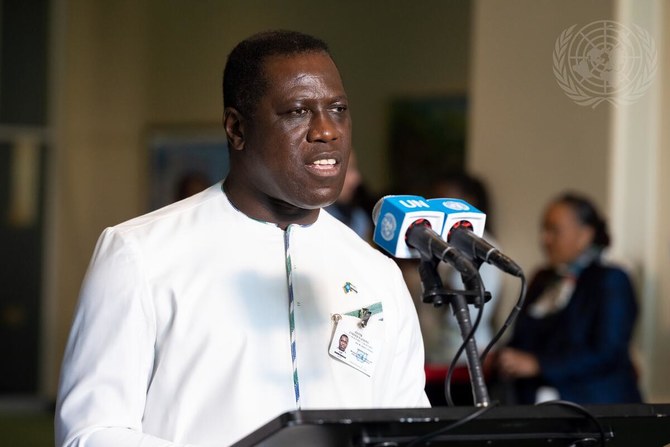

NEW YORK CITY: The world needs to be prepared for a new status quo, in which all nations have a voice, to emerge after the war in Ukraine ends, Sierra Leone’s foreign minister told Arab News on Tuesday.
David Francis said that “for the first time, those who have been marginalized, excluded, underrepresented or unrepresented in the permanent and non-permanent category of the UN Security Council are now saying ‘Our voice must be heard.’”
He was speaking at the UN headquarters in New York on Tuesday after the organization’s General Assembly elected his country a non-permanent member of the Security Council, the world body tasked with maintaining international peace and security. Sierra Leone was elected alongside Slovenia, Algeria, Guyana and the Republic of Korea to serve two-year tenures that will begin on Jan. 1, 2024.
The Security Council has 15 members, five of which, known as the P5, are permanent: China, France, Russia, the UK and the US. Each of them holds the power to veto any council resolution or decision.
The remaining 10, non-permanent members are elected by the 193-member General Assembly in a way that reflects the geographical distribution of member states by region.
Calls have intensified recently for Security Council reforms to ensure the positions of nations in the Global South are better represented and empower them to play a more significant role in efforts to solve their problems.
Francis said that 2024 will be “a defining year for the reform of the Security Council,” and the P5 are showing real commitment to the greater inclusion of regions that have long been sidelined, including Africa.
There are still question marks, however, over whether the five permanent members are truly open to the idea of a permanent seat for the African Union on the council and whether, short of that, reforms would have any significant meaning at all.
Asked by Arab News about these concerns, Francis said: “Well, things happened in the world: The Ukraine crisis, the prevailing geopolitics, and the emergence of the Global South solidarity is very important.
“We should not underestimate the Western countries themselves, but (also the) Russian Federation. In my discussions with European foreign ministers — the UK foreign secretary, the US deputy secretary of state, the French, (and) I’m just back from China; I had the same discussion with the Chinese foreign minister and a telephone conversation with Sergey Lavrov, the Russian foreign minister — there’s a general consensus that now is the time to reform the Security Council to make it fit for purpose to address the issue of the historic injustice and underrepresentation of regions such as Africa. So I am confident that we will make that move.”
The five newly elected council members will replace Albania, Brazil, Gabon, Ghana and the UAE, whose two-year terms end on Dec. 31, and join existing non-permanent members Ecuador, Japan, Malta, Mozambique and Switzerland.


