US defense secretary discusses upgrading ties with India to counter China 

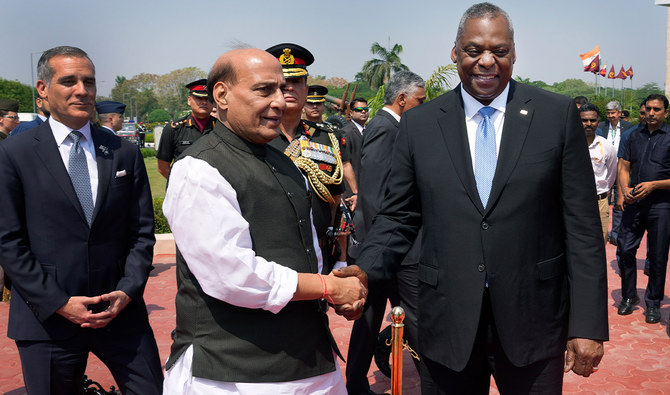
Indian Defense Minister Rajnath Singh, second left, welcomes U.S. Secretary of Defense, Lloyd Austin before their meeting, in New Delhi, India, on June 5, 2023. (AP)
Short Url
Updated 05 June 2023
Follow

US defense secretary discusses upgrading ties with India to counter China 

  • Lloyd Austin’s visit comes as India strengthens its domestic defense industry by acquiring new technologies 
  • Secretary Austin and his Indian counterpart explored ways of building resilient supply chains, New Delhi says 

NEW DELHI: US Defense Secretary Lloyd Austin on Monday discussed upgrading partnership with India, a major arms buyer, and set a roadmap for cooperation for the next five years as both countries grapple with China’s economic rise and increased belligerence, officials said. 

Austin’s visit comes as India strengthens its domestic defense industry by acquiring new technologies and reducing reliance on imports, particularly from Russia, its largest supplier of military hardware despite the ongoing war in Ukraine. 

Austin and his Indian counterpart, Rajnath Singh, explored ways of building resilient supply chains, a statement from India’s Defense Ministry said. They decided “to identify opportunities for the co-development of new technologies and co-production of existing and new systems and facilitate increased collaboration between defense startup ecosystems of the two countries.” 

They also discussed regional security issues given their shared interest in maintaining peace and stability in the Indo-Pacific, it said. 

“I’m returning to India to meet with key leaders for discussions about strengthening our Major Defense Partnership. Together, we’re advancing a shared vision for a free and open Indo-Pacific,” Austin tweeted after his arrival in New Delhi on Sunday. 

Austin, who is on his second visit to India, was expected to lay the groundwork for Prime Minister Narendra Modi’s visit to Washington on June 22, which has fueled speculation about a possible announcement of defense contracts. 

India is looking to buy 18 armed high-altitude long-endurance unmanned aerial vehicles from General Atomics Aeronautical Systems Inc. for an estimated $1.5 billion to $2 billion, said Rahul Bedi, a defense analyst. The UAVs would likely be deployed along its restive borders with China and Pakistan and in the strategic Indian Ocean region, Bedi said. 

Indian media reports said a joint production and manufacture of combat aircraft engines, infantry combat vehicles, howitzers and their precision ordnance were discussed last month in Washington at a meeting of the US-India Defense Policy Group. 

Austin arrived in New Delhi from Singapore, where he attended the Shangri-La Dialogue, an annual forum bringing together top defense officials, diplomats and leaders. Austin lobbied for support for Washington’s vision of a “free, open, and secure Indo-Pacific within a world of rules and rights” as the best course to counter increasing Chinese assertiveness in the region. 

China’s Defense Minister Gen. Li Shangfu said at the conference that the US has been “deceiving and exploiting” Asia-Pacific nations to advance its own self-interests to preserve “its dominant position.” 

Li suggested that Washington has been holding on to alliances that are “remnants of the Cold War” and establishing new pacts, like the AUKUS agreement with Britain and Australia and the Quad grouping with Australia, India and Japan, “to divide the world into ideologically-driven camps and provoke confrontation.” 

India is trying a balancing act in its ties with Washington and Moscow, and has been reducing its dependence on Russian arms by also buying from the US, France, Germany and other countries. 

The US defense trade with India has risen from near zero in 2008 to over $20 billion in 2020. Major Indian purchases from the United States included long-range maritime patrol aircraft, C-130 transport aircraft, missiles and drones. 

Experts say up to 60 percent of Indian defense equipment comes from Russia, and New Delhi finds itself in a bind at a time when it is facing a 3-year-old border standoff with China in eastern Ladakh, where tens of thousands of soldiers are stationed within shooting distance. Twenty Indian soldiers and four Chinese troops died in a clash in 2020. 


Venezuela begins ‘large’ prisoner release amid US pressure

Updated 4 sec ago
Follow

Venezuela begins ‘large’ prisoner release amid US pressure

  • The releases are the first since Maduro’s former deputy Delcy Rodriguez took over, with the backing of President Donald Trump
  • The releases were announced by Rodriguez’s brother, parliament speaker Jorge Rodriguez

CARACAS: Venezuela on Thursday began releasing a “large number” of political prisoners, including several foreigners, in an apparent concession to the United States after its ouster of ruler Nicolas Maduro.
The releases are the first since Maduro’s former deputy Delcy Rodriguez took over, with the backing of President Donald Trump, who says he is content to let her govern as long as she gives Washington access to oil.
The White House credited Trump with securing the prisoners’ freedom.
“This is one example of how the president is using maximum leverage to do right by the American and Venezuelan people,” Deputy Press Secretary Anna Kelly said in a statement to AFP.
The releases were announced by Rodriguez’s brother, parliament speaker Jorge Rodriguez, a key figure in “chavismo,” the anti-US socialist movement founded by Maduro’s predecessor Hugo Chavez.
He said “a large number of Venezuelan and foreign nationals” were being immediately freed for the sake of “peaceful coexistence.”
He did not say which prisoners would be released, nor how many or from where.
Renowned Spanish-Venezuelan activist Rocio San Miguel, imprisoned since February 2024 over a purported plot to assassinate Maduro, was among five Spanish citizens freed, according to Spain’s foreign ministry.
Security was stepped up Thursday afternoon outside the notorious El Helicoide detention center in Caracas, used by the intelligence services to jail political and other prisoners.
Miguel was held in El Helicoide after her arrest.
Leading opposition figure Alfredo Diaz, who died in December in custody, was also held at the facility.
Families gathered outside on Thursday for news of their loved ones.
“I’m nervous. Please God may it be reality,” the mother of a detained activist from the party of opposition leader Maria Corina Machado told AFP.
On Tuesday, Trump had told Republican lawmakers that Rodriguez’s administration was closing a torture chamber “in the middle of Caracas” but gave no further details.
His remarks had sparked speculation that Venezuelan authorities had agreed to close El Helicoide.
Venezuelan rights NGO Foro Penal estimates over 800 political prisoners are languishing in the country’s jails.
It welcomed the government’s plans to liberate some of them but was still verifying releases.
As tensions with Washington climaxed in the past month Venezuela had already released dozens of dissenters in two phases.

- Trump rebuked by Senate -

Thursday’s move by Caracas came as Trump suggested the United States could run Venezuela and tap into its oil reserves for years.
Shortly after Maduro’s seizure in US airstrikes and a special forces raid that left 100 people dead, according to Caracas, Trump announced that the US would “run” the Caribbean country for a transitional period.
“Only time will tell” how long Washington will demand direct oversight of the country, he told The New York Times in an interview published Thursday.
When asked whether that meant three months, six months or a year, he replied: “I would say much longer.”
Meanwhile, the US Senate on Thursday took a major step toward passing a resolution to rein in military actions against Venezuela.
The Democratic-led legislation, expected to pass a vote next week, reflects widespread disquiet among lawmakers over Saturday’s secretive capture of Maduro, conducted without their express approval.
It is expected to face resistance in the Republican-dominated House, however.

- Millions of barrels of crude -

Oil has emerged as the key to US control over Venezuela, which has the world’s largest proven reserves.
Trump announced a plan earlier this week for the United States to sell between 30 million and 50 million barrels of Venezuelan crude, with Caracas then using the money to buy US-made products.
Delcy Rodriguez on Wednesday called the US attack to depose Maduro, who was taken to New York with his wife to face trial on drugs charges, a “stain” on relations with the United States.
But she also defended the planned oil sales to Washington.
On the streets of Caracas, opinions remain mixed about the plan.
“I feel we’ll have more opportunities if the oil is in the hands of the United States than in the hands of the government,” said Jose Antonio Blanco, 26.
The Wall Street Journal reported that Trump, who will meet oil executives on Friday, is also considering a plan for the US to exert control over Venezuela’s state oil company PDVSA.
Trump has warned Rodriguez she will pay “a very big price, probably bigger than Maduro” if she does not comply with his agenda.
“Her power comes from Washington, not from the internal structure. If Trump decides she’s no longer useful, she’ll go like Maduro,” Venezuela’s former information minister Andres Izarra told AFP in an email.