

Venezuela begins ‘large’ prisoner release amid US pressure

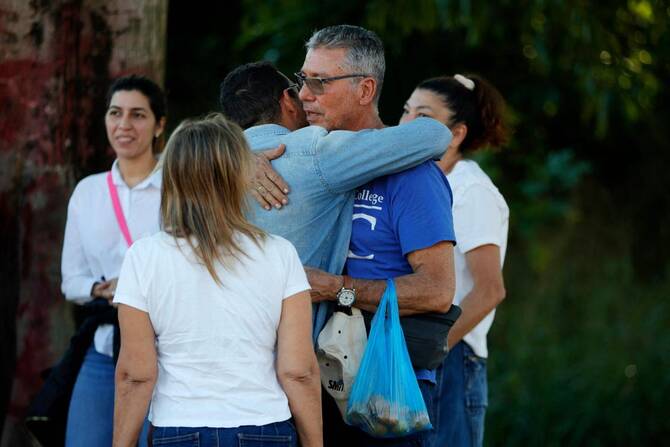
Relatives of prisoners hug each other as they wait in front of El Rodeo jail in Caracas on Jan. 8, 2026. (AFP)
Short Url
Updated 09 January 2026
Follow

Venezuela begins ‘large’ prisoner release amid US pressure

  • The releases are the first since Maduro’s former deputy Delcy Rodriguez took over, with the backing of President Donald Trump
  • The releases were announced by Rodriguez’s brother, parliament speaker Jorge Rodriguez

CARACAS: Venezuela on Thursday began releasing a “large number” of political prisoners, including several foreigners, in an apparent concession to the United States after its ouster of ruler Nicolas Maduro.
The releases are the first since Maduro’s former deputy Delcy Rodriguez took over, with the backing of President Donald Trump, who says he is content to let her govern as long as she gives Washington access to oil.
The White House credited Trump with securing the prisoners’ freedom.
“This is one example of how the president is using maximum leverage to do right by the American and Venezuelan people,” Deputy Press Secretary Anna Kelly said in a statement to AFP.
The releases were announced by Rodriguez’s brother, parliament speaker Jorge Rodriguez, a key figure in “chavismo,” the anti-US socialist movement founded by Maduro’s predecessor Hugo Chavez.
He said “a large number of Venezuelan and foreign nationals” were being immediately freed for the sake of “peaceful coexistence.”
He did not say which prisoners would be released, nor how many or from where.
Renowned Spanish-Venezuelan activist Rocio San Miguel, imprisoned since February 2024 over a purported plot to assassinate Maduro, was among five Spanish citizens freed, according to Spain’s foreign ministry.
Security was stepped up Thursday afternoon outside the notorious El Helicoide detention center in Caracas, used by the intelligence services to jail political and other prisoners.
Miguel was held in El Helicoide after her arrest.
Leading opposition figure Alfredo Diaz, who died in December in custody, was also held at the facility.
Families gathered outside on Thursday for news of their loved ones.
“I’m nervous. Please God may it be reality,” the mother of a detained activist from the party of opposition leader Maria Corina Machado told AFP.
On Tuesday, Trump had told Republican lawmakers that Rodriguez’s administration was closing a torture chamber “in the middle of Caracas” but gave no further details.
His remarks had sparked speculation that Venezuelan authorities had agreed to close El Helicoide.
Venezuelan rights NGO Foro Penal estimates over 800 political prisoners are languishing in the country’s jails.
It welcomed the government’s plans to liberate some of them but was still verifying releases.
As tensions with Washington climaxed in the past month Venezuela had already released dozens of dissenters in two phases.

- Trump rebuked by Senate -

Thursday’s move by Caracas came as Trump suggested the United States could run Venezuela and tap into its oil reserves for years.
Shortly after Maduro’s seizure in US airstrikes and a special forces raid that left 100 people dead, according to Caracas, Trump announced that the US would “run” the Caribbean country for a transitional period.
“Only time will tell” how long Washington will demand direct oversight of the country, he told The New York Times in an interview published Thursday.
When asked whether that meant three months, six months or a year, he replied: “I would say much longer.”
Meanwhile, the US Senate on Thursday took a major step toward passing a resolution to rein in military actions against Venezuela.
The Democratic-led legislation, expected to pass a vote next week, reflects widespread disquiet among lawmakers over Saturday’s secretive capture of Maduro, conducted without their express approval.
It is expected to face resistance in the Republican-dominated House, however.

- Millions of barrels of crude -

Oil has emerged as the key to US control over Venezuela, which has the world’s largest proven reserves.
Trump announced a plan earlier this week for the United States to sell between 30 million and 50 million barrels of Venezuelan crude, with Caracas then using the money to buy US-made products.
Delcy Rodriguez on Wednesday called the US attack to depose Maduro, who was taken to New York with his wife to face trial on drugs charges, a “stain” on relations with the United States.
But she also defended the planned oil sales to Washington.
On the streets of Caracas, opinions remain mixed about the plan.
“I feel we’ll have more opportunities if the oil is in the hands of the United States than in the hands of the government,” said Jose Antonio Blanco, 26.
The Wall Street Journal reported that Trump, who will meet oil executives on Friday, is also considering a plan for the US to exert control over Venezuela’s state oil company PDVSA.
Trump has warned Rodriguez she will pay “a very big price, probably bigger than Maduro” if she does not comply with his agenda.
“Her power comes from Washington, not from the internal structure. If Trump decides she’s no longer useful, she’ll go like Maduro,” Venezuela’s former information minister Andres Izarra told AFP in an email.


Greenland crisis boosts Danish apps designed to identify and help boycott US goods

Updated 4 sec ago
Follow

Greenland crisis boosts Danish apps designed to identify and help boycott US goods

  • Boycott campaigns are usually short-lived and real change often requires an organized effort rather than individual consumers
COPENHAGEN: The makers of mobile apps designed to help shoppers identify and boycott American goods say they saw a surge of interest in Denmark and beyond after the recent flare-up in tensions over US President Donald Trump’s designs on Greenland.
The creator of the “Made O’Meter” app, Ian Rosenfeldt, said he saw around 30,000 downloads of the free app in just three days at the height of the trans-Atlantic diplomatic crisis in late January out of more than 100,000 since it was launched in March.
Apps offer practical help
Rosenfeldt, who lives in Copenhagen and works in digital marketing, decided to create the app a year ago after joining a Facebook group of like-minded Danes hoping to boycott US goods.
“Many people were frustrated and thinking, ‘How do we actually do this in practical terms,’” the 53-year-old recalled. “If you use a bar code scanner, it’s difficult to see if a product is actually American or not, if it’s Danish or not. And if you don’t know that, you can’t really make a conscious choice.”
The latest version of “Made O’Meter” uses artificial intelligence to identify and analyze several products at a time, then recommend similar European-made alternatives. Users can set preferences, like “No USA-owned brands” or “Only EU-based brands.” The app claims over 95 percent accuracy.
“By using artificial intelligence, you can take an image of a product … and it can make a deep dive to go out and find the correct information about the product in many levels,” Rosenfeldt told The Associated Press during a demonstration at a Copenhagen grocery store. “This way, you have information that you can use to take decisions on what you think is right.”
‘Losing an ally’
After an initial surge of downloads when the app was launched, usage tailed off. Until last month, when Trump stepped up his rhetoric about the need for the US to acquire Greenland, a strategically important and mineral-rich Arctic island that is a semiautonomous territory of Denmark.
Usage peaked Jan. 23, when there were almost 40,000 scans in one day, compared with 500 or so daily last summer. It has dropped back since but there were still around 5,000 a day this week, said Rosenfeldt, who noted “Made O’Meter” is used by over 20,000 people in Denmark but also by people in Germany, Spain, Italy, even Venezuela.
“It’s become much more personal,” said Rosenfeldt, who spoke of “losing an ally and a friend.”
Trump announced in January he would slap new tariffs on Denmark and seven other European countries that opposed his takeover calls, only to abruptly drop his threats after he said a “framework” for a deal over access to mineral-rich Greenland was reached with NATO Secretary-General Mark Rutte’s help. Few details of that agreement have emerged.
The US began technical talks in late January to put together an Arctic security deal with Denmark and Greenland, which say sovereignty is not negotiable.
Rosenfeldt knows such boycotts won’t damage the US economy, but hopes to send a message to supermarkets and encourage greater reliance on European producers.
“Maybe we can send a signal and people will listen and we can make a change,” he added.
The protest may be largely symbolic
Another Danish app, “NonUSA,” topped 100,000 downloads at the beginning of February. One of its creators, 21-year-old Jonas Pipper, said there were over 25,000 downloads Jan. 21, when 526 product scans were performed in a minute at one point. Of the users, some 46,000 are in Denmark and around 10,000 in Germany.
“We noticed some users saying they felt like a little bit of the pressure was lifted off them,” Pipper said. “They feel like they kind of gained the power back in this situation.”
It’s questionable whether such apps will have much practical effect.
Christina Gravert, an associate professor of economics at the University of Copenhagen, said there are actually few US products on Danish grocery store shelves, “around 1 to 3 percent”. Nuts, wines and candy, for example. But there is widespread use of American technology in Denmark, from Apple iPhones to Microsoft Office tools.
“If you really want to have an impact, that’s where you should start,” she said.
Even “Made O’Meter” and “NonUSA” are downloaded from Apple’s App Store and Google’s Play Store.
Gravert, who specializes in behavioral economics, said such boycott campaigns are usually short-lived and real change often requires an organized effort rather than individual consumers.
“It can be interesting for big supermarket brands to say, OK, we’re not going to carry these products anymore because consumers don’t want to buy them,” she said. “If you think about large companies, this might have some type of impact on the import (they) do.”
On a recent morning, shoppers leaving one Copenhagen grocery store were divided.
“We do boycott, but we don’t know all the American goods. So, it’s mostly the well-known trademarks,” said Morten Nielsen, 68, a retired navy officer. “It’s a personal feeling … we feel we do something, I know we are not doing very much.”
“I love America, I love traveling in America,” said 63-year-old retiree Charlotte Fuglsang. “I don’t think we should protest that way.”