

Indian railways minister says signaling system error led to crash that killed over 300 people

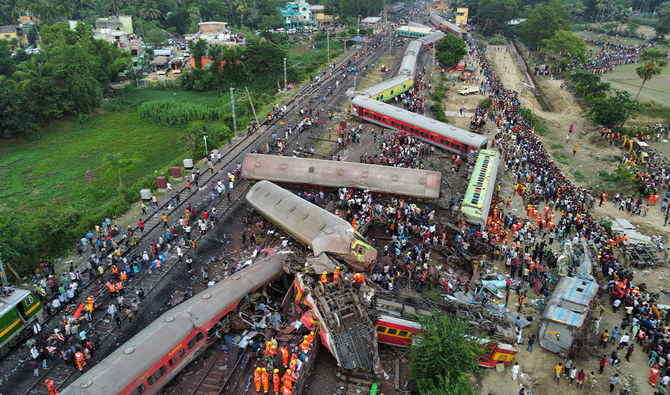
A drone view shows derailed coaches after trains collided in Balasore district in the eastern state of Odisha, India, on June 3, 2023. (REUTERS)
Short Url
Updated 04 June 2023
Follow

Indian railways minister says signaling system error led to crash that killed over 300 people

  • The explanation came as authorities worked to clear the mangled wreckage of the two passenger trains that derailed Friday night 
  • Preliminary investigations reveal a signal was given to Coromandel Express to enter the main track, but the signal was later taken off 

BALASORE: The train derailment in eastern India that killed more than 300 people and injured hundreds more was caused by an error in the electronic signaling system that led a train to wrongly change tracks, India’s railways minister said Sunday. 

’’Who has done it and what is the reason will come out of an investigation,” Ashwini Vaishnaw said in an interview with New Delhi Television network. 

The explanation came as authorities worked to clear the mangled wreckage of the two passenger trains that derailed Friday night in Balasore district of eastern Odisha state, in one of the country’s deadliest rail accidents in decades. 

The Press Trust of India news agency earlier reported that preliminary investigations revealed that a signal was given to the Coromandel Express to enter the main track line but the signal was later taken off. The train entered another line, known as the loop line, and crashed into a goods train parked there, PTI said. 

Fifteen bodies were recovered on Saturday evening and efforts continued overnight as heavy cranes were used to remove an engine that had settled on top of a rail car. No bodies were found in the engine and the work was completed on Sunday morning, said Sudhanshu Sarangi, director-general of fire and emergency services in Odisha. 

The accident occurred at a time when Prime Minister Narendra Modi is focusing on the modernization of the British colonial-era railroad network in India, which has become the world’s most populous country with 1.42 billion people. Despite government efforts to improve rail safety, several hundred accidents occur every year on India’s railways, the largest train network under one management in the world. 

Chaotic scenes erupted on Friday night as rescuers climbed atop the wrecked trains to break open doors and windows using cutting torches to try to save people who were trapped inside the rail cars. 

Modi visited the crash site on Saturday to examine the relief effort and talk to rescue officials. He also visited a hospital where he asked doctors about the treatments being given to the injured, and spoke to some of the patients. 

Modi told reporters he felt the pain of those who suffered in the accident. He said the government would do its utmost to help them and strictly punish anyone found responsible. 

Ten to 12 coaches of one train derailed, and debris from some of the mangled coaches fell onto a nearby track. The debris was hit by another passenger train coming from the opposite direction, causing up to three coaches of the second train to also derail, said Amitabh Sharma, a Railroad Ministry spokesperson. 

In 1995, two trains collided near New Delhi, killing 358 people in one of the worst train accidents in India. In 2016, a passenger train slid off the tracks between the cities of Indore and Patna, killing 146 people. 

Most train accidents in India are blamed on human error or outdated signaling equipment. 

More than 12 million people ride 14,000 trains across India every day, traveling on 64,000 kilometers (40,000 miles) of track. 


At top UN court, Myanmar denies deadly Rohingya campaign amounts to genocide

Updated 2 sec ago
Follow

At top UN court, Myanmar denies deadly Rohingya campaign amounts to genocide

  • The country defended itself Friday at the United Nations top court against allegations of breaching the genocide convention
  • Myanmar launched the campaign in Rakhine state in 2017 after an attack by a Rohingya insurgent group
THE HAGUE: Myanmar insisted Friday that its deadly military campaign against the Rohingya ethnic minority was a legitimate counter-terrorism operation and did not amount to genocide, as it defended itself at the top United Nations court against an allegation of breaching the genocide convention.
Myanmar launched the campaign in Rakhine state in 2017 after an attack by a Rohingya insurgent group. Security forces were accused of mass rapes, killings and torching thousands of homes as more than 700,000 Rohingya fled into neighboring Bangladesh.
“Myanmar was not obliged to remain idle and allow terrorists to have free reign of northern Rakhine state,” the country’s representative Ko Ko Hlaing told black-robed judges at the International Court of Justice.
Gambia filed genocide case in 2019
African nation Gambia brought a case at the court in 2019 alleging that Myanmar’s military actions amount to a breach of the Genocide Convention that was drawn up in the aftermath of World War II and the Holocaust.
Some 1.2 million members of the Rohingya minority are still languishing in chaotic, overcrowded camps in Bangladesh, where armed groups recruit children and girls as young as 12 are forced into prostitution. The sudden and severe foreign aid cuts imposed last year by US President Donald Trump shuttered thousands of the camps’ schools and have caused children to starve to death.
Buddhist-majority Myanmar has long considered the Rohingya Muslim minority to be “Bengalis” from Bangladesh even though their families have lived in the country for generations. Nearly all have been denied citizenship since 1982.
Myanmar denies Gambia claims of ‘genocidal intent’
As hearings opened Monday, Gambian Justice Minister Dawda Jallow said his nation filed the case after the Rohingya “endured decades of appalling persecution, and years of dehumanizing propaganda. This culminated in the savage, genocidal ‘clearance operations’ of 2016 and 2017, which were followed by continued genocidal policies meant to erase their existence in Myanmar.”
Hlaing disputed the evidence Gambia cited in its case, including the findings of an international fact-finding mission set up by the UN’s Human Rights Council.
“Myanmar’s position is that the Gambia has failed to meet its burden of proof,” he said. “This case will be decided on the basis of proven facts, not unsubstantiated allegations. Emotional anguish and blurry factual pictures are not a substitute for rigorous presentation of facts.”
Aung San Suu Kyi represented Myanmar at court in 2019. Now she’s imprisoned
Nobel Peace Prize winner Aung San Suu Kyi represented her country at jurisdiction hearings in the case in 2019, denying that Myanmar armed forces committed genocide and instead casting the mass exodus of Rohingya people from the country she led as an unfortunate result of a battle with insurgents.
The pro-democracy icon is now in prison after being convicted of what her supporters call trumped-up charges after a military takeover of power.
Myanmar contested the court’s jurisdiction, saying Gambia was not directly involved in the conflict and therefore could not initiate a case. Both countries are signatories to the genocide convention, and in 2022, judges rejected the argument, allowing the case to move forward.
Gambia rejects Myanmar’s claims that it was combating terrorism, with Jallow telling judges on Monday that “genocidal intent is the only reasonable inference that can be drawn from Myanmar’s pattern of conduct.”
In late 2024, prosecutors at another Hague-based tribunal, the International Criminal Court, requested an arrest warrant for the head of Myanmar’s military regime for crimes committed against the country’s Rohingya Muslim minority. Senior Gen. Min Aung Hlaing, who seized power from Suu Kyi in 2021, is accused of crimes against humanity for the persecution of the Rohingya. The request is still pending.