

Nearly 300 killed in one of India’s worst rail disasters in history

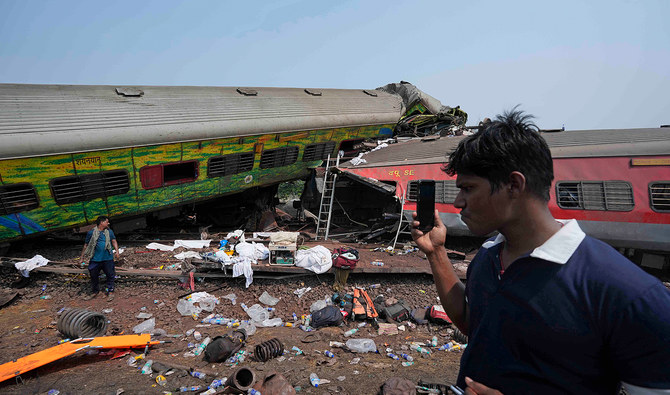
People inspect the site of passenger trains that derailed in Balasore district, in the eastern Indian state of Orissa, Saturday, June 3, 2023. (Photo courtesy: AP)
Short Url
Updated 03 June 2023
Follow

Nearly 300 killed in one of India’s worst rail disasters in history

  • Two trains carrying thousands of passengers collided with a freight train
  • Odisha observes day of mourning after the ‘unimaginable scale’ disaster

NEW DELHI: Nearly 300 people have died and hundreds of others were injured in eastern India when three trains collided in one of the worst rail disasters in the country’s history, authorities said on Saturday.

The accident took place in Balasore district of Odisha state on Friday, when the Coromandel Shalimar Express from Kolkata to Chennai derailed after hitting a parked freight train. Another train, the Howrah Superfast Express, traveling in the opposite from Yesvantpur to Howrah, then hit the overturned carriages.

The Coromandel Shalimar Express had 2,000 people on board and the Howrah Superfast Express at least 1,000, according to their passenger manifests.
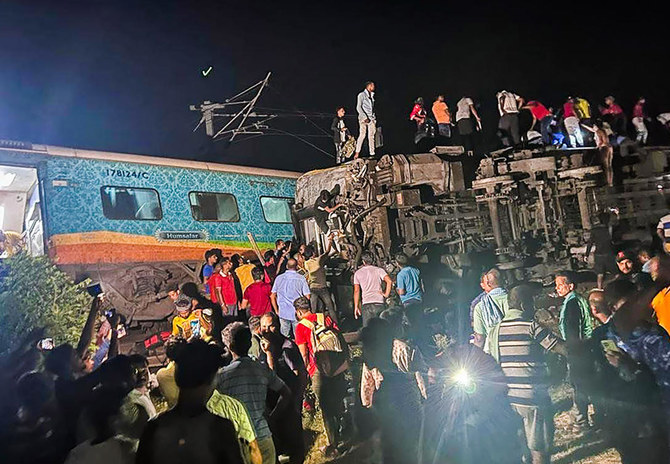


Rescuers work at the site of passenger trains that derailed in Balasore district, in the eastern Indian state of Orissa, on June 2, 2023. (AP)

The state government of Odisha sent 200 ambulances, hundreds of first responders to the scene as it mobilized dozens of doctors to attend to the injured as it said the accident was a “disaster of unimaginable scale.”

The South Eastern Railway which has jurisdiction over the area confirmed on Saturday afternoon that at least 261 people were killed in the crash.

“Another 650 injured passengers are being treated at various hospitals in Odisha,” SER spokesperson Aditya Chowdhury told reporters.

Rescuers who continued to dig through debris to find survivors feared that the toll might still increase.
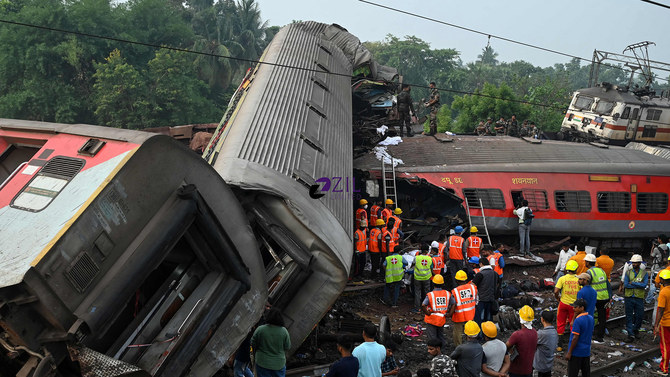


Rescue workers gather around damaged carriages at the accident site of a three-train collision near Balasore, about 200 km (125 miles) from the state capital Bhubaneswar in the eastern state of Odisha, on June 3, 2023. (AFP)

Dr. Sudhanshu Sarangi, director general of Odisha Fire Service, said the aftermath of the accident was “extremely distressing” and many of the rescued were critically injured.

“So many dead bodies, the smell, the rigor mortis, it’s its terrible. We won’t be able to sleep for a few nights. It’s a terrible tragedy,” he told Arab News.

A day of mourning was observed in Odisha on Saturday as top officials, including Prime Minister Narendra Modi and Railway Minister Ashwini Vaishnaw arrived in the crash site.

The accident has caused disruptions in the movement of hundreds of trains from eastern India to the rest of the country.

India has the largest network of railway tracks in the world with over 13 million people traveling 70,000 kilometers of track in more than 14,000 trains every day.

Each year several hundred accidents are recorded on the country’s railways, but the one in Odisha was the worst since August 1999, when two trains collided near Kolkata killing at least 285 people.

In August 1995, at least 350 people are killed when two trains collided 200km from Delhi.

The country’s worst train disaster took place in June 1981, when seven of the nine coaches of an overcrowded train fell into a river during a cyclone in the eastern state of Bihar. 
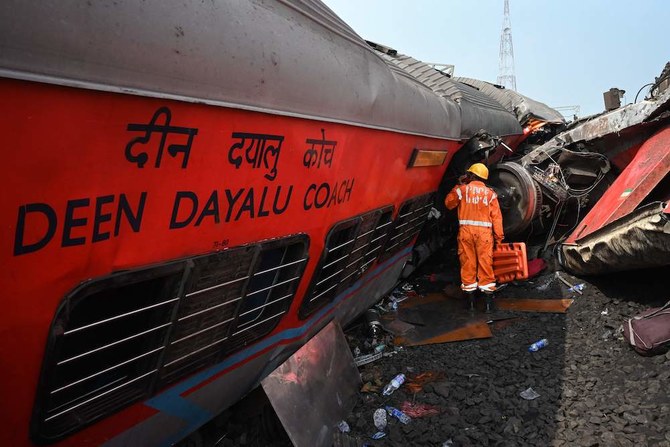


A rescue worker looks into a damaged carriage at the accident site of a three-train collision in Balasore district in the eastern Indian state of Odishaut. (AFP)


With murals, Indian artist transforms slums into ‘walls of learning’

Updated 5 sec ago
Follow

With murals, Indian artist transforms slums into ‘walls of learning’

  • Rouble Nagi won the $1 million Global Teacher Prize at Dubai summit last week
  • Her foundation set up 800 learning centers across more than 100 slums, villages 

New Delhi: It was about a decade ago that Rouble Nagi began painting the walls of Mumbai’s slums with art and colors, turning the neglected spaces where India’s low-income communities live into vibrancy.   

What started as a project of beautification quickly transformed into a mission of education through art, one that seeks to reach the most marginalized children in India. 

Together with a team of locals, volunteers and residents, Nagi started painting the slums with interactive murals, which she calls the “Living Walls of Learning,” as an alternative way to educate children.

“The ‘Living Walls of Learning’ is our answer to the lack of infrastructure within the education pillar. In these communities, traditional schools are often physically distant or psychologically intimidating. We solve this by turning the slum itself into a classroom,” Nagi told Arab News. 

An estimated 236 million people, or nearly half of India’s urban population, lived in slums in 2020, according to World Bank data. 

“The abandoned, broken or dilapidated walls (are transformed) into open-air classrooms using interactive murals created by the students themselves. These aren’t just paintings; they are visual curricula teaching literacy, numeracy, science and social responsibility,” she said, adding that the initiative “treats education as a living, breathing part of daily life.” 

Her Rouble Nagi Art Foundation has established more than 800 learning centers across more than 100 slums and villages in India, as the slum transformation initiative expanded beyond Mumbai and now includes parts of Maharashtra, the country’s second-most populous state. 

“These centers provide safe spaces for children to begin structured learning, receive remedial education, emotional support, and creative enrichment,” Nagi said. 

Over the years, RNAF said that it had helped bring more than one million children into formal education and reduced dropout rates by more than 50 percent, with the help of more than 600 trained educators.

Last week, the 40-year-old Indian artist and educator became the 10th recipient of the $1 million Global Teacher Prize, which she accepted at the World Governments Summit in Dubai.  

Nagi plans on using the money to build an institute that offers free vocational training and digital literacy. 

“This project aims to equip (marginalized children and young people) with practical skills for employment and self-reliance, helping transform their life chances,” she said. 

She believes that strengthening pathways from informal learning spaces to formal schooling and skill-based education can create “sustainable, long-term educational opportunities” that “empower learners to break cycles of poverty and become active contributors” to their communities. 

“For me, this award is not just personal; it is a validation of the work done by the entire Rouble Nagi Art Foundation team, our teachers, volunteers and the communities we work with,” she said.  

“It shines a global spotlight on children who are often invisible to the formal education system and affirms that creativity, compassion and persistence can transform lives.”