

Tunisian FM hails Italy’s support over IMF loan

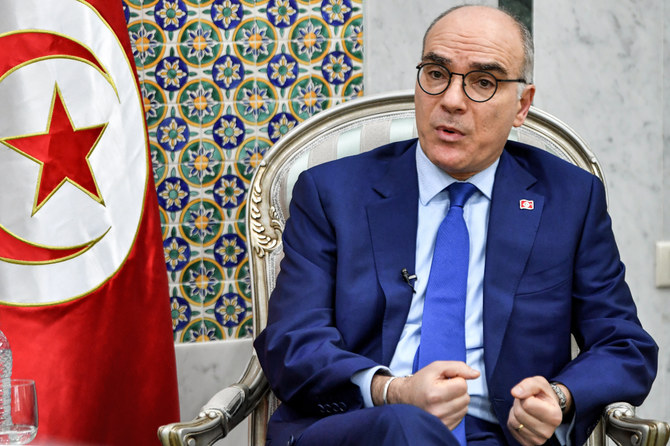
Tunisia’s foreign minister Nabil Ammar thanked Italy for efforts to explain Tunisia’s viewpoint regarding negotiations for IMF loan of nearly $1.9 billion. (File/AFP)
Short Url
Updated 03 June 2023
Follow

Tunisian FM hails Italy’s support over IMF loan

  • International Monetary Fund seeks govt reforms but Rome backs disbursement ‘without preconditions’
  • Prime Minister Giorgia Meloni to pay official visit to North African country next week

ROME: Tunisia’s foreign minister has hailed “Italy’s clear understanding of the … need to support the … economic recovery underway” in his country.

Nabil Ammar was speaking on Friday night at a ceremony in the residence of Italy’s ambassador in Tunis on the occasion of Italy’s National Day. The event was attended by representatives of Tunisia’s government and business community.

Ammar thanked Italy for all its efforts to explain Tunisia’s viewpoint to other countries regarding negotiations for a loan of nearly $1.9 billion from the International Monetary Fund.

The IMF requires Tunisia’s government to carry out a series of reforms before giving the loan. However, Tunisia is asking for a first tranche of funding to be released immediately by the IMF, while the rest of the loan can be paid in line with the progress of reforms.

Ammar described Italy’s backing of Tunisia on this point as “intelligent and constructive.” He recalled that Italian Prime Minister Giorgia Meloni urged the IMF at last month’s G7 Summit to adopt a “practical” approach to disbursing funds to Tunisia “without preconditions.”

Ammar stressed that the challenges facing all Mediterranean countries and others worldwide on migration “go beyond the capacities of individual states and require all of us to raise solidarity to the level of a fundamental value more quickly than ever before.”

He expressed his hope that the proposal by Tunisian President Kais Saied to organize a regional conference on migration will be accepted “so that this phenomenon can be effectively tackled in a way that takes account of the humanitarian dimension.”

Saied made the proposal during his meeting in Tunis with Italian Interior Minister Matteo Piantedosi on May 15.

Meloni and Saied on Friday night discussed bilateral relations during a phone call. According to a press release by Meloni’s office, she accepted Saied’s invitation to pay an official visit to Tunisia next week.


Gaza fuel running short after Israel closes borders amid Iran war

Gaza is wholly ‌dependent on fuel ‌brought in by trucks from Israel ​and ‌Egypt.
Updated 02 March 2026
Follow

Gaza fuel running short after Israel closes borders amid Iran war

  • Israel’s military closed all Gaza border crossings on Saturday after announcing air strikes on Iran carried out jointly with the US
  • Israeli authorities say the crossings cannot be operated safely during war

CAIRO/JERUSALEM: Gaza is rapidly running out of its limited fuel supply and stocks of food staples may become tight, officials say, after Israel blocked the ​entry of fuel and goods into the war-shattered territory, citing fighting with Iran.
Israel’s military closed all Gaza border crossings on Saturday after announcing air strikes on Iran carried out jointly with the United States. Israeli authorities say the crossings cannot be operated safely during war and have not said how long they would be shut.
Few days’ worth of supplies
Gaza is wholly ‌dependent on fuel ‌brought in by trucks from Israel ​and ‌Egypt ⁠and a ​lack ⁠of fresh supplies would put hospital operations at risk and threaten water and sanitation services, local officials say. Most Palestinians in Gaza are internally displaced after Israel’s two-year war with Hamas militants.
“I expect we have maybe a couple of days’ running time,” said United Nations official Karuna Herrmann, who directs fuel distribution in Gaza.
Amjad ⁠Al-Shawa, a Palestinian aid leader in Gaza, ‌who works with the UN and NGOs, ‌estimated fuel supplies could last three or ​four days, while stocks ‌of vegetables, flour, and other essentials could also soon run out ‌if the crossings remain shut.
Reuters was unable to independently verify those estimates.
Israel’s COGAT military agency, which controls access to Gaza, said that enough food had been delivered to the territory since the start of ‌an October truce to provide for the population.
“(The) existing stock is expected to suffice for ⁠an extended period,” ⁠COGAT said, without elaborating. It declined to comment on potential fuel shortages.
The truce was part of broader US-backed plan to end the war that involves reopening the Rafah border crossing with Egypt, increasing the flow of aid into the enclave, and rebuilding it.
Hamada Abu Laila, a displaced Palestinian in Gaza, said the closures were stoking fear of a return of famine, which gripped parts of the enclave last year after Israel blocked aid deliveries for 11 weeks.
“Why is it our fault, in ​Gaza, with regional wars ​between Israel, Iran, and America? It is not our fault,” Abu Laila said.