

Restoration lags for Syria’s famed Roman ruins at Palmyra and other war-battered historic sites

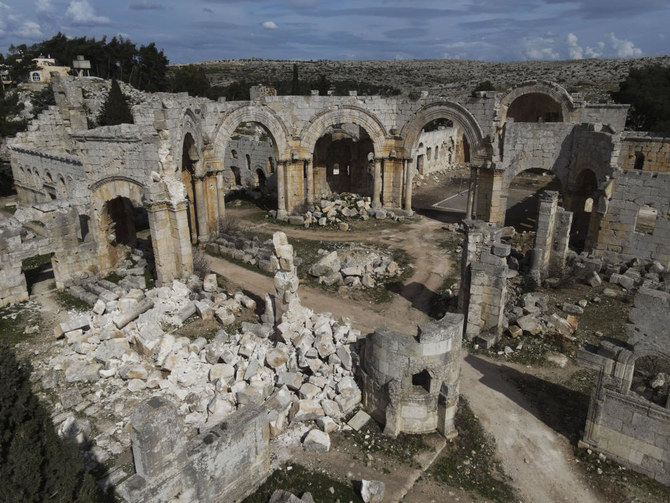
A general view of the Church of Saint Simeon, 30 kilometers (19 miles) northwest of Aleppo, Syra, is seen Wednesday, March 8, 2023. The Byzantine-era church suffered destruction during the war and was further damaged in the February 2023 earthquake, which hit Turkey and Syria. (AP Photo/Omar Albam)
Short Url
Updated 02 June 2023
Follow

Restoration lags for Syria’s famed Roman ruins at Palmyra and other war-battered historic sites

  • Many sites were damaged by the war and more recently by the deadly 7.8-magnitude earthquake that struck a wide area of neighboring Turkiye and also Syria in February.
  • Before the war, Palmyra — one of Syria’s six UNESCO world heritage sites — was the country’s archaeological crown jewel, a tourist attraction that drew tens of thousands of visitors each year

PALMYRA: At the height of the Daesh group’s rampage across Syria, the world watched in horror as the militants blew up an iconic arch and temple in the country’s famed Roman ruins in Palmyra.
Eight years later, Daesh has lost its hold but restoration work on the site has been held up by security issues, leftover IS land mines and lack of funding.
Other archaeological sites throughout Syria face similar problems, both in areas held by the government and by the opposition. They were damaged by the war or, more recently, by the deadly 7.8-magnitude earthquake that struck a wide area of neighboring Turkiye and also Syria in February.
Youssef Kanjou, a former director of Syria’s Aleppo National Museum, said the situation of heritage sites in his country is a “disaster.”
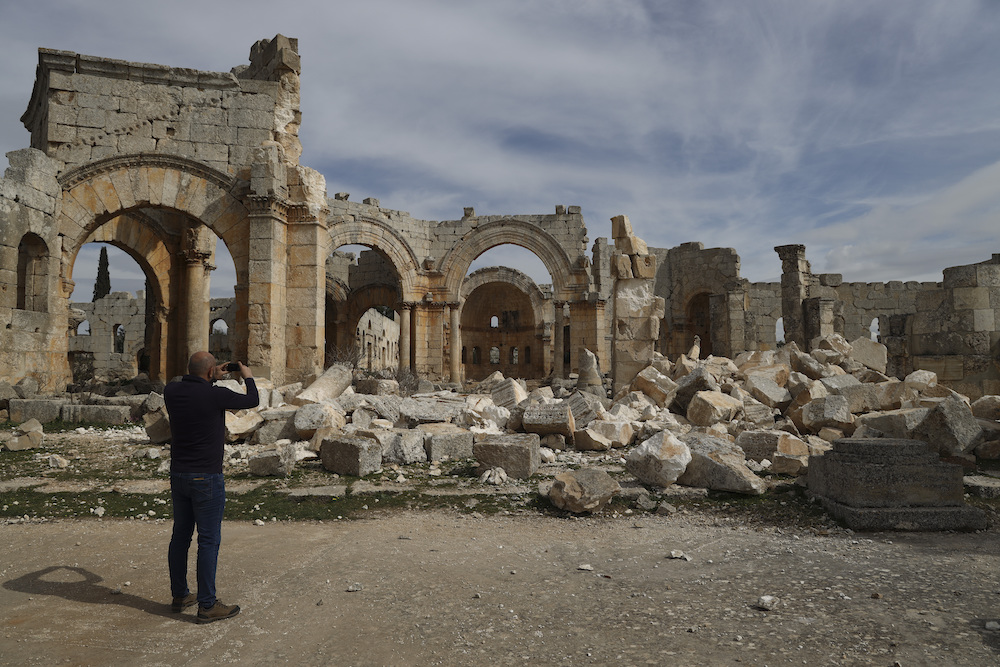

Without a coordinated preservation and restoration effort, said Kanjou, now a researcher at Tübingen University in Germany, “We will lose what was not destroyed by the war or the earthquake.”
Before the war, Palmyra — one of Syria’s six UNESCO world heritage sites — was the country’s archaeological crown jewel, a tourist attraction that drew tens of thousands of visitors each year. The ancient city was the capital of an Arab client state of the Roman Empire that briefly rebelled and carved out its own kingdom in the third century, led by Queen Zenobia.
In more recent times, the area had darker associations. It was home to the Tadmur prison, where thousands of opponents of the Assad family’s rule in Syria were reportedly tortured. IS demolished the prison after capturing the town.
The militants later destroyed Palmyra’s historic temples of Bel and Baalshamin and the Arch of Triumph, viewing them as monuments to idolatry, and beheaded an elderly antiquities scholar who had dedicated his life to overseeing the ruins.
Today, the road through the desert from Homs to Palmyra is dotted with Syrian army checkpoints. In the town adjacent to the ancient site, some shops have reopened, but signs of war remain in the form of charred vehicles and burned-out or boarded-up stores and houses.
The Palmyra Museum is closed, and the much-loved lion statue that used to stand in front of it has been moved to Damascus for restoration and safekeeping.
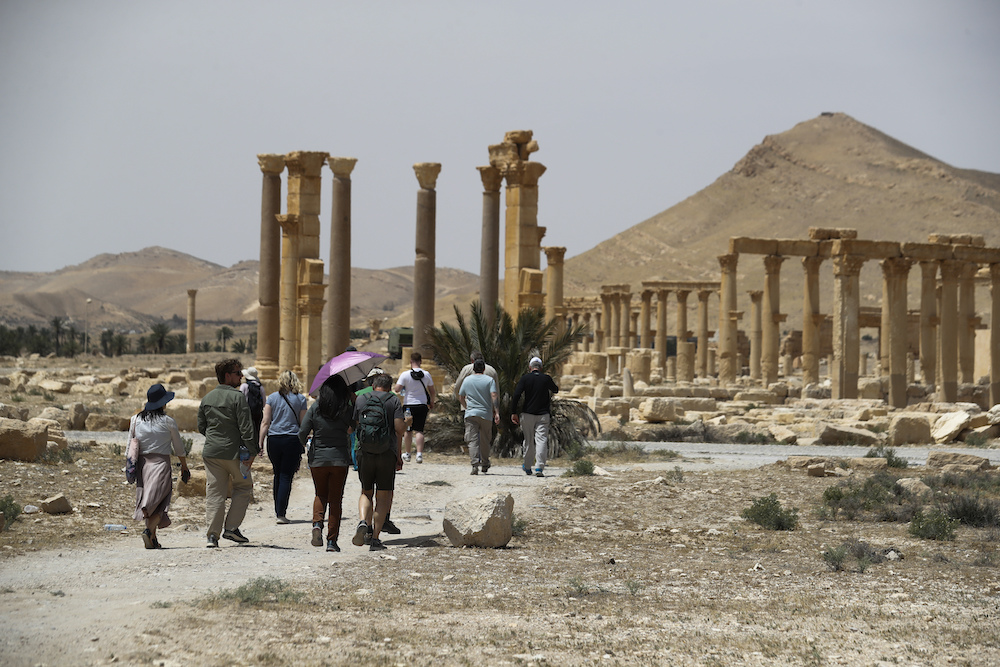
Nevertheless, Syrian and foreign tourists have begun to trickle back.

“We thought it was impossible that foreigners would return to Palmyra,” said Qais Fathallah, who used to run a hotel there but fled to Homs when IS took over. Now he is back in Palmyra, operating a restaurant, where he said he serves tourists regularly.
On a recent day, a group of tourists from countries including the United Kingdom, Canada and China, and another, with Syrian university students, were wandering through the ruins.
Some of the Syrian tourists had visited in better days. For communication engineering student Fares Mardini, it was the first time.
“Now I’ve finally come, and I see so much destruction. It’s something really upsetting,” he said. “I hope it can be restored and return to what it was.”
In 2019, international experts convened by UNESCO, the United Nations’ cultural agency, said detailed studies would need to be done before starting major restorations.
Youmna Tabet, program specialist at the Arab states unit of UNESCO’s World Heritage Center, said restoration work often involves difficult choices, particularly if there isn’t enough original material for rebuilding.
“Is it worth it to rebuild it with very little authenticity or should we rather focus on having 3D documentation of how it was?” she said.
Missions to the site were held up at first by security issues, including land mines that had to be cleared. IS cells still occasionally carry out attacks in the area.
Money is also a problem.
“There is a big lack of funding so far, for all the sites in Syria,” Tabet said, noting that international donors have been wary of breaching sanctions on Syria, which have been imposed by the United States, the European Union and others.
US sanctions exempt activities related to preservation and protection of cultural heritage sites, but sanctions-related obstacles remain, such as a ban on exporting US-made items to Syria.
Russia, an ally of Syrian President Bashar Assad’s government, has begun restoring Palmyra’s triumphal arch, the largest-scale project underway to date at the site.

“We have some funding from some friends in some places, but it is not sufficient in relation to the disaster that occurred,” said Mohammad Nazir Awad, director general of Syria’s department of Antiquities and Museums.
It doesn’t have to be this way, said Maamoun Abdulkarim, who headed the antiquities department at the time of the IS incursion. Abdulkarim pointed to the international push to recover damaged heritage sites in the city of Mosul in neighboring Iraq, also controlled by the militants for some time, as an example of a successful restoration.
“We need to make some separation between political affairs and cultural heritage affairs,” said Abdulkarim, now a professor at the University of Sharjah. He warned that damaged structures are in danger of deteriorating further or collapsing as the rehabilitation work is delayed.
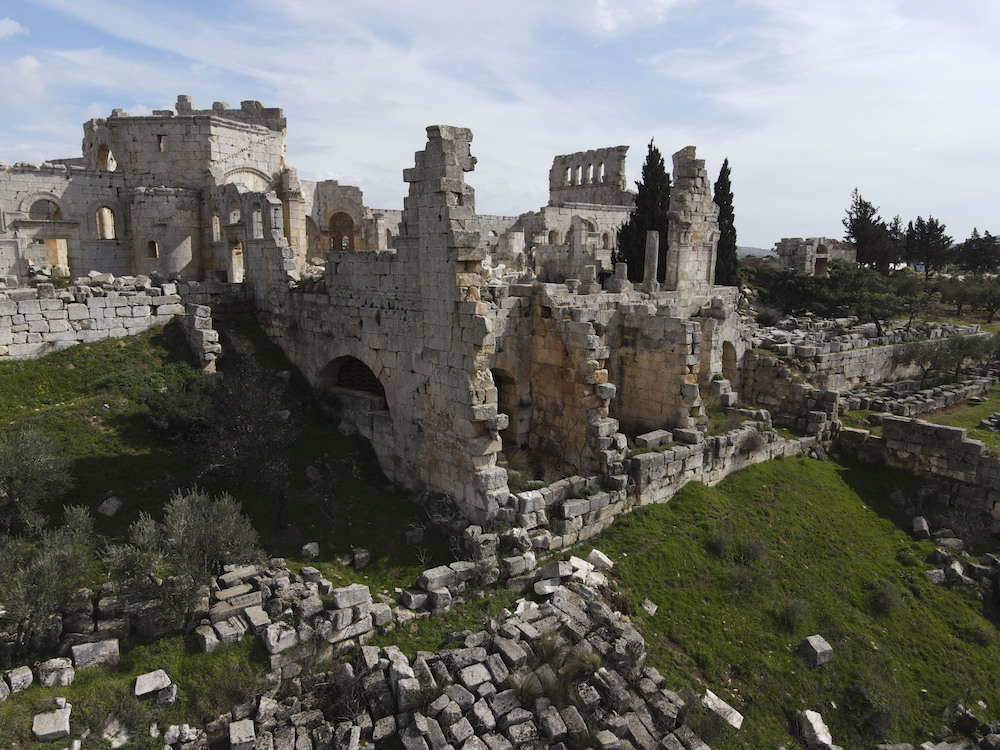
The deadly Feb. 6 earthquake caused further destruction at some sites already damaged by the war. This includes the old city of Aleppo, which is under the control of the government, and the Byzantine-era church of Saint Simeon in the Aleppo countryside, in an area controlled by Turkish-backed opposition forces.
About one-fifth of the church was damaged in the earthquake, including the basilica arch, said Hassan Al-Ismail, a researcher with Syrians for Heritage a non-governmental organization. He said the earthquake compounded earlier damage caused by bombings and vandalism.
The group tried to stabilize the structure with wooden and metal supports and to preserve the stones that fell from it for later use in restoration.
Ayman Al-Nabo, head of antiquities in the opposition-held city of Idlib, appealed for international assistance in stabilizing and restoring sites damaged by the earthquake.
Antiquities should be seen as “neutral to the political reality,” he said. “This is global human heritage, which belongs to the whole world, not just the Syrians.”


A Kurdish-majority neighborhood in Syria recovers from clashes with hope for the future

Updated 8 sec ago
Follow

A Kurdish-majority neighborhood in Syria recovers from clashes with hope for the future

ALEPPO: A month after clashes rocked a Kurdish-majority neighborhood in Syria ‘s second-largest city of Aleppo, most of the tens of thousands of residents who fled the fighting between government forces and the Kurdish-led Syrian Democratic Forces have returned — an unusually quick turnaround in a country where conflict has left many displaced for years.
“Ninety percent of the people have come back,” Aaliya Jaafar, a Kurdish resident of the Sheikh Maqsoud neighborhood who runs a hair salon, said Saturday. “And they didn’t take long. This was maybe the shortest displacement in Syria.”
Her family only briefly left their house when government forces launched a drone strike on a lot next door where weapons were stored, setting off explosions.
The Associated Press visited the community that was briefly at the center of Syria’s fragile transition from years of civil war as the new government tries to assert control over the country and gain the trust of minority groups anxious about their security.
Lessons learned
The clashes broke out Jan. 6 in the predominantly Kurdish neighborhoods of Sheikh Maqsoud, Achrafieh and Bani Zaid after the government and the SDF reached an impasse in talks on how to merge Syria’s largest remaining armed group into the national army. Security forces captured the neighborhoods after several days of intense fighting during which at least 23 people were killed and more than 140,000 people displaced.
However, Syria’s new government took measures to avoid civilians being harmed, unlike during previous outbreaks of violence between its forces and other groups on the coast and in the southern province of Sweida, during which hundreds of civilians from the Alawite and Druze religious minorities were killed in sectarian revenge attacks.
Before entering the contested Aleppo neighborhoods, the Syrian army opened corridors for civilians to flee.
Ali Sheikh Ahmad, a former member of the SDF-affiliated local police force who runs a secondhand clothing shop in Sheikh Maqsoud, was among those who left. He and his family returned a few days after the fighting stopped.
At first, he said, residents were afraid of revenge attacks after Kurdish forces withdrew and handed over the neighborhood to government forces. But that has not happened. A ceasefire agreement between Damascus and the SDF has been holding, and the two sides have made progress toward political and military integration.
“We didn’t have any serious problems like what happened on the coast or in Sweida,” Sheikh Ahmad said. The new security forces “treated us well,” and residents’ fears began to dissipate.
Jaafar agreed that residents had been afraid at first but that government forces “didn’t harm anyone, to be honest, and they imposed security, so people were reassured.”
The neighborhood’s shops have since reopened and traffic moves normally, but the checkpoint at the neighborhood’s entrance is now manned by government forces instead of Kurdish fighters.
Residents, both Kurds and Arabs, chatted with neighbors along the street. An Arab man who said he was named Saddam after the late Iraqi dictator — known for oppressing the Kurds — smiled as his son and a group of Kurdish children played with a dirty but friendly orange kitten.
Other children played with surgical staplers from a neighborhood hospital that was targeted during the recent fighting, holding them like toy guns. The government accused the SDF of taking over the hospital and using it as a military site, while the SDF said it was sheltering civilians.
One boy, looking pleased with himself, emerged from an alleyway carrying the remnant of an artillery shell.
Economic woes remain
On Friday, SDF leader Mazloum Abdi said he had held a “very productive meeting” with US Secretary of State Marco Rubio and Syrian Foreign Minister Asaad Al-Shibani on the sidelines of a security conference in Munich to discuss progress made on the integration agreement.
While the security situation is calm, residents said their economic plight has worsened. Many previously relied on jobs with the SDF-affiliated local authorities, who are no longer in charge. And small businesses suffered after the clashes drove away customers and interrupted electricity and other services.
“The economic situation has really deteriorated,” Jaafar said. “For more than a month, we’ve barely worked at all.”
Others are taking a longer view. Sheikh Ahmad said he hopes that if the ceasefire remains in place and the political situation stabilizes, he will be able to return to his original home in the town of Afrin near the border with Turkiye, which his family fled during a 2018 Turkish offensive against Kurdish forces.
Like many Syrians. Sheikh Ahmad has been displaced multiple times since mass protests against the government of then-President Bashar Assad spiraled into a brutal 14-year civil war.
Assad was ousted in November 2024 in an insurgent offensive, but the country has continued to see sporadic outbreaks of violence, and the new government has struggled to win the trust of religious and ethnic minorities.
Hopes for reconciliation
Last month, interim President Ahmad Al-Sharaa issued a decree strengthening the rights of Syria’s Kurdish minority, including recognizing Kurdish as a national language along with Arabic and adopting Nowruz, a traditional celebration of spring and renewal marked by Kurds around the region, as an official holiday. Kurds make up about 10 percent of Syria’s population.
The decree also restored the citizenship of tens of thousands of Kurds in northeastern Al-Hasakah province after they were stripped of it during the 1962 census
Sheikh Ahmad said he was encouraged by Al-Sharaa’s attempts to reassure the Kurds that they are equal citizens and hopes to see more than tolerance among Syria’s different communities.
“We want something better than that. We want people to love each other. We’ve had enough of wars after 15 years. It’s enough,” he said.