DAKAR: The United Nations and African Union called for calm in Senegal Friday after an outbreak of deadly violence that prompted authorities to deploy the army.
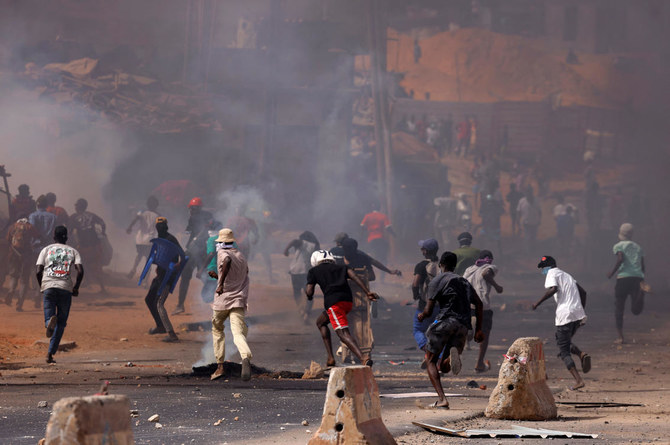
Nine people were killed on Thursday after popular opposition politician, Ousmane Sonko, was sentenced to two years in jail, which may take him out of the running in 2024 presidential elections.
UN Secretary-General Antonio Guterres condemned the violence and “urged all those involved to (...) exercise restraint,” a spokesman said.
The African Union said its commission president, Moussa Faki Mahamat, strongly condemned the violence and urged leaders to avoid acts which “tarnish the face of Senegalese democracy, of which Africa has always been proud.”
The Community of West African States (ECOWAS) called on all parties to “defend the country’s laudable reputation as a bastion of peace and stability.”
The EU and Senegal’s former colonial power France also expressed concern over the violence.
Sonko was convicted for “corrupting” a young woman, in a case which has deeply divided Senegal, usually a bastion of stability in West Africa.
After some of the worst political violence in years on Thursday, tensions remained high on Friday, with sporadic clashes reported in the capital and soldiers deployed on the streets.
Sonko, who was tried in absentia, has yet to be taken into custody for his jail term, which is likely to cause further tensions.
The streets of the capital were largely deserted, AFP journalists observed.
The government acknowledged that it had restricted access to social networks such as Facebook, WhatsApp and Twitter in order to stop “the dissemination of hateful and subversive messages.”
There was extensive destruction on the main university campus, where prolonged clashes took place on Thursday.
Students with suitcases lined the streets outside the university, struggling to find transportation after being told to leave campus.
“We didn’t expect this, political affairs shouldn’t concern us,” said Babacar Ndiaye, a 26-year-old student.
“But there is injustice,” he added, referring to Sonko’s conviction.
Since 2021, when Sonko was initially arrested, around 30 civilians have been killed in unrest largely linked to his legal affairs.
The government and the opposition blame each other for the violence.
Sonko was initially charged with rape and issuing death threats against an employee of a beauty salon where he said he received massages.
However, the court acquitted him on these charges and convicted him for “debauching” a person under the age of 21, without clarifying the immoral acts he is alleged to have committed.
Under the electoral code, the verdict would appear to render him ineligible for next year’s election.
Sonko has maintained his innocence and claims the president is trying to frame him to keep him out of next year’s election — a charge the government denies.
The head of the PASTEF-Patriots party could be arrested “at any time,” Justice Minister Ismaila Madior Fall told journalists after the ruling on Thursday.
Dakar residents interviewed by AFP said they feared the possible consequences of an arrest.
“If they arrest him, we have to fear the worst,” says Yankouba Sane, a university employee.
“If there’s one person who will never go to prison in Senegal, it’s Ousmane Sonko,” said Alioune Diop, a 46-year-old shopkeeper. “If they put him on trial, they’re going to make the situation worse.”
Sonko is presumed to remain in his Dakar home, where he has been blocked in by security forces since the weekend. He alleges he is being “illegally held.”
International football star Sadio Mane, who is Senegalese, and the Khalifa General of Medina Baye, Serigne Mahi Ibrahim Niass — an eminent religious dignitary — have also called for peace.
Amnesty International urged authorities to stop “arbitrary arrests” and lift restrictions on access to social networks.
The NGO Reporters Without Borders also called on authorities to fully restore Internet access.
“Socio-political violence must not be used as a pretext to restrict the right to inform,” it said.


![]()

UN, AU urge calm after deadly clashes in Senegal
Short Url
https://arab.news/68cby
UN, AU urge calm after deadly clashes in Senegal
- Nine people were killed on Thursday after popular opposition politician, Ousmane Sonko, was sentenced to two years in jail
- The EU and Senegal's former colonial power France also expressed concern over the violence


Latest updates




© 2026 SAUDI RESEARCH & PUBLISHING COMPANY, All Rights Reserved And subject to Terms of Use Agreement.