CAPE TOWN: South Africa attempted to shift attention away from its stance on the Ukraine conflict on Friday, as it hosted a BRICS meeting overshadowed by questions about a possible visit to the country by Russian President Vladimir Putin.
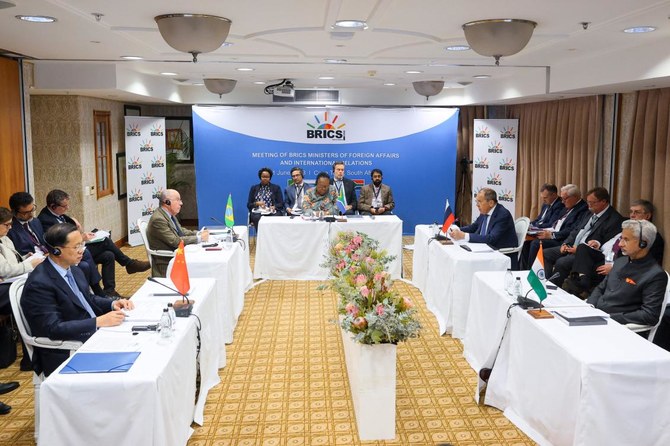
Top diplomats from Brazil, Russia, India, China and South Africa met in Cape Town for a second day of talks on the bloc’s ambition to provide an alternative to a western-led global order.
However the question of whether Putin would attend a subsequent gathering of the bloc in August, having been invited before an ICC arrest warrant was issued, has dominated this week’s meeting.
Putin is wanted by the International Criminal Court over accusations that Russia unlawfully deported Ukrainian children.
A member of the ICC with strong trade and economic relations with the United States and Europe, South Africa would be expected to arrest him if he sets foot in the country.
The issue has put Pretoria in a tight diplomatic spot, and ministers largely dodged a barrage of questions about Putin during the first day of discussions.
On Friday, South African Foreign Minister Naledi Pandor sought to shift focus away from Putin and the war in Ukraine.
“As countries gathered in this room today... we all represent together a significant majority of the world’s territory, population and economy,” Pandor said.
Representatives of about a dozen other nations, including Iran, Saudi Arabia, Cuba and Kazakhstan, attended in person or virtually, for a “Friends of BRICS” session.
On Thursday, BRICS ministers welcomed what they said was the interest expressed by numerous countries to join the bloc.
“We in this room need to determine a plan of action for our countries and for the world,” Pandor said in opening remarks on Friday.
“We cannot allow a conflict in one part of the world to replace the ambition of eradicating global poverty as the world’s greatest global challenge,” she added, in an apparent reference to the war in Ukraine.
Russia’s invasion of its neighbor has sent food and energy prices soaring in much of the world, exacerbating food insecurity in poor countries.
Pandor took a swing at western nations, saying the world has “faltered in cooperation” since rich countries’ “attention and resources” have been “diverted” by the war.
“The plight of the poor is forgotten and the great powers are engaged in world conflict,” she said. “We need to turn this around.”


South Africa avoids Vladimir Putin arrest dilemma at BRICS meeting
https://arab.news/mdjkg
South Africa avoids Vladimir Putin arrest dilemma at BRICS meeting

- Top diplomats from Brazil, Russia, India, China and South Africa meet for talks on the bloc’s ambition to provide an alternative to a western-led global order


Gordon Brown ‘regrets’ Iraq War support, new biography says
- Former UK PM claims he was ‘misled’ over evidence of WMDs
- Robin Cook, the foreign secretary who resigned in protest over calls for war, had a ‘clearer view’
LONDON: Former UK Prime Minister Gordon Brown regrets his failure to oppose Tony Blair’s push for war with Iraq, a new biography has said.
Brown told the author of “Gordon Brown: Power with Purpose,” James Macintyre, that Robin Cook, the former foreign secretary who opposed the war, had a “clearer view” than the rest of the government at the time.
Cook quit the Cabinet in 2003 after protesting against the war, claiming that the push to topple Saddam Hussein was based on faulty information over a claimed stockpile of weapons of mass destruction.
That information served as the fundamental basis for the US-led war but was later discredited following the invasion of Iraq.
Brown, chancellor at the time, publicly supported Blair’s push for war, but now says he was “misled.”
If Brown had joined Cook’s protest at the time, the campaign to avoid British involvement in the war may have succeeded, political observers have since said.
The former prime minister said: “Robin had been in front of us and Robin had a clearer view. He felt very strongly there were no weapons.
“And I did not have that evidence … I was being told that there were these weapons. But I was misled like everybody else.
“And I did ask lots of questions … and I didn’t get the correct answers,” he added.
“Gordon Brown: Power with Purpose,” will be published by Bloomsbury next month.