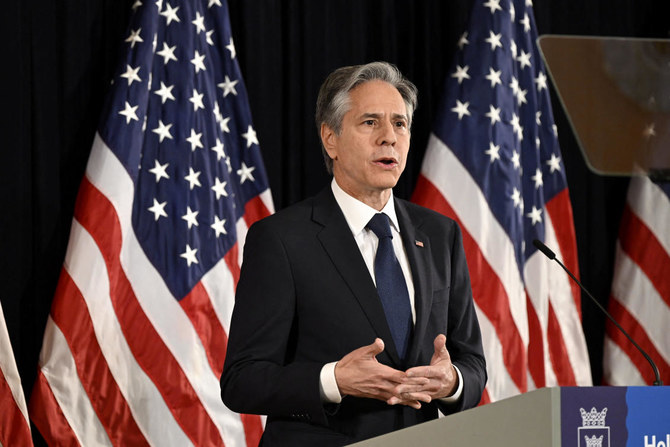
HELSINKI/WASHINGTON: US Secretary of State Antony Blinken said on Friday the United States was working with Ukraine and other allies to build consensus around the core elements of a “just and lasting peace” to end the war with Russia.
Washington would also encourage initiatives by other countries to bring about an end to the conflict, as long as they uphold the United Nations Charter and Ukraine’s sovereignty, territorial integrity and independence.
“We will support efforts – whether by Brazil, China, or any other nation – if they help find a way to a just and lasting peace,” Blinken said in a speech.
Still, Washington would continue to support Ukraine militarily as the prerequisite for meaningful diplomacy is that Kyiv is capable of deterring and defending against any future aggression.
“Putin’s war of aggression against Ukraine has been a strategic failure,” Blinken said.
Speaking in Finland, the NATO alliance’s newest member, Blinken said the US would help build a “Ukrainian military of the future.”
That meant “a modern air force, integrated air and missile defense, advanced tanks and armored vehicles, the national capacity to produce ammunition, and the training and support to keep forces and equipment combat ready.”

US seeks ‘just and lasting peace’ for Ukraine, Blinken says
https://arab.news/6c8qt
US seeks ‘just and lasting peace’ for Ukraine, Blinken says
- Washington would also encourage initiatives by other countries to bring about an end to the conflict
- ‘Putin’s war of aggression against Ukraine has been a strategic failure’
UNICEF warns of rise in sexual deepfakes of children
- The findings underscored the use of “nudification” tools, which digitally alter or remove clothing to create sexualized images
UNITED NATIONS, United States: The UN children’s agency on Wednesday highlighted a rapid rise in the use of artificial intelligence to create sexually explicit images of children, warning of real harm to young victims caused by the deepfakes.
According to a UNICEF-led investigation in 11 countries, at least 1.2 million children said their images were manipulated into sexually explicit deepfakes — in some countries at a rate equivalent to “one child in a typical classroom” of 25 students.
The findings underscored the use of “nudification” tools, which digitally alter or remove clothing to create sexualized images.
“We must be clear. Sexualized images of children generated or manipulated using AI tools are child sexual abuse material,” UNICEF said in a statement.
“Deepfake abuse is abuse, and there is nothing fake about the harm it causes.”
The agency criticized AI developers for creating tools without proper safeguards.
“The risks can be compounded when generative AI tools are embedded directly into social media platforms where manipulated images spread rapidly,” UNICEF said.
Elon Musk’s AI chatbot Grok has been hit with bans and investigations in several countries for allowing users to create and share sexualized pictures of women and children using simple text prompts.
UNICEF’s study found that children are increasingly aware of deepfakes.
“In some of the study countries, up to two-thirds of children said they worry that AI could be used to create fake sexual images or videos. Levels of concern vary widely between countries, underscoring the urgent need for stronger awareness, prevention, and protection measures,” the agency said.
UNICEF urged “robust guardrails” for AI chatbots, as well as moves by digital companies to prevent the circulation of deepfakes, not just the removal of offending images after they have already been shared.
Legislation is also needed across all countries to expand definitions of child sexual abuse material to include AI-generated imagery, it said.
The countries included in the study were Armenia, Brazil, Colombia, Dominican Republic, Mexico, Montenegro, Morocco, North Macedonia, Pakistan, Serbia, and Tunisia.


