

Ex-PM Khan to file defamation suit against Pakistan’s anti-corruption watchdog

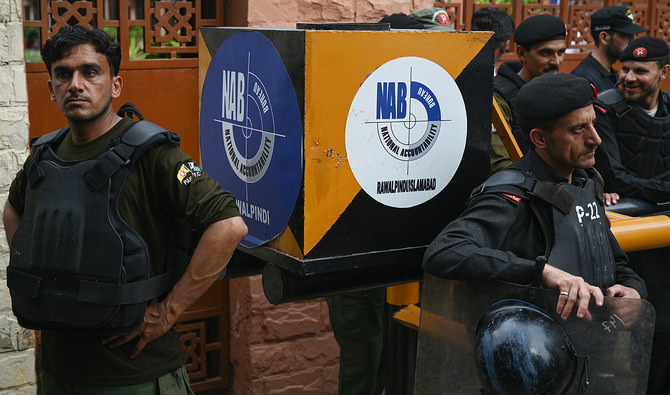
Pakistan's frontier constabulary personnel stand guard at the entrance of National Accountability Bureau (NAB) court, during the case hearing of former Pakistan's prime minister Imran Khan, in Islamabad on May 23, 2023. (Photo courtesy: AFP/File)
Short Url
Updated 02 June 2023
Follow

Ex-PM Khan to file defamation suit against Pakistan’s anti-corruption watchdog

  • The ex-PM is accused of receiving land in return for granting £190 million settlement to a real estate tycoon
  • His arrest in the case on May 9 sparked violent protests in Pakistan, prompting a clampdown by authorities

ISLAMABAD: Former prime minister Imran Khan said on Friday he had decided to file a Rs15 billion ($52.93 million) defamation suit against the chief of the country’s anti-corruption watchdog, weeks after his arrest in a graft case.

Khan was arrested by paramilitary troops in Islamabad on May 9 on the orders of officials of Pakistan’s National Accountability Bureau (NAB) in the Al-Qadir Trust land bribe case. He is accused of getting undue benefit from a Pakistani property tycoon, Malik Riaz Hussain, after granting him a settlement of £190 million seized by the United Kingdom’s National Crime Agency as part of a deal.

The Al-Qadir Trust, owned by Khan and his third wife Bushra Bibi, runs a university outside Islamabad devoted to spirituality and Islamic teachings. The project is inspired by Khan’s wife, who is as a spiritual leader. 

The government of PM Shehbaz Sharif says the trust was a front for Khan to receive valuable lands as a bribe from the real estate developer. The Al-Qadir Trust has nearly 60 acres of land worth Rs7 billion ($24.7 million) and another tract in Islamabad close to Khan’s hilltop home. The 60-acre parcel is the official site of the university, but quit a little has been built there. 

“I have decided to file a Rs15 Billion Defamation Suit, against Chairman, NAB. I have served Legal Notice upon him,” Khan wrote on Twitter.

“My Arrest Warrant was issued on a public holiday and was kept in secrecy for eight days. I was not informed about conversion of Al-Qadir Trust Case Inquiry into Investigation.”

To execute the warrant, Khan said, the paramilitary troops subjected him to “brute force,” while the motive behind his arrest was to defame him.

“To execute Arrest Warrant, Pakistan Rangers was used which subjected me to brute force,” he said.

“Ulterior motive was to defame me by arresting me from premises of Islamabad High Court. And show the world that I was arrested on corruption charges.”

Khan’s arrest, later declared “illegal” by the country’s top court, led to violent protests by his supporters in parts of Pakistan. The violence that targeted military installations, government buildings and law enforcement has since prompted a crackdown by authorities on Khan’s party. The ex-premier claims that thousands of his Pakistan Tehreek-e-Insaf (PTI) party’s supporters have been detained since the May 9 protests. 

Khan, who has been agitating for snap elections ever since he was ousted in a no-trust vote last year, has accused the government of attempting to “crush” his party through the clampdown ahead of the upcoming general elections. The government denies it. 


Pakistan increases Reko Diq investment to $244 million as Barrick reviews project

Updated 5 sec ago
Follow

Pakistan increases Reko Diq investment to $244 million as Barrick reviews project

  • State-owned PPL injects $50.2 million more in special purpose vehicle formed to manage Islamabad’s 25 percent stake in copper-gold mine
  • Canadian operator Barrick Mining Corporation this month ordered project’s review following deadly separatist attacks in Balochistan province

KARACHI: The state-run Pakistan Petroleum Limited (PPL) has invested an additional Rs14 billion ($50.2 million) equity in the multi-billion-dollar Reko Diq copper-gold mine, the company said in its latest financial report on Thursday, as the project’s Canadian operator reviews the project following recently deadly attacks. 

Canada’s Barrick Mining Corporation owns a 50 percent share in Reko Diq in the southwestern Balochistan province, along with three Pakistani federal state-owned enterprises including PPL that own 25 percent, while the Balochistan government has the remaining 25 percent share in the project.

The Canadian company announced earlier this month it planned to “immediately” begin a comprehensive review of all aspects of the Reko Diq project following coordinated attacks in Balochistan on Jan. 30-31 that killed 36 civilians and 22 security forces personnel. 

“With respect to the Reko Diq project, the company has made further equity investment in Pakistan Minerals Private Limited (PMPL) during the period amounting to Rs14,025 million ($50.2m),” PPL told its shareholders in its financial statement for the half year ending at Dec. 31.

The additional equity has increased PPL’s total cost of investment in the PMPL to Rs68.1 billion ($243.6 million), it added. 

The PMPL is a special purpose vehicle formed to manage the federal government’s 25 percent stake in the Reko Diq project. It is a consortium of three state-owned enterprises (SOEs) namely the PPL, the Oil & Gas Development Company Limited (OGDCL) and Government Holdings (Private) Limited (GHPL) which is responsible for handling financing, equity contributions and strategic, legal or technical dealings with partners like Barrick.

“The project continued to advance site works during the period (July-December FY26),” the PPL said. “The operator (Barrick) is undertaking a review of all aspects of the project, including with respect to the project’s security arrangements, development timetable and capital budget.” 

This week, Balochistan Chief Minister Sarfraz Bugti assured investors that Pakistan has the “capacity and capability” to secure the Reko Diq project amid surging militancy. 

The PPL explores, drills, and produces oil and natural gas. Its current portfolio, together with its subsidiaries and associates, consists of 47 exploratory blocks that include one offshore Block-5 in Abu Dhabi and one onshore block in Yemen.

In December, PPL signed a strategic Deed of Assignment under which it assigned 25 percent of its participating interest (PI) and operatorship of Eastern Offshore Indus C block to Turkish Petroleum Overseas Company, a unit of state-owned Türkiye Petrolleri Anonim Ortaklığı.

Assigning 20 percent PI each to OGDCL and Mari Energies Limited, the company has retained the remaining 35 percent PI to play a key role in the block’s development.