

Saudi authorities reveal plans for biggest Hajj organizational operation in history

1 / 2
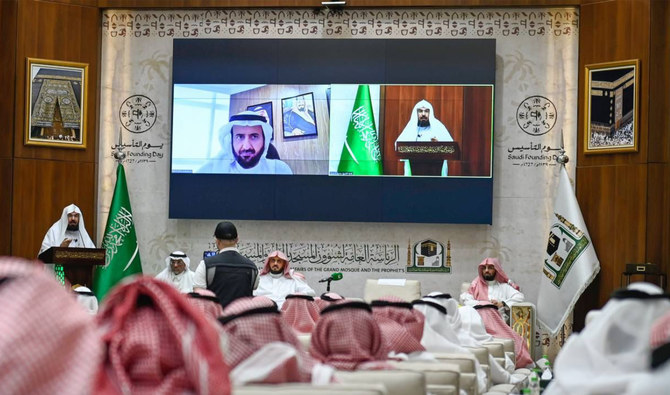
Dr. Abdulrahman Al-Sudais, president of the General Presidency for the Affairs of the Two Holy Mosques, noted that the focus for this year’s pilgrimage related to the government agency’s 2024 strategic goals based around Vision 2030. (Supplied)
2 / 2
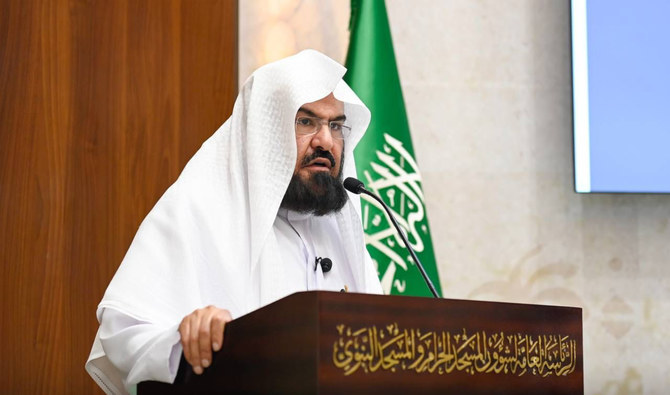
Dr. Abdulrahman Al-Sudais, president of the General Presidency for the Affairs of the Two Holy Mosques, noted that the focus for this year’s pilgrimage related to the government agency’s 2024 strategic goals based around Vision 2030. (Supplied)
Short Url
Updated 01 June 2023
Follow

Saudi authorities reveal plans for biggest Hajj organizational operation in history

  • A record 14,000 staff, along with thousands of volunteers, will be deployed in the Two Holy Mosques

MAKKAH: Saudi religious authorities on Thursday revealed plans for the biggest-ever organizational operation in Hajj season history.

A record 14,000 staff, along with thousands of volunteers, will be deployed in the Two Holy Mosques to handle the millions of worshippers taking part in the pilgrimage.

Making the announcement, Dr. Abdulrahman Al-Sudais, president of the General Presidency for the Affairs of the Two Holy Mosques, noted that the focus for this year’s pilgrimage related to the government agency’s 2024 strategic goals based around Vision 2030.

Speaking in the presence of Saudi Minister of Hajj and Umrah Tawfiq Al-Rabiah, he said: “We are pleased to announce our operational plan for this Hajj season, considered the largest in the history of the presidency and its agency for the affairs of the Prophet’s Mosque, now that the COVID-19 (coronavirus) pandemic has come to an end and that millions of pilgrims are expected.

“The operational plan will be conducted in accordance with an integrated services system set by our leaders,” he added.

Al-Sudais pointed out that the plan, drawn up based on the experiences of previous seasons, had been a year in the making.

Thousands of volunteering opportunities will be made available, and 300,000 copies of the Qur’an will be distributed between the Grand Mosque in Makkah and the Prophet’s Mosque in Madinah.

More than 35,000 hours of Qur’an recitation and memorization teaching workshops will be run, along with round-the-clock scientific and orientation broadcasts in 10 languages.

And arrangements have been made to provide translation services, guidance, and answers to pilgrims’ questions in 51 languages.

Al-Sudais said that the presidency aimed to distribute 40 million liters of Zamzam water in the Two Holy Mosques via more than 30,000 distribution points, and at least 2 million bottles on a daily basis.

In addition, digital technology, apps, and robots would be employed to help improve the worshipper experience.


SR 4.5bn raised from 135m donations through the Saudi Ehsan charity platform in 2025

Updated 4 sec ago
Follow

SR 4.5bn raised from 135m donations through the Saudi Ehsan charity platform in 2025

  • More than 330m donations made on the platform over past 5 years worth a total of SR14bn, officials reveal in run-up to 6th National Campaign for Charitable Work
  • In addition, the Jood Eskan platform that helps low-income families secure housing has raised SR5bn from 4.5m donors since its launch in 2019

RIYADH: Ahead of the launch on March 3 of the sixth National Campaign for Charitable Work on the Ehsan platform, officials on Monday revealed that more than SR4.5 billion ($1.2 billion) was donated through the platform in 2025 alone.

Abdullah Alghamdi, president of the Saudi Data and Artificial Intelligence Authority, said there were 135 million donations last year worth a total daily average of SR12.45 million, compared with about SR2.8 million during the platform’s first campaign in 2021.

Over the past five years, he added, more than 330 million donations have been made through Ehsan, worth a total of SR14 billion.

The platform was built on three main pillars, Alghamdi said: reliability, transparency and ease of use. It uses advanced data analytics and artificial intelligence to verify beneficiary eligibility and prevent duplication of support, he added, and a donation can be completed in less than five seconds.

It was built to “humanize the donation journey,” he said, by ensuring donors can see the direct effects of their contributions, and operates under a framework of governance that includes 13 supervisory entities and five subcommittees.

The Ehsan Waqf Fund, which was introduced to ensure long-term sustainability, so far has collected SR2.2 billion of a SR5 billion target, Alghamdi said.

Majed Al-Hogail, the minister of municipalities and housing, highlighted the expanding role of nonprofit organizations in the housing sector in particular. More than 313 nonprofits now operate within the system, he said, supported by more than 345,000 volunteers working alongside public and private organizations.

Housing initiatives have helped support more than 106,000 families eligible for assistance, he added, and prevented more than 200,000 households from losing their homes. In addition, a rent-support program is assisting about 6,600 families this year, “expanding the reach of support to more households.”

The Jood Eskan housing platform, which enables donors to help people on low incomes secure housing, began by supporting 100 families and now serves more than 50,000 across the Kingdom, Al-Hogail said. Since its launch in 2019, more than 4.5 million donors have contributed more than SR5 billion to housing initiatives, he added.

“This transformation is the result of cumulative efforts built on clear governance, precise eligibility criteria, and electronic integration with relevant entities,” Al-Hogail said.

He also highlighted digital-transformation efforts designed to accelerate the provision of assistance, including the linking of a debt defaulters support platform to the Ministry of Justice, which has reduced processing times for cases from a month to 19 days. Meanwhile an electronic signature service cut the processing time for property-ownership procedures from 14 days to just two.

“In 2025, more than 150,000 digital operations were implemented and the needs of over 400,000 beneficiary families were studied through the integration of national databases,” Al-Hogail said.