

At Pakistan army facility, breeding Arabian horses is a passion and a science

1 / 3
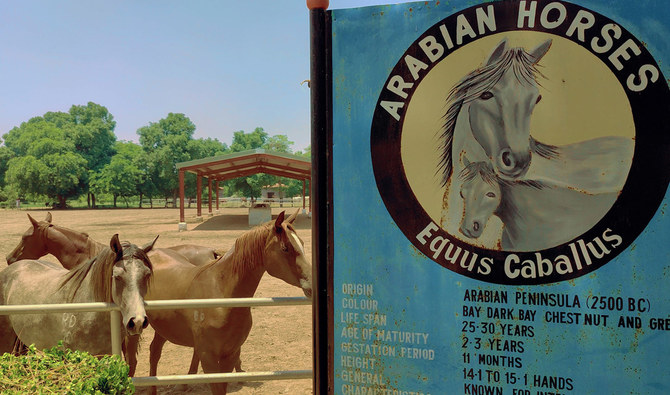
Arabian horses are seen at Remount Depot Mona in Mandi Bahauddin, Punjab, Pakistan on May 27, 2023. (AN photo)
2 / 3
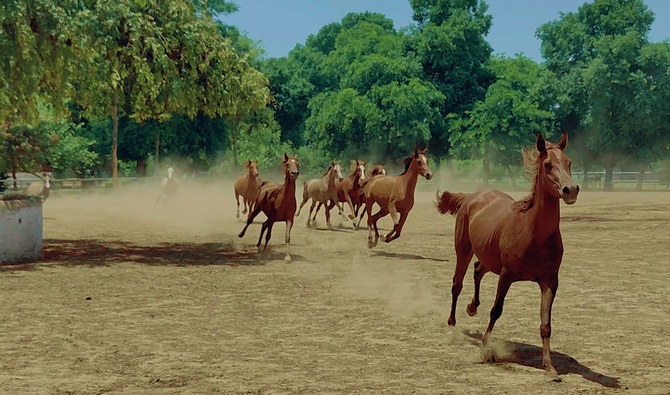
Arabian horses are seen at Remount Depot Mona in Mandi Bahauddin, Punjab, Pakistan on May 27, 2023. (AN photo)
3 / 3
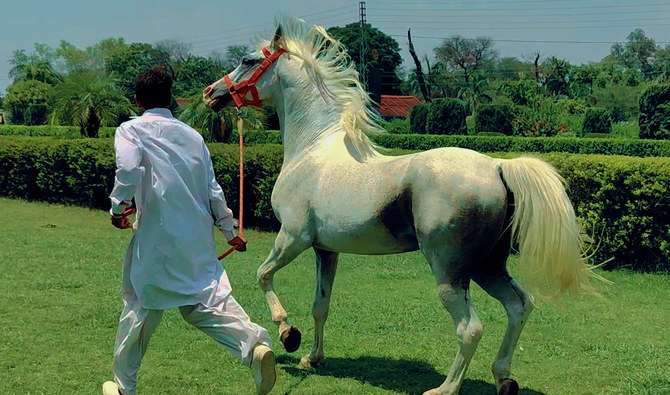
Arabian horses are seen at Remount Depot Mona in Mandi Bahauddin, Punjab, Pakistan on May 27, 2023. (AN photo)
Short Url
Updated 31 May 2023
Follow

At Pakistan army facility, breeding Arabian horses is a passion and a science

  • Over 600 Arabians at Remount Depot Mona are trained for equestrian games and dressage events
  • Archeological evidence suggests the Arabian horse dates back over 4,500 years in the Middle East

MONA: With its long, arched neck, refined wedge-shaped head and high tail carriage, the Arabian is one of the most easily recognizable horse breeds in the world. 

It is also one of the most ancient, with archaeological evidence available of horses in the Middle East that resemble modern Arabians dating back over 4,500 years. 

In Pakistan, over 600 Arabians can be found at the Remount Depot Mona military facility located in Mandi Bahauddin, with the animals specially trained for equestrian games and dressage events. 

Founded in 1902, the depot is spread over 10,000 hectares of land, complete with roads, buildings, a canal and a train line, and serves as a hub for breeding and nurturing horses, donkeys and mules. 

Pakistan started importing Arabian horses almost 70 years ago, often placing them in competitions as prized show animals and keeping a pool as gifts for foreign dignitaries. 

“Pakistan has 808 Arab horses, which are registered with the World Arabian Horse Organization,  of which 627 animals are from the Remount Depot Mona while only 181 are from all over the country,” Brig. Mohammed Naeem, the commandant of the depot, told Arab News during a visit to the facility last week.

WAHO, founded in 1970, is a UK-based charity with 82 affiliated countries that works to preserve pure Arabian bloodlines, promote breeding knowledge globally, coordinate member clubs, establish uniformity in breed terminology, and consult on other Arabian horse-related matters. 

But what makes the Arabian horse so special?

“Among known breeds of horses, the most ancient breed is the Arabian horse, which originated around 2,500 B.C. from the Arab Peninsula,” Naeem said, adding that the animals were renowned for their “exceptional beauty,” particularly when they ran and raised their tails, showing off their “elegant form.” 

Even though the precise origins of the Arabian are unknown, the breed is thought to have originated on the northern edge of the Syrian desert.
“They are widely recognized as one of the most famous horse breeds in the world,” Naeem added.

Pakistan became a member of WAHO in 1997, with Mona Remount Depot its sole representative in the country. While horse breeding at the depot began as a passion in 1956, the depot successfully turned to science in 2021 when it launched a test tube program. 

“At our facility, we have successfully witnessed the birth of 15 test tube babies thus far, with an additional 12 pregnancies currently ongoing,” Naeem said. 

The first Arab horse at the depot was imported in 1955 from the US and 31 others after that from different countries. 

“The price of an imported Arabian horse varies from $5,000 to $50,000, depending on the quality and pedigree of the animal,” Naeem said. 

“The expenses for importing also vary depending on the country of origin and whether the animal is transported in a single cage or a group cage. From Gulf states, it costs around $10,000, while from Western countries and the US, it can cost up to $20,000.” 

At the depot, the brigadier said, the cost of breeding, raising, and training an Arabian was “significantly lower due to locally produced fodder and other factors.” 

Naeem explained: “The budget of the depot is provided by the Ministry of Defense.” 

A pool of Arab horses, the brigadier said, was also kept to be presented as gifts by the Pakistani government and army to visiting dignitaries. 

“Thirty-six animals have been presented to different heads of state, including of Saudi Arabia, the UAE, Qatar, Bangladesh, Sri Lanka, and other countries,” Naeem said.  

The rulers of Jordan, Qatar, and Saudi Arabia had gifted horses to Pakistani rulers also at different points over the last decades. 

“King Faisal gifted an Arabian horse to Gen. Mohammed Zia ul Haq,” he said, referring to the Pakistani military officer, who was the sixth president of Pakistan, “and the Saudi king also gifted a horse to Gen. Pervez Musharraf,” he said. Musharraf was the 10th president of Pakistan. 

Horses given as gifts to Pakistani rulers were always kept at the depot, Naeem said.

According to experts, the Arabian is classified as a “hot-blooded” breed, with its sensitivity and intelligence enabling quick learning and greater communication with riders. This is why the breed is trained for equestrian games such as riding, dressage, polo, and tent pegging. 

“We have horses specifically trained for show jumping and vaulting, which are used for various functions,” Naeem said. 

One of the depot’s Arabian horses won the best polo pony prize in Pakistan six times, the brigadier added. 

“These horses are highly responsive animals,” said Mohammed Rasaldar, a trainer at the facility who runs daily training sessions with the animals that start at 6 a.m. and continue through the day. “The more love and attention they receive, the more attached and responsive they become. 

“We have a 39-week-long training course for them, during which we expose them to various environments to eliminate their fears…They also receive training for different games throughout this course.” 

Mohammed Akhtar, who trains the horses for polo, said the animals respond to every command. 

“A horse is a very powerful animal,” he said, “and man can control it only by training it with a lot of love and compassion.” 


House votes to slap back Trump’s tariffs on Canada in rare bipartisan rebuke

Updated 12 February 2026
Follow

House votes to slap back Trump’s tariffs on Canada in rare bipartisan rebuke

WASHINGTON: The House voted Wednesday to slap back President Donald Trump’s tariffs on Canada, a rare if largely symbolic rebuke of the White House agenda as Republicans joined Democrats over the objections of GOP leadership.
The tally, 219-211, was among the first times the House, controlled by Republicans, has confronted the president over a signature policy, and drew instant recrimination from Trump himself. The resolution seeks to end the national emergency Trump declared to impose the tariffs, though actually undoing the policy would require support from the president, which is highly unlikely. It next goes to the Senate.
Trump believes in the power of tariffs to force US trade partners to the negotiating table. But lawmakers are facing unrest back home from businesses caught in the trade wars and constituents navigating pocketbook issues and high prices.
“Today’s vote is simple, very simple: Will you vote to lower the cost of living for the American family or will you keep prices high out of loyalty to one person — Donald J. Trump?” said Rep. Gregory Meeks of New York, the top Democrat on the House Foreign Affairs Committee, who authored the resolution.
Within minutes, as the gavel struck, Trump fired off a stern warning to those in the Republican Party who would dare to cross him.
“Any Republican, in the House or the Senate, that votes against TARIFFS will seriously suffer the consequences come Election time, and that includes Primaries!” the president posted on social media.
The high-stakes moment provides a snapshot of the House’s unease with the president’s direction, especially ahead of the midterm elections as economic issues resonate among voters. The Senate has already voted to reject Trump’s tariffs on Canada and other countries in a show of displeasure. But both chambers would have to approve the tariff rollbacks, and send the resolution to Trump for the president’s signature — or veto.
Six House Republicans voted for the resolution, and one Democrat voted against it.
From Canada, Ontario, Premier Doug Ford on social media called the vote “an important victory with more work ahead.” He thanked lawmakers from both parties “who stood up in support of free trade and economic growth between our two great countries. Let’s end the tariffs and together build a more prosperous and secure future.”
Trump recently threatened to impose a 100 percent tariff on goods imported from Canada over that country’s proposed China trade deal, intensifying a feud with the longtime US ally and Prime Minister Mark Carney.
GOP defections forced the vote
House Speaker Mike Johnson tried to prevent this showdown.
Johnson insisted lawmakers wait for a pending Supreme Court ruling in a lawsuit about the tariffs. He engineered a complicated rules change to prevent floor action. But Johnson’s strategy collapsed late Tuesday, as Republicans peeled off during a procedural vote to ensure the Democratic measure was able to advance.
“The president’s trade policies have been of great benefit,” Johnson, R-Louisiana, had said. “And I think the sentiment is that we allow a little more runway for this to be worked out between the executive branch and the judicial branch.”
Late Tuesday evening, Johnson could be seen speaking to holdout Republican lawmakers as the GOP leadership team struggled to shore up support during a lengthy procedural vote, but the numbers lined up against him.
“We’re disappointed,” Kevin Hassett, the director of the White House’s National Economic Council, told reporters at the White House on Wednesday morning. “The president will make sure they don’t repeal his tariffs.”
Terminating Trump’s emergency
The resolution put forward by Meeks would terminate the national emergency that Trump declared a year ago as one of his executive orders.
The administration claimed illicit drug flow from Canada constitutes an unusual and extraordinary threat that allows the president to slap tariffs on imported goods outside the terms of the US-Mexico-Canada trade agreement.
The Republican chairman of the House Foreign Affairs Committee, Rep. Brian Mast of Florida, said the flow of fentanyl into the US is a dire national emergency and the policy must be left in place.
“Let’s be clear again about what this resolution is and what it’s not. It’s not a debate about tariffs. You can talk about those, but that’s not really what it is,” Mast said. “This is Democrats trying to ignore that there is a fentanyl crisis.”
Experts say fentanyl produced by cartels in Mexico is largely smuggled into the US from land crossings in California and Arizona. Fentanyl is also made in Canada and smuggled into the US, but to a much lesser extent.
Torn between Trump and tariffs
Ahead of voting, some rank-and-file Republican lawmakers expressed unease over the choices ahead as Democrats — and a few renegade Republicans — impressed on their colleagues the need to flex their power as the legislative branch rather than ceding so much power to the president to take authority over trade and tariff policy.
Rep. Don Bacon, R-Nebraska, said he was unpersuaded by Johnson’s call to wait until the Supreme Court makes its decision about the legality of Trump’s tariffs. He voted for passage.
“Why doesn’t the Congress stand on its own two feet and say that we’re an independent branch?” Bacon said. “We should defend our authorities. I hope the Supreme Court does, but if we don’t do it, shame on us.”
Bacon, who is retiring rather than facing reelection, also argued that tariffs are bad economic policy.
Other Republicans had to swiftly make up their minds after Johnson’s gambit — which would have paused the calendar days to prevent the measure from coming forward — was turned back.
“At the end of the day, we’re going to have to support our president,” said Rep. Keith Self, R-Texas.
Rep. Darrell Issa, R-Calif., said he doesn’t want to tie the president’s hands on trade and would support the tariffs on Canada “at this time.”