

Ex-PM Khan sends defamation notice to health minister after being accused of substance use

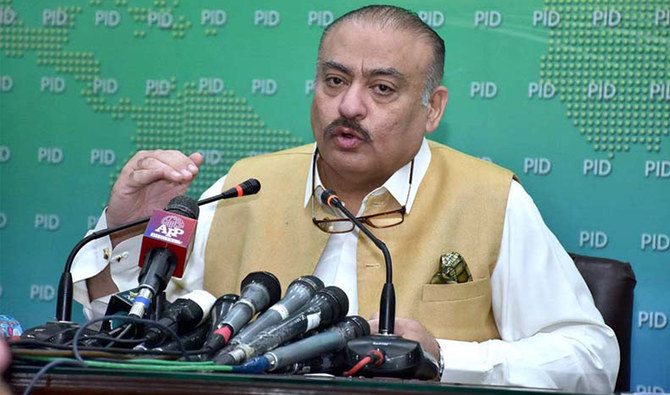
The file photo shows Pakistan's health minister Abdul Qadir Patel addressing a press conference in Islamabad, Pakistan, on June 29, 2022. (APP/File)
Short Url
Updated 30 May 2023
Follow

Ex-PM Khan sends defamation notice to health minister after being accused of substance use

  • The former prime minister demands unconditional apology in 15 days while serving a Rs10 billion legal notice
  • The health minister recently shared Khan’s medical report with journalists while questioning his mental stability

ISLAMABAD: Former prime minister Imran Khan on Tuesday sent a Rs10 billion ($35.05 million) legal notice to Pakistan’s health minister Abdul Qadir Patel for making “false, disparaging and malicious” allegations in a recent news conference wherein he accused the ex-premier of substance use.

Last week, the health minister publicized Khan’s confidential medical report, allegedly prepared while he was taken into custody earlier this month, saying traces of alcohol and illegal drugs were found in the former PM’s urine sample. He also rebutted that Khan had endured a fracture to his leg after an apparent assassination attempt on him last November when he received gunshot wounds while leading an anti-government rally.

The minister shared Khan’s medical report while calling it a “public document” and maintained it also raised questions about the ex-premier’s mental stability.

“We act for and on behalf of Mr. Imran Ahmed Khan Niazi … who has instructed us to serve upon you the following legal notice under Section 8 of the Defamation Ordinance, 2002 … on account of dissemination and circulation of wrongful, baseless, false, misleading, erroneous, malicious and defamatory information/facts made against Our Client by you vide your Press Conference, dated 26.05.2023,” said the notice Khan’s legal team sent Patel.

The presser, as per the notice, was watched in Pakistan as well as all over the world through electronic media channels, YouTube, and various other social media platforms, while its details were also published in national and international newspapers.

The notice asked the health minister to retract his statements, tender unconditional apology, accept that he had misstated information, and pay Rs10 billion for defaming the former prime minister. It asked the minister to take these actions within 15 days, warning him that Khan would otherwise initiate legal proceedings against Patel.

It may be recalled that Khan was arrested by paramilitary Rangers on the instructions of Pakistan’s anti-graft body on May 9 in a corruption reference amounting to £190 million. He remained in the custody of authorities until his arrest and detention were declared “illegal” by the country’s judiciary that ordered his release.


Pakistan, Egypt reaffirm support for dialogue, diplomacy to resolve regional issues

Updated 04 January 2026
Follow

Pakistan, Egypt reaffirm support for dialogue, diplomacy to resolve regional issues

  • The development comes amid tensions over Yemen following the Southern Transitional Council advance into Hadramaut, Al-Mahra
  • Saudi Arabia has invited factions in south Yemen to hold a dialogue in Riyadh to 'discuss just solutions to the southern cause'

ISLAMABAD: Pakistan and Egypt have reaffirmed their support for dialogue and diplomacy as the preferred means to resolve regional issues, the Pakistani foreign office said on Sunday, amid tensions over Yemen.

The development comes days after Saudi Arabia-led Coalition to Support Legitimacy in Yemen said it conducted a “limited” airstrike targeting two shipments of smuggled weapons and other military hardware coming from the Emirati port of Fujairah into Mukalla in southern Yemen.

Coalition Forces spokesman Major General Turki Al-Maliki said the weapons and combat vehicles were meant to support the Southern Transitional Council (STC) forces, backed by the United Arab Emirates (UAE), in Yemen's Hadramaut and Al-Mahra "with the aim of fueling the conflict." The UAE has since announced withdrawal of its remaining troops from Yemen, rejecting any actions that could threaten the Kingdom or undermine regional stability.

Pakistan's Foreign Minister Ishaq Dar on Sunday spoke with his Egyptian counterpart Badr Ahmed Mohamed Abdelatty over the phone and discussed the current regional situation with him, according to a Pakistani foreign office statement.

"Both leaders reviewed current regional situation and appreciated efforts of all parties in resolving issues through dialogue and diplomacy," the statement said.

Separately, Saudi Arabia’s foreign ministry has invited factions in south Yemen to hold a dialogue in Riyadh to “discuss just solutions to the southern cause.” The STC on Saturday welcomed Saudi Arabia’s invitation to take part in the inclusive dialogue among southern Yemeni factions.

Disregarding previous agreements with the Arab Coalition, the STC group had launched a sweeping military campaign early in December, seizing the governorates of Hadramaut along the Saudi border and the eastern governorate of Al-Mahra in Yemen’s border with Oman. It also took control of the strategic PetroMasila oilfields, which account for a massive portion of Yemen’s remaining oil wealth.

Pakistan this week expressed solidarity with Saudi Arabia and reaffirmed Islamabad’s commitment to the Kingdom’s security.

“Pakistan expresses complete solidarity with the Kingdom of Saudi Arabia and reaffirms its commitment to security of the Kingdom,” Pakistani foreign office spokesperson Tahir Andrabi told reporters at a weekly news briefing.

“Pakistan maintains its firm support for the resolution of Yemen issue through dialogue and diplomacy and hopes that Yemen’s people and regional powers work together toward inclusive and enduring settlement of the issue, safeguarding regional stability.”

Pakistan and Saudi Arabia signed a landmark defense pact in September last year, according to which aggression against one country will be treated as an attack against both. The pact signaled a push by both governments to formalize long-standing military ties into a binding security commitment.