

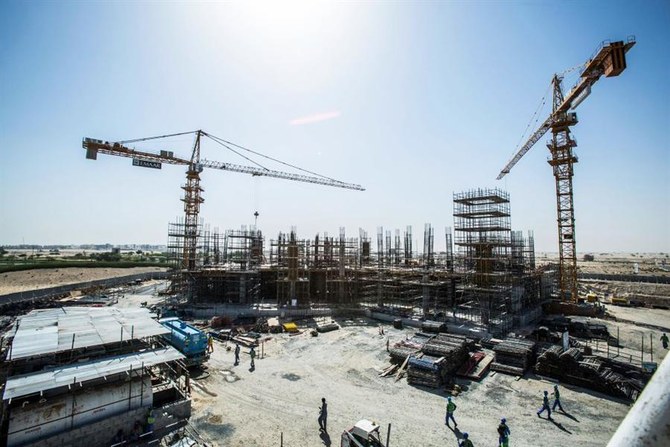
Saudi construction sector accounts for 6% of GDP, says official

According to a report issued by the US-Saudi Business Council recently, contract values in the Kingdom’s construction sector reached SR71.5 million during the fourth quarter of 2022, accounting for 37 percent of the total contracts awarded last year. File  
Short Url
Updated 30 May 2023
Follow

Saudi construction sector accounts for 6% of GDP, says official

RIYADH: The construction sector, valued at over SR255 billion ($68 billion) accounts for 6 percent of the gross domestic product of the Kingdom, according to the chairman of Saudi Contractors Authority.

Speaking at the Builders of Egypt Forum in Cairo on Sunday, Zakria Al-Abdulqadir said the construction sector is the second-largest non-oil sector in Saudi Arabia.

The official said the authority organized the sixth edition of the Future Projects Forum last week, which showcased 3,000 projects worth around $270 billion.

He said SCA is the current chair of the Federation of Contractors from Islamic Countries, which represents the construction sector of 26 Islamic countries.

The Cairo event was organized by the Egyptian Federation for Construction and Building Contractors in collaboration with the African Federation for Construction Contractors’ Association.

According to a report issued by the US-Saudi Business Council recently, contract values in the Kingdom’s construction sector reached SR71.5 million during the fourth quarter of 2022, accounting for 37 percent of the total contracts awarded last year.   

The report said the overall deals struck between October and December were the highest since the first quarter of 2015 when contract values touched SR88.1 billion.   

“The surge in contract awards continues unabated on the back of a growing economy that was fueled by significant oil revenues and the acceleration of giga-projects following the COVID-19 slowdown,” said Albara’a Alwazir, director of economic research at the USSBC.


Saudi environmental compliance sector unveils opportunities worth over $8bn

Updated 25 February 2026
Follow

Saudi environmental compliance sector unveils opportunities worth over $8bn

RIYADH: The Invest Saudi platform offers specialized opportunities with expected revenues exceeding SR30 billion ($8 billion), according to the National Center for Environmental Compliance.

In a statement, the center invited local and international investors to seize the listed opportunities and benefit from various incentives, ranging from administrative support to direct financing.

Saad Al-Zubaidi, executive director of business development, explained that this market size reflects the specialized nature of the environmental compliance sector as a supporting sector for all economic activities. 

Sectors such as industry, energy, mining, construction, services, and infrastructure rely on it to comply with environmental regulations and enhance operational efficiency.

Incentive and financing packages

The center, in integration with various government entities, is working on developing comprehensive incentive packages for investors in the field.

These packages include direct financing tools, soft loans, and guarantee programs, in addition to regulatory and procedural enablers aimed at accelerating the investment cycle and reducing operational risks.

The payback period for investments starts from 4 years and does not exceed 7 years at most, according to the center.

The current market size stands at SR14 billion, according to Al-Zubaidi, who expects it to double within 5 years.

The market diversifies across fields including the manufacturing of pollution control systems, the manufacturing of air and water quality monitoring devices, soil and groundwater rehabilitation, and building specialized technical capacities in the environmental field.

Trend toward localizing environmental technologies

Al-Zubaidi confirmed that the announced opportunities have had their preliminary studies completed and are available for investors to review their details and to complete technical and financial feasibility studies according to various business models.

The focus is not limited to maximizing economic return but extends to localizing environmental technologies, transferring knowledge, and building local value chains capable of meeting the growing demand across various sectors.