New endowment fund to boost environmental sustainability in Kingdom

1 / 4
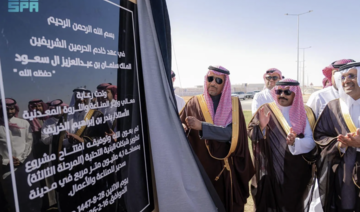
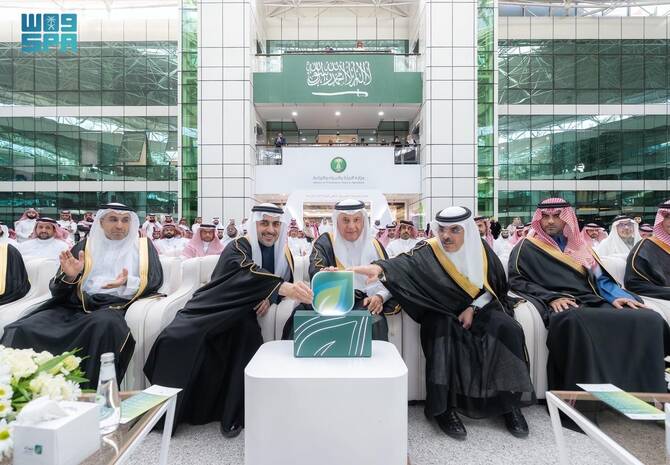
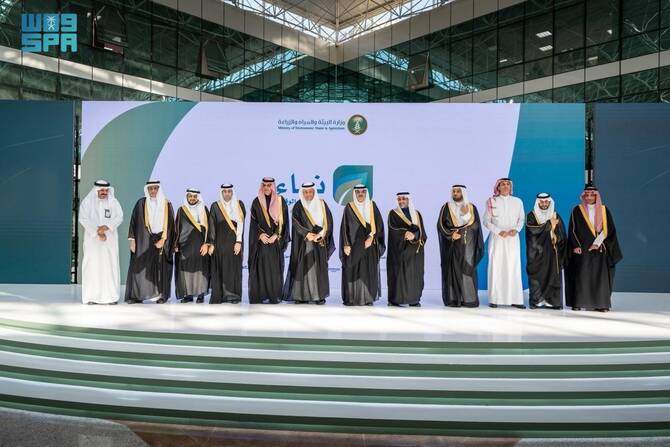
Minister of Environment, Water and Agriculture Abdulrahman Al-Fadhli launched the Namaa Endowment Fund in Riyadh on Tuesday. (SPA)
2 / 4
Minister of Environment, Water and Agriculture Abdulrahman Al-Fadhli launched the Namaa Endowment Fund in Riyadh on Tuesday. (SPA)
3 / 4
Minister of Environment, Water and Agriculture Abdulrahman Al-Fadhli launched the Namaa Endowment Fund in Riyadh on Tuesday. (SPA)
4 / 4
Minister of Environment, Water and Agriculture Abdulrahman Al-Fadhli launched the Namaa Endowment Fund in Riyadh on Tuesday. (SPA)
Short Url
Updated 17 February 2026
Follow

New endowment fund to boost environmental sustainability in Kingdom

  • Move will boost nonprofit sector’s contribution to the national economy, says minister
  • Initiative aims to expand vegetation cover, protect biodiversity, reduce food waste

RIYADH: Saudi Arabia’s Minister of Environment, Water and Agriculture Abdulrahman Al-Fadhli launched the Namaa Endowment Fund in Riyadh on Tuesday, aiming to strengthen the sustainability of the Kingdom’s nonprofit environmental sector.

The fund will support economic and social development, meet community needs, enhance the nonprofit sector’s contribution to GDP, and promote environmental, water, and agricultural sustainability.

Al-Fadhli said the fund introduces a new model of institutional endowment work and marks a strategic step toward achieving economic and social development goals.

He added that it will boost the nonprofit sector’s contribution to the national economy in line with Vision 2030, the Saudi Press Agency reported.

The minister noted that his department will collaborate with the General Authority for Awqaf, the Capital Market Authority, and SNB Capital to support the fund and encourage private companies, business leaders, and community members to contribute via an authorized online platform with a robust financial management system.

Al-Fadhli invited the public to contribute to the fund to drive development and ensure the long-term sustainability of the environment, water, and agriculture sectors.

The fund aims to maximize the developmental impact of its endowment assets and finance charitable initiatives within the ministry’s system, including nonprofit organizations such as the Reef National Foundation, the Vegetation Cover Development Foundation, and the Sekaya Charitable Foundation.

These initiatives will focus on water provision and conservation, afforestation, biodiversity protection, expanding vegetation cover, supporting the circular economy, advancing environmental sustainability, promoting agriculture and irrigation, and reducing food waste.

Governor of the General Authority for Awqaf Emad Al-Kharashi announced that the authority will contribute SR100 million ($26.6 million) as a starting base to build a sustainable endowment model.

He said the fund combines the cultural value of endowments with modern investment tools to achieve sustainability and growth, helping preserve the environment and natural resources.

Al-Kharashi emphasized that environment, water, and agriculture are not just service sectors, but essential pillars of life, foundations of food security, and guarantees for continued development.

The fund is designed to invest in entrepreneurship within the ministry’s sectors, activate environmental, water, and agricultural assets, and strengthen the developmental role of nonprofit organizations.

Contributions can be made via namadon.sa.


Red Sea Global unveils scientific model for regenerative tourism worldwide

Updated 26 February 2026
Follow

Red Sea Global unveils scientific model for regenerative tourism worldwide

  • The report details the model’s rollout at “The Red Sea” and “AMAALA” destinations, backed by studies covering 8 marine habitats

TABUK: Red Sea Global (RSG) has unveiled a science-based model aimed at achieving a 30% net positive conservation benefit across its tourism destinations by 2040. 

The framework is now available for global adoption, according to a statement released by RSG.

Owned by Saudi Arabia’s Public Investment Fund (PIF), Red Sea Global is the multi-project developer behind ambitious regenerative tourism destinations like “The Red Sea” and “AMAALA.” 

As a cornerstone of the Kingdom’s Vision 2030, the company aims to diversify the national economy while setting new global benchmarks for sustainable, nature-positive development.

CEO John Pagano stated that openly sharing this detailed approach will help elevate the global tourism sector and secure a healthier environment for future generations.
 

Map showing the boundaries of the Red Sea Zone. (Graphic from the RSG report)

The cornerstone of this initiative is the proprietary SIIG Model, a four-step framework:
• Survey: Establish biodiversity baselines and monitor long-term changes.
• Identify: Assess risks to priority habitats and species.
• Intervene: Execute evidence-based actions, such as regulating fishing and enhancing natural habitats.
• Gain: Measure and verify biodiversity improvements.

The report details the model’s rollout at “The Red Sea” and “AMAALA” destinations, backed by extensive 2022–2023 environmental baseline studies covering eight marine habitats and priority species groups during 2022 and 2023. 

A major intervention is the 5,015-square-kilometer Fishery Management Area in Al-Wajh Lagoon. The plan reserves 38% of the area for priority conservation—protecting 62% of local coral reefs—while allocating 61% for sustainable fishing.

According to scientific modeling, eliminating fishing in high-protection zones could increase reef fish populations by 113%, sharks and rays by 72%, and marine mammals by 24%. These measures are expected to boost coral resilience, support ecosystem recovery, and protect vulnerable species like sea turtles and seabirds.
Ihab Kindi, RSG’s Red Sea Destination Executive Director, called the data-driven model a practical roadmap for large-scale marine recovery. The complete methodology is available in the new report, “The SIIG Model: A Roadmap Toward Achieving Measurable Conservation Gains.”