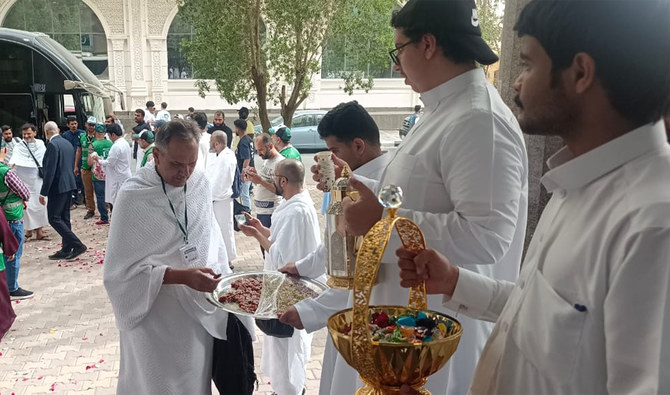

ISLAMABAD: The first group of 773 Pakistani pilgrims had reached Makkah from Madinah ahead of the annual Hajj pilgrimage, the Pakistani religious affairs ministry said on Tuesday.
This year, Saudi Arabia has restored Pakistan’s pre-pandemic Hajj quota of 179,210 pilgrims and waved off the upper age limit of 65. Around 80,000 Pakistani pilgrims are performing the pilgrimage this year under the government scheme, while over 91,000 will use private tour operators.
As per the Pakistani religious affairs ministry, Hajj flights from the country commenced on May 21, with the final flight departing for Saudi Arabia on June 21.
“DG Hajj Mission in Makkah Abdul Wahab Soomro welcomed the pilgrims who were served dates, coffee and juice in the traditional manner on their arrival at Makkah,” the ministry said.
Accommodation arrangements for the pilgrims had been made in the Azizia and Bitha Quraish areas of Makkah.
Director of Hajj Makkah Faheem Afridi said that a special bus service would be available to take pilgrims from Azizia to Haram.
“All the Pakistani Hajj pilgrims are well catered for, will be provided three meals including breakfast in Makkah,” the statement said. “The health of pilgrims will be taken care of. To meet the complete nutritional needs of the pilgrims, fruits are being served in the afternoon and sweets in the night.”
The ministry said all Hajj pilgrims who landed in Madinah would reach Makkah after eight days.
For the Hajj pilgrimage, pilgrims perform the welcome tawaf after entering Makkah, circling the Kaaba seven times in a counterclockwise direction, starting at the Black Stone. They then head to the hills of Safa and Marwa, where they perform saee, which is the act of going back and forth between the two hills seven times.
Pilgrims then travel to Mina, an area of 20 square kilometers nearly five kilometers away from the Grand Mosque in Makkah, on the eighth day of Dhul Hijjah, also known as Yom Al-Tarwiyah, where they will stay and fill their day and evening with prayers and supplications, resting and consuming water ahead of their long, perilous journey.
On the second day of Hajj, pilgrims travel to Mt. Arafat, 20 kilometers away. The day is devoted to prayer and supplications as they observe duhr (noon) combined with asr (afternoon) prayers until sunset.
The Day of Arafat is considered the most critical day for pilgrims and the millions not performing. It is the day that, “atones for the sins of the preceding and coming (Muslim) year” and is the best day for worship and supplication in the entire year.
After sunset, pilgrims descend from Mount Arafat and make their way to Muzdalifah for isha (night) prayers, collect pebbles no larger than the size of a fingertip ahead of the stoning ritual on the next day, and rest until midnight or dawn, when they will make the long journey back to Mina for the final steps of Hajj, the stoning ritual at Jamarat Al-Aqabah.
On the third day of Hajj, Eid Al-Adha, pilgrims stone the Jamarat Al-Aqabah, or the big pillar, a place where the Prophet Ibrahim threw seven pebbles at the devil. After doing so, pilgrims change from their Ihram; sacrificial animals are slaughtered, and men cut or shave their heads while women cut a fingertip’s length of hair to commemorate the end of the Hajj pilgrimage.
For three days, known as Ayyam Al-Tashreeq, pilgrims stay in Mina and perform the stoning of the other two pillars, Al-Jamarah Al-Wusta and Al-Jamarah Al-Sughra.