

PM Sharif seeks Ericsson’s global expertise as Pakistan eyes 5G rollout

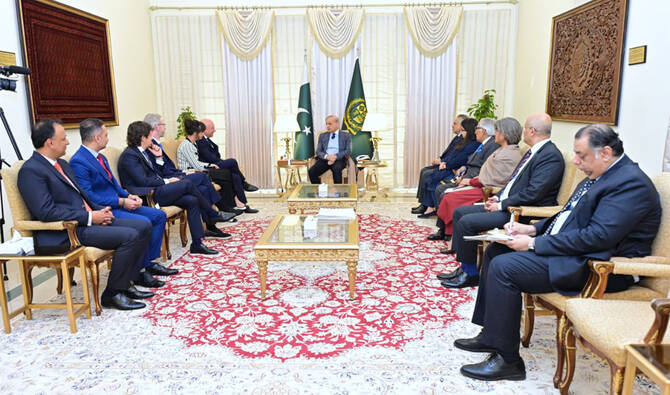
Prime Minister Muhammad Shehbaz Sharif meeting with a delegation from Ericsson led by President Patrick Johansson, in Islamabad on January 13, 2026. (PMO)
Short Url
Updated 13 January 2026
Follow

PM Sharif seeks Ericsson’s global expertise as Pakistan eyes 5G rollout

  • The prime minister says Pakistan wants to benefit from Ericsson’s experience in advanced networks
  • Government aims to auction 5G spectrum by late January or early February, the IT minister has said

ISLAMABAD: Prime Minister Shehbaz Sharif said on Monday the government was keen to draw on global expertise as it prepares to move ahead with next-generation digital connectivity, holding talks with Sweden’s Ericsson at a time when Islamabad plans to auction 5G spectrum in the coming weeks.

Last month, Pakistan’s information technology minister said the government was aiming to hold its long-delayed 5G spectrum auction by late January or early February to pave the way for the country’s first rollout of 5G services.

The prime minister discussed the role of next-generation digital connectivity in supporting economic growth, productivity and public service delivery during talks with an Ericsson delegation led by Patrick Johansson, the company’s president for Europe, the Middle East and Africa, the prime minister’s office said.

“Pakistan is interested in benefiting from Ericsson’s global experience in advanced networks, including 5G, and remains committed to developing secure and sustainable information technology infrastructure in line with national needs,” Sharif said, according to the statement.

The government has said expanding digital connectivity is central to its broader economic agenda, which includes improving financial inclusion, promoting cashless payments and strengthening disaster preparedness through technology.

The statement said Ericsson’s delegation welcomed Pakistan’s efforts to improve its telecom infrastructure, including plans for the 5G spectrum auction.

The meeting was also attended by Deputy Prime Minister Ishaq Dar, IT minister Shaza Fatima Khawaja and senior government officials.


Pakistan assembly speaker warns opposition against anti-state remarks in parliament

Updated 17 January 2026
Follow

Pakistan assembly speaker warns opposition against anti-state remarks in parliament

  • Ayaz Sadiq says criticism of judiciary and armed forces will not be allowed on assembly floor
  • He calls violence during protests unacceptable, vows neutrality as National Assembly speaker

ISLAMABAD: Pakistan’s National Assembly Speaker Sardar Ayaz Sadiq said on Saturday that opposition lawmakers would not be allowed to speak against Pakistan, the judiciary or the armed forces on the floor of parliament, calling such remarks unacceptable.

Speaking to reporters during a visit to the eastern city of Lahore, Sadiq said parliamentary debate must remain within constitutional and legal limits, while reiterating his commitment to act impartially as speaker.

“No one will be allowed to speak against Pakistan, the judiciary or the armed forces on the floor of the National Assembly,” Sadiq said. “Negative or controversial remarks about judges or the armed forces are unacceptable.”

His comments come amid heightened political tensions after opposition groups held protests in the past, criticizing state institutions and targeting government and military properties.

The speaker said peaceful protest was a democratic right but drew a sharp line at violence and vandalism.

“Protest is the right of every citizen in a democratic society, but it must remain peaceful and within the bounds of the constitution and the law,” he continued, adding that arson, damage to property and the use of sticks or weapons in the name of protest were “unacceptable” and posed a threat to the rule of law.

“No opposition lawmaker will be allowed to speak on the National Assembly floor if they speak against Pakistan,” Sadiq said.

The speaker also noted the country’s economic indicators were gradually improving, citing an increase in foreign exchange reserves, and said Pakistan had further strengthened relations with countries including the United States, China, Russia, Türkiye and Saudi Arabia.