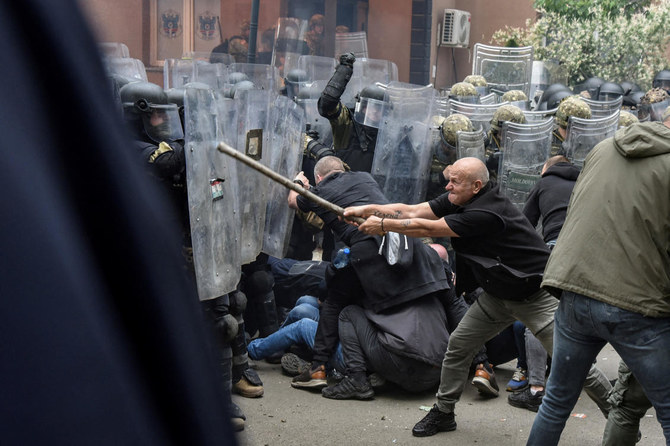
LEPOSAVIC, Kosovo: Around 25 NATO peacekeeping soldiers defending three town halls in northern Kosovo were injured in clashes with Serb protesters on Monday, while Serbia’s president put the army on the highest level of combat alert.
KFOR, the NATO-led peacekeeping mission to Kosovo, condemned the violence.
“While countering the most active fringes of the crowd, several soldiers of the Italian and Hungarian KFOR contingent were the subject of unprovoked attacks and sustained trauma wounds with fractures and burns due to the explosion of incendiary devices,” it said in a statement.
Hungary’s defense minister Kristof Szalay-Bobrovniczky said that 7 Hungarian soldiers were seriously injured and that they will be taken to Hungary for treatment. He said 20 soldiers were injured. Italian soldiers were also injured in clashes.
“What is happening is absolutely unacceptable and irresponsible,” Italy’s Giorgia Meloni said in a statement. “It is vital to avoid further unilateral actions on the part of the Kosovar authorities and that all the parties in question immediately take a step back to ease the tensions.”
Serbian President Aleksandar Vucic said that 52 Serbs were injured, three of them seriously.
Kosovo President Vjosa Osmani accused Serbian counterpart Aleksandar Vucic of destabilising Kosovo.
“Serb illegal structures turned into criminal gangs have attacked Kosovo police, KFOR (peacekeeping) officers & journalists. Those who carry out Vucic’s orders to destabilize the north of Kosovo, must face justice,” Osmani tweeted.
Vucic accused Kosovo Prime Minister Albin Kurti of creating tensions. He called on Serbs in Kosovo to avoid clashes with NATO soldiers.
The tense situation developed after ethnic Albanian mayors took office in northern Kosovo’s Serb majority area after elections the Serbs boycotted — a move that led the US and its allies to rebuke Pristina on Friday.
In Zvecan, one of the towns, Kosovo police — staffed by ethnic Albanians after Serbs quit the force last year — sprayed pepper gas to repel a crowd of Serbs who broke through a security barricade and tried to force their way into the municipality building, witnesses said.
Serb protesters in Zvecan threw tear gas and stun grenades at NATO soldiers. Serbs also clashed with police in Zvecan and spray-painted NATO vehicles with the letter “Z,” referring to a Russian sign used in war in Ukraine.
In Leposavic, close to the border with Serbia, US peacekeeping troops in riot gear placed barbed wire around the town hall to protect it from hundreds of angry Serbs.
Later in the day protesters threw eggs at a parked car belonging to the new Leposavic mayor.
Vucic, who is the commander-in-chief of the Serbian armed forces, raised the army’s combat readiness to the highest level, Defense Minister Milos Vucevic told reporters.
“This implies that immediately before 2:00 p.m. (1200 GMT), the Serbian Armed Forces’ Chief of the General Staff issued additional instructions for the deployment of the army’s units in specific, designated positions,” Vucevic said, without elaborating.
NATO peacekeepers also blocked off the town hall in Zubin Potok to protect it from angry local Serbs, witnesses said.
Igor Simic, deputy head of the Serb List, the biggest Belgrade-backed Kosovo Serb party, accused Kosovo Prime Minister Albin Kurti of fueling tensions in the north.
“We are interested in peace. Albanians who live here are interested in peace, and only he (Kurti) wants to make chaos,” Simic told reporters in Zvecan.
Serbs, who comprise a majority in Kosovo’s north, have never accepted its 2008 declaration of independence from Serbia and still see Belgrade as their capital more than two decades after the Kosovo Albanian uprising against repressive Serbian rule.
Ethnic Albanians make up more than 90 percent of the population in Kosovo as a whole, but northern Serbs have long demanded the implementation of an EU-brokered 2013 deal for the creation of an association of autonomous municipalities in their area.
Serbs refused to take part in local elections in April and ethnic Albanian candidates won the mayoralties in four Serb-majority municipalities — including North Mitrovica, where no incidents were reported on Monday — with a 3.5 percent turnout.
Serbs demand that the Kosovo government remove ethnic Albanian mayors from town halls and allow local administrations financed by Belgrade resume their work.
On Friday, three out of the four ethnic Albanian mayors were escorted into their offices by police, who were pelted with rocks and responded with tear gas and water cannon to disperse the protesters.
The United States and its allies, which have strongly backed Kosovo’s independence, rebuked Pristina on Friday, saying imposing mayors in Serb-majority areas without popular support undercut efforts to normalize relations.
Kurti defended Pristina’s position, tweeting after a weekend phone call with the European Union’s foreign policy chief: “Emphasized that elected mayors will provide services to all citizens.”
Serbian Foreign Minister Ivica Dacic told RTS it was “not possible to have mayors who have not been elected by Serbs in Serb-majority municipalities.”
After meeting Kurti, US ambassador to Kosovo Jeffrey Hovenier told reporters: “We are concerned about reports today about violence against official property.”
“We’ve seen pictures of graffiti against KFOR cars and police cars, we’ve heard about attacks on journalists, we condemn that, that is not appropriate response.”


![]()

NATO soldiers injured in Kosovo clashes with Serb protesters
Short Url
https://arab.news/vse2x
NATO soldiers injured in Kosovo clashes with Serb protesters
- KFOR: ‘Several soldiers of the Italian and Hungarian KFOR contingent were the subject of unprovoked attacks and sustained trauma wounds with fractures and burns’
- Serbian President Aleksandar Vucic said that 52 Serbs were injured, three of them seriously


Latest updates




© 2026 SAUDI RESEARCH & PUBLISHING COMPANY, All Rights Reserved And subject to Terms of Use Agreement.