Russia blames US, EU for escalating tensions in Kosovo

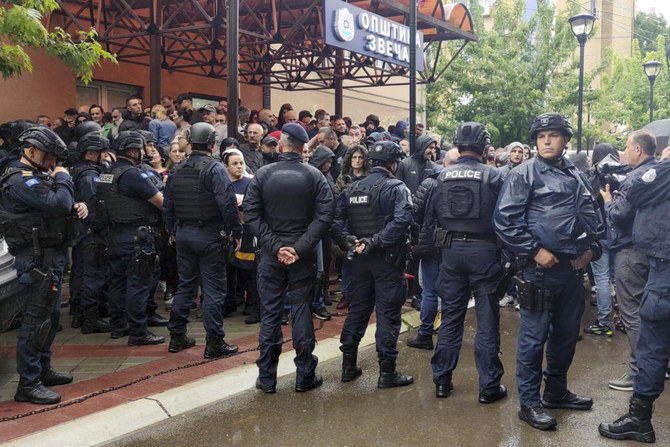
In this image made from video, Kosovar police stand guard confronting ethnic Serbs outside municipality building in Zvecan, northern Kosovo on May 26, 2023. (AP)
Short Url
Updated 27 May 2023
Follow

Russia blames US, EU for escalating tensions in Kosovo

  • The clashes led Serbian President Aleksandar Vucic on Friday to place the army on full combat alert
  • Serbia and its traditional ally Russia do not recognise Kosovo's independence

KOSOVO: Russia on Saturday blamed Kosovo, the United States and European Union for escalating tensions in the Balkans and said it was watching with concern after violent clashes between Kosovan police and protesters opposed to ethnic Albanian mayors.
The United States and allies on Friday rebuked Kosovo, saying the use of force to install mayors in ethnic Serb areas undermined efforts to improve troubled relations with neighboring Serbia. NATO on Saturday urged Kosovo to dial down tensions.
The clashes led Serbian President Aleksandar Vucic on Friday to place the army on full combat alert and ordered units to move closer to the border.
“We decisively condemn Pristina’s provocative steps, which have brought the situation close to the hot phase and directly threaten the security of the whole Balkans region,” Russia’s foreign ministry spokeswoman Maria Zakharova said in a statement.
“The responsibility for this lies fully with the United States and the European Union,” she said, adding that rebukes of Kosovo by “Western mediators” had come too late.
Serbia and its traditional ally Russia do not recognize Kosovo’s independence, and Moscow has blocked the country’s bid to become a member of the United Nations. Serbia still considers Kosovo part of its territory.


UN refugee agency chief: ‘Very difficult moment in history’

UNHCR High Commissioner Barham Salih during an interview in Rome on Monday. (AP)
Updated 4 sec ago
Follow

UN refugee agency chief: ‘Very difficult moment in history’

  • According to his agency also known as UNHCR, there are 117.3 million forcibly displaced people around the world from 194 countries

ROME: The first refugee to lead the UN refugee agency has said that the world faces “a very difficult moment in history” and is appealing to a common humanity amid dramatic change.
Repression of immigrants is growing, and the funding to protect them is plummeting. 
Without ever mentioning the Trump administration or its policies directly, Barham Salih said his office will have to be inventive to confront the crisis, which includes losing well over $1 billion in US support.

FASTFACT

There are 117.3 million forcibly displaced people around the world from 194 countries.

“Of course it’s a fight, undeniably so, but I think also I’m hopeful and confident that there is enough humanity out there to really enable us to do that,” said Salih, a former president of Iraq.
He was also adamant on the need to safeguard the 1951 refugee convention as the Trump administration campaigns for other governments to join it in upending a decades-old system and redefining asylum rules.
Salih, who took up his role as high commissioner for refugees on Jan. 1, described it as an international legal responsibility and a moral responsibility.
According to his agency also known as UNHCR, there are 117.3 million forcibly displaced people around the world from 194 countries. Salih’s challenge is supporting some 30 million refugees with significantly less funds.
In 2024 and 2025, funding from the US dropped from $2.1 billion to $800 million, and yet the country remains UNHCR’s largest donor.
“Resources made available to helping refugees are being constrained and limited in very, very significant way,” Salih said.
The Trump administration is also reviewing the US asylum system, suspending the refugee program in 2025 and setting a limit for entries to 7,500, mostly white South Africans — a historic low for refugee admittance since the program’s inception in 1980.
The Trump administration also has tightened immigration enforcement as part of its promise to increase deportations, while facing criticism for deportations to third countries and an uproar over two fatal shootings by federal officers and other deaths.
“We have to accept the need for adapting with a new environment in the world,” Salih said. 
His agency is seeking to be more cost-effective, “to really deliver assistance to the people who need it, rather than be part of a system that sustains dependency on humanitarian assistance,” he added. Salih has already met Pope Leo XIV at the Vatican. He said he was grateful for the support of the pontiff — the first pope from the US.
“The voice of the church and faith-based organizations in this endeavor is absolutely vital,” Salih said. “His moral support, his voice of the need for supporting refugees and what we do as UNHCR at this moment is very, very important.”