

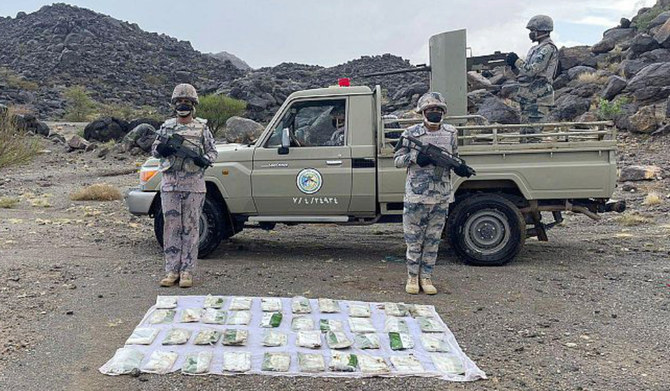
Saudi authorities arrest 7 drug smugglers

In in the Eastern Province, police have arrested individuals carrying prohibited drugs. (SPA)
Short Url
Updated 31 August 2023
Follow

Saudi authorities arrest 7 drug smugglers

  • The Kingdom's Border Guard land patrols in Jazan have also foiled an attempt to smuggle 350kg of the narcotic qat

RIYADH: Saudi authorities tackling drug traders and smugglers reported a number of arrests across the Kingdom in recent days.

On Monday, the General Directorate for Narcotics Control arrested four Bangladeshi residents attempting to sell methamphetamine and narcotic tablets in the Eastern Province.

Authorities also arrested a citizen in the Eastern Province for attempting to sell hashish and prohibited tablets, and for being in possession of firearms and live bullets.

Initial legal procedures were completed and they were referred to the Public Prosecution, the Saudi Press Agency reported.

Meanwhile, police patrols in the Fifa governorate of the Jazan region arrested a Pakistani resident in possession of 101kg of qat hidden in his vehicle.

The Kingdom's Border Guard land patrols in Jazan have also foiled an attempt to smuggle 350kg of the narcotic qat.

The seized narcotics were handed over to the competent authority, and preliminary legal procedures were completed.

In the Qassim region, the police department arrested a citizen for distributing hashish and narcotic pills. According to police, the individual was found in possession of dangerous weapons and mobile phones. He was transferred to the appropriate authorities for legal action.

The General Directorate of Narcotics Control reaffirmed its commitment to prevent drug smuggling and tighten customs procedures on imports and exports.

The Saudi government has urged anyone with information related to suspected smuggling operations or customs violations to call the confidential hotline 1910, the international number 00 966 114208417, or email [email protected].

Tips received by the authority related to smuggling crimes and breaches of common customs law are treated with strict confidentiality. Financial rewards are offered for valid tips.


Saudi Arabia expresses concern over UAE pressure on STC, warns against threats to its security

Updated 10 sec ago
Follow

Saudi Arabia expresses concern over UAE pressure on STC, warns against threats to its security

Riyadh: Saudi Arabia on Tuesday expressed regret over what it described as pressure by the United Arab Emirates on Southern Transitional Council (STC) forces to carry out military operations in Yemen’s Hadramaut and Al-Mahra governorates, warning that such actions pose a direct threat to the Kingdom’s national security and regional stability.

In a statement, the Saudi Ministry of Foreign Affairs said the reported moves were inconsistent with the principles of the Arab Coalition that supports the internationally recognised government of Yemen and undermined ongoing efforts to achieve security and stability in the country.


The ministry referred to earlier statements by the Yemeni Presidential Leadership Council and the coalition leadership concerning the movement of ships carrying weapons and heavy vehicles from Fujairah port to Mukalla without official authorization.

Saudi Arabia stressed that any threat to its national security constituted a “red line,” adding that it would not hesitate to take all necessary measures to confront and neutralize such risks.

The Kingdom reaffirmed its support for Yemen’s security, stability, and sovereignty, as well as its full backing of the Yemeni Presidential Leadership Council and its government. It also reiterated that the southern issue is a just cause that can only be addressed through dialogue as part of a comprehensive political solution involving all Yemeni parties, including the STC.

Riyadh further emphasized the importance of the UAE responding to Yemen’s request to withdraw its military forces within 24 hours and to halt military or financial support to any Yemeni faction. The statement called for wisdom to prevail in order to preserve Gulf unity, bilateral relations, and the shared goal of regional stability and development.