Websites linked to Iran’s presidency hacked with images of exile group’s leaders

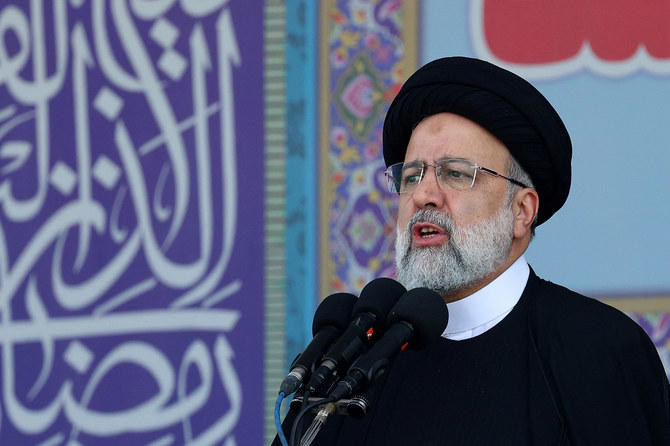
One site bore the slogan: “Death to Khamenei Raisi- Hail to Rajavi.” (File/AFP)
Short Url
Updated 29 May 2023
Follow

Websites linked to Iran’s presidency hacked with images of exile group’s leaders

  • Iran has been targeted by a series of embarrassing hacks amid the rising tensions over its rapidly advancing nuclear program

DUBAI: A series of websites linked to Iran’s presidency bore the images of two leaders of an exiled opposition group Monday, with others showing the pictures of Islamic Republic’s supreme leader and president crossed out.
An Internet account describing itself as a group of hackers claimed responsibility for allegedly taking down websites. The account GhyamSarnegouni, whose name in Farsi means “Rise to Overthrow,” previously claimed hacking websites associated with Iran’s Foreign Ministry earlier this month.
Iranian state media and officials did not immediately acknowledge the apparent hack. However, Associated Press journalists accessing the sites found them defaced with images of Massoud Rajavi, the long-missing leader of the Iranian exile group Mujahedeen-e-Khalq, and his wife Maryam, who is now the public face of the group.
One site bore the slogan: “Death to Khamenei Raisi- Hail to Rajavi.” Iran’s Supreme Leader Ayatollah Ali Khamenei and Iran’s president Ebrahim Raisi both were targeted similarly in the previously claimed hacked in May.
Iran has been targeted by a series of embarrassing hacks amid the rising tensions over its rapidly advancing nuclear program. That’s included the signal of Iranian state television being targeted, gasoline pumps that provide subsidized fuel being targeted in a cyberattack and government surveillance camera imagery being released, including from a notorious prison.
The Mujahedeen-e-Khalq, known by the acronym MEK, did not immediately respond to a request for comment. The MEK had angrily condemned a prisoner swap Belgium conducted with Iran on Friday to free an aid worker that saw an Iranian diplomat convicted of being behind a bomb plot targeting the group released.
The MEK began as a Marxist group opposing the rule of Shah Mohammad Reza Pahlavi. It claimed and was suspected in a series of attacks against US officials in Iran in the 1970s, something the group now denies.
It supported the 1979 Islamic Revolution, but soon had a falling out with Ayatollah Ruhollah Khomeini and turned against the cleric. It carried out a series of assassinations and bombings targeting the young Islamic Republic.
The MEK later fled into Iraq and backed dictator Saddam Hussein during his bloody eight-year war against Iran in the 1980s. That saw many oppose the group in Iran. Although largely based in Albania, the group claims to operate a network inside Iran.


Foreign media group slams Israel for refusing to lift Gaza press ban

Updated 07 January 2026
Follow

Foreign media group slams Israel for refusing to lift Gaza press ban

  • Foreign Press Association expresses 'profound disappointment' with Israeli government’s response to a Supreme Court appeal
  • Israel has barred foreign journalists from independently entering the devastated territory since the war started

JERUSALEM: An international media association on Tuesday criticized the Israeli government for maintaining its ban on unrestricted media access to Gaza, calling the move disappointing.
The government had told the Supreme Court in a submission late Sunday that the ban should remain in place, citing security risks in the Gaza Strip.
The submission was in response to a petition filed by the Foreign Press Association (FPA) — which represents hundreds of journalists in Israel and Palestinian territories — seeking immediate and unrestricted access for foreign journalists to the Gaza Strip.
“The Foreign Press Association expresses its profound disappointment with the Israeli government’s latest response to our appeal for full and free access to the Gaza Strip,” the association said on Tuesday.
“Instead of presenting a plan for allowing journalists into Gaza independently and letting us work alongside our brave Palestinian colleagues, the government has decided once again to lock us out” despite the ceasefire in the territory, it added.
Since the outbreak of the Gaza war in October 2023, triggered by an attack on Israel by the Palestinian militant group Hamas, the government has barred foreign journalists from independently entering the devastated territory.
Instead, Israel has allowed only a limited number of reporters to enter Gaza on a case-by-case basis, embedded with its military inside the blockaded Palestinian territory.
The FPA filed its petition in 2024, after which the court granted the government several extensions to submit its response.
Last month, however, the court set January 4 as a final deadline for the government to present a plan for allowing media access to Gaza.
In its submission, the government maintained that the ban should remain in place.
“This is for security reasons, based on the position of the defense establishment, which maintains that a security risk associated with such entry still exists,” the government submission said.
The government also said that the search for the remains of the last hostage held in Gaza was ongoing, suggesting that allowing journalists in at this stage could hinder the operation.
The remains of Ran Gvili, whose body was taken to Gaza after he was killed during Hamas’s 2023 attack, have still not been recovered despite the ceasefire.
The FPA said it planned to submit a “robust response” to the court, and expressed hope the “judges will put an end to this charade.”
“The FPA is confident that the court will provide justice in light of the continuous infringement of the fundamental principles of freedom of speech, the public’s right to know and free press,” the association added.
The Supreme Court is expected to issue a ruling on the matter, though it is unclear when a decision will be handed down.
An AFP journalist sits on the board of the FPA.