Amazon scientists simulate how warming may impact jungle

1 / 4
Brazil's Science and Technology Minister Luciana Santos is accompanied by scientists during her visit to the AmazonFACE project in Manaus, Brazil, on May 23, 2023. (Raul Vasconcelos/ASCOM MCTI/Handout via REUTERS)
2 / 4
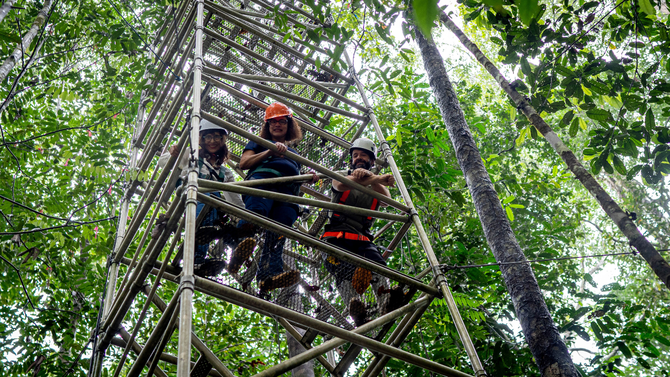
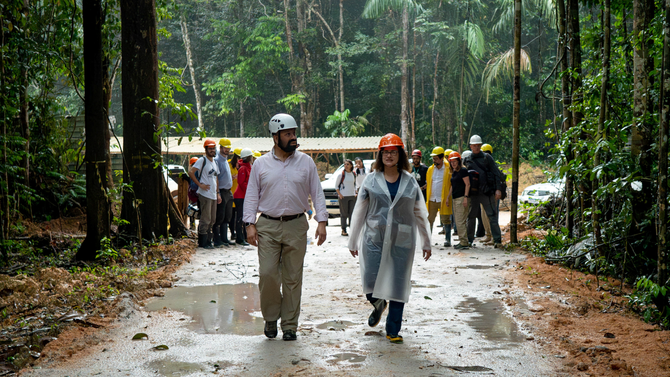
British Foreign Secretary James Cleverly and Brazil's Science and Technology Minister Luciana Santos visiting the AmazonFACE project in Manaus, Brazil, on May 23, 2023. (Raul Vasconcelos/ASCOM MCTI/Handout via REUTERS)
3 / 4
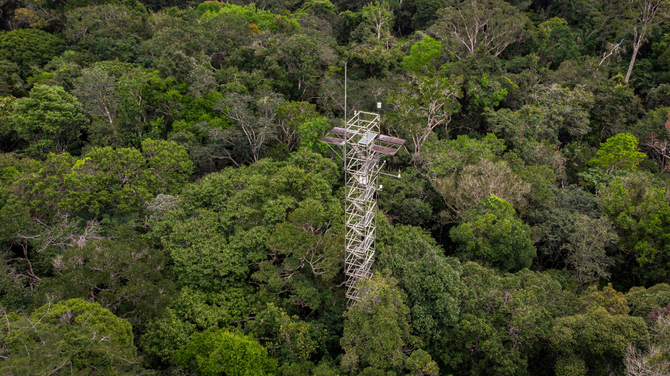
A tower, part of the AmazonFACE project, is seen in Manaus, Brazil, on May 23, 2023.(Raul Vasconcelos/ASCOM MCTI/Handout via REUTERS)
4 / 4
A tower, part of the AmazonFACE project, is seen in Manaus, Brazil, on May 23, 2023.(Raul Vasconcelos/ASCOM MCTI/Handout via REUTERS)
Short Url
Updated 27 May 2023
Follow

Amazon scientists simulate how warming may impact jungle

  • The AmazonFACE project, co-financed by Brazil and the UK, is a simulation to see how the lungs of the world will endure global warming

MANAUS, Brazil: Deep in the Amazon, an experiment unfolds that may allow a peek into the future to see what will happen to the world’s largest rainforest when carbon dioxide levels rise.

It is a simulation to see how the lungs of the world will endure global warming.
The AmazonFACE project, co-financed by Brazil and the United Kingdom, is “an open-air laboratory that will allow us to understand how the rainforest will behave in future climate change scenarios,” says Carlos Quesada, one of the project coordinators.
Quesada stands at the foot of a soaring metal tower that protrudes through the rainforest canopy at a site 50 miles (80 kilometers) north of Manaus in northwest Brazil.
Sixteen other towers arranged in a circle around it will “pump” CO2 into the ring, replicating levels that may happen with global warming.
“How will the rainforest react to the rising temperature, the reduction in water availability, in a world with more carbon in the atmosphere?” asks Quesada, a researcher at an Amazon research institute that is part of the Brazilian Ministry of Science and Technology.
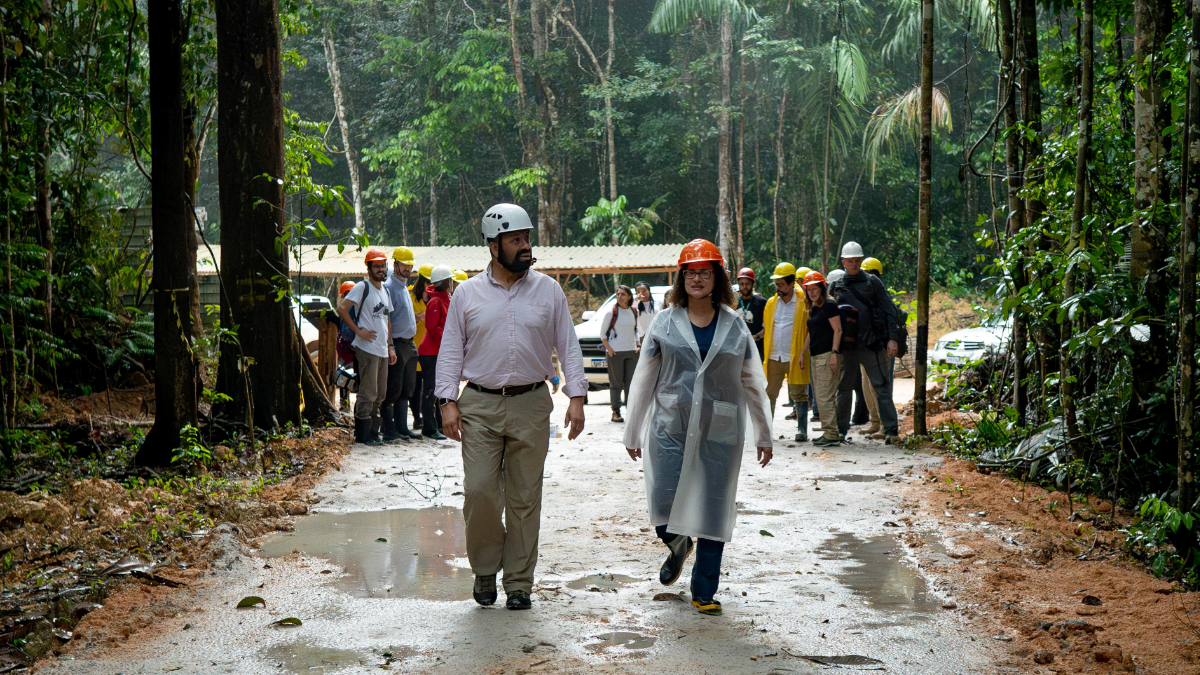


British Foreign Secretary James Cleverly and Brazil's Science and Technology Minister Luciana Santos visiting the AmazonFACE project in Manaus, Brazil, on May 23, 2023. (Raul Vasconcelos/ASCOM MCTI/Handout via REUTERS)

The technology known as FACE (Free Air CO2 Enrichment) has already been used to study the impact on forests in Australia, the United States and the United Kingdom, but never in a tropical rainforest.
By 2024, there will be six “carbon rings” pumping CO2 — one of the causes of global warming — at a concentration 40 percent to 50 percent higher than today.
Over a decade, researchers will analyze the processes occurring in leaves, roots, soil, water and nutrient cycles.
“We will have more accurate projections on how the Amazon rainforest can help combat climate change with its ability to absorb carbon from the atmosphere. Also, it will help us understand how the rainforest will be impacted by these changes,” says David Lapola, a researcher at the University of Campinas, who coordinates the project with Quesada.
The carbon increase in the atmosphere may lead to creation of grassy plains, or savanna, where Amazon rainforest once flourished, with vegetation better adapted to higher temperatures and longer droughts.
But CO2 could also “fertilize” the forest and make it temporarily more resistant to these changes.
“This is a positive scenario, at least for a short time, a period for us to get to zero emission policies, to keep temperature increases to only 1.5 degrees Centigrade,” Quesada says.
The project “is a window to the future. You open the window and look at what might be happening 30 years ahead,” he says.
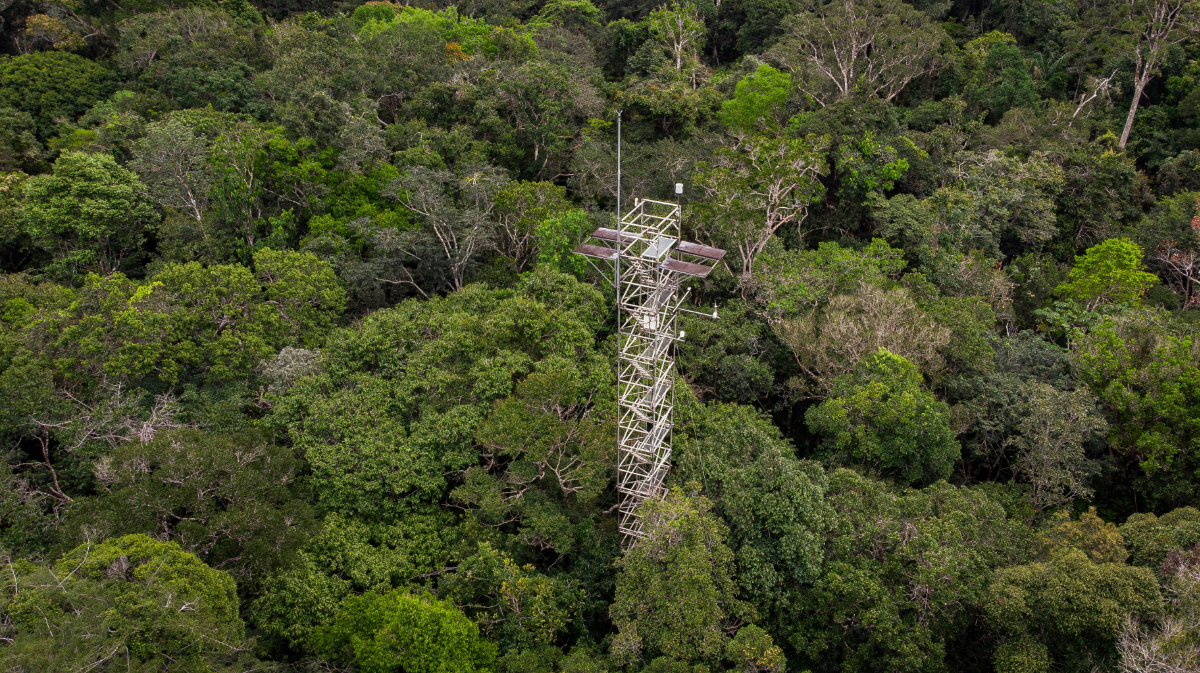


A tower, part of the AmazonFACE or Free-Air CO2 Enrichment project, is seen in Manaus, Brazil, on May 23, 2023. (Raul Vasconcelos/ASCOM MCTI/Handout via REUTERS)

The UN’s Intergovernmental Panel on Climate Change (IPCC) urged ambitious action to counter global warming again this year.
According to its latest March report, global warming will surpass 1.5 degrees Celsius in the decades after 2030, leading to irreversible loss of ecosystems.
Coinciding with global warming is the impact of human-caused deforestation in the Amazon.
A landmark 2018 study by scientists Thomas Lovejoy and Carlos Nobre found that the Amazon is hurtling toward a tipping point where savannas begin to replace rainforest.
They said that would happen with deforestation of 20 to 25 percent of Amazon territory. Currently, deforestation stands at 15 percent.

AmazonFACE, coordinated by University of Campinas and the Brazilian Ministry of Science, has the support of the Foreign Office and the British Meteorological Service (MET office).
British Foreign Secretary James Cleverly visited the facilities this week and announced a new contribution of 2 million pounds ($2.4 million) to the project, which since 2021 has already received 7.3 million pounds from the United Kingdom.
Brazil, for its part, has invested 32 million reais ($6.4 million).


Inside the Mexican resort that was the final hideout of ‘El Mencho’

Updated 2 sec ago
Follow

Inside the Mexican resort that was the final hideout of ‘El Mencho’

  • The roar of machine guns and drone of helicopters shook the luxurious resort where Mexico’s most-wanted cartel boss hid on Sunday
TAPALPA:The roar of machine guns and drone of helicopters shook the luxurious resort where Mexico’s most-wanted cartel boss hid on Sunday, plunging tourists enjoying the picturesque western Mexican town of Tapalpa into panic.
Nemesio Oseguera, the powerful Jalisco New Generation Cartel (CJNG) leader known as “El Mencho,” attempted to flee the audacious Mexican military operation in the mountainous area of the Jalisco state but was wounded during the escape and died while in transport to a hospital.
“It was terrifying... you could hear machine guns firing from the ground into the air and from the air to the ground,” a tourist who arrived at the resort the night before the operation told AFP, speaking on condition of anonymity for his safety.
The gunfire erupted around dawn.
“It gradually increased, and then the weapons were loud,” the man said, estimating the shootout lasted a couple of hours.
Tourists who rented the exclusive cabins were allowed to leave on Tuesday, following an initial request from the mayor’s office on Sunday to shelter in place.
Last date
Oseguera had his last date in the cabin resort with a girlfriend, who officials say was key to tracking the drug lord.
He had maintained a low profile at the Tapalpa Country Club, according to AFP interviews.
“I didn’t know there were people like that (here),” said one young domestic worker who lives in the area, speaking on the condition of anonymity.
But a tourist, who also asked not to be identified, said he had heard that the drug lord “was in this region.”
He said he imagined what might happen if they tried to arrest the cartel boss.
“It was a very tense moment,” he said of the violence, which involved a firefight between government special forces and the cartel’s security detail.
Authorities on Tuesday prevented people from approaching the scene of the battle.
The drug lord’s two-story stone resort house, which displayed large religious images on the exterior, was surrounded by hundreds of shell casings and an abandoned Jeep with its doors open, according to residents.
Mexican media outlets published images of the cabin’s luxurious interior, showing furniture with open drawers and unmade beds.
A table with religious images and candles, a handwritten prayer and medication for the kidney problems that had reportedly plagued Oseguera for years could also be seen.
Incendiary revenge
Oseguera’s killing made Tapalpa, a town known for its scenic charm and ecotourism activities, the epicenter of a wave of retaliation from the CJNG that spread to 20 of Mexico’s 32 states.
“They were burning cars and buses on the outskirts of Tapalpa,” the domestic worker recalled.
By Tuesday, the town was desolate.
Tourists, who usually spend weekends in this wooded retreat, began to head home.
str-lp/lga/lb