

World Bank approves $213 million for flood recovery, resilience in Pakistan’s southwest

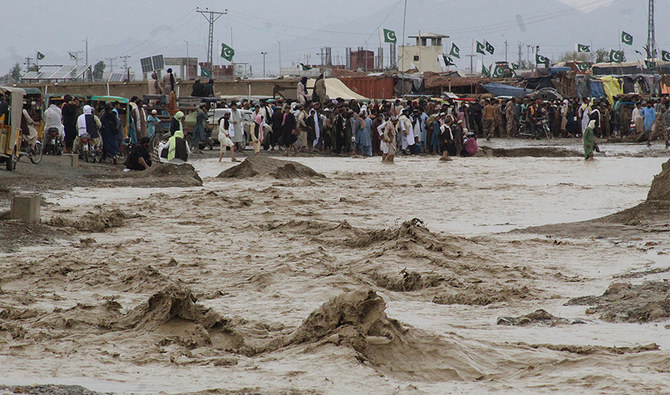
People wade through flooded mud water after heavy monsoon rainfall in the border town of Chaman in Balochistan province on August 25, 2022. (AFP/File)
Short Url
Updated 26 May 2023
Follow

World Bank approves $213 million for flood recovery, resilience in Pakistan’s southwest

  • The allocated amount is expected to benefit around 2.7 million people in selected communities across Balochistan province
  • World Bank has worked with Pakistan since 1950 and provided a total assistance of $40 billion to the country over the years

ISLAMABAD: The World Bank has approved $213 million to aid the recovery efforts from the devastating floods that struck Pakistan and destroyed houses, crops and public infrastructure in much of its southwestern Balochistan province, said an official statement released on Thursday night.

Unprecedented rains and floods wreaked havoc in Pakistan’s southern regions of Sindh and Balochistan, which accounted for most casualties out of more than 1,700 fatalities across the South Asian country. The deluges impacted 33 million Pakistanis and caused over $30 billion economic losses.

“We will be working closely with the Government of Balochistan to support the affected communities by providing livelihood support and rehabilitating irrigation and flood protection infrastructures,” Najy Benhassine, the World Bank country director for Pakistan, was quoted in the statement.

He said the project aimed to restore livelihoods and enhance resilience to potential future climate-related disasters and natural hazards.

According to the details, the integrated flood resilience and adaptation project will provide housing reconstruction grants to approximately 35,100 homeowners, ensuring adherence to resilience standards.

Additionally, smallholder farmers will receive livelihood grants to support livestock, promote climate-smart agriculture, and engage in other productive activities.

The project will also focus on rehabilitating damaged community infrastructure such as water supply, irrigation, roads, and community facilities, thereby restoring essential services.

Highlighting the vulnerability of Balochistan to natural disasters, Yoro Sidibe, senior water specialist at the World Bank, emphasized the project’s aim to provide economic opportunities to affected communities while strengthening institutional capacity for disaster preparedness and response.

The project is set to benefit around 2.7 million people in selected communities across Balochistan, mitigating flood risks through resilient protection infrastructure and improved early warning systems.

The World Bank has been working with Pakistan since 1950 and provided a total assistance of $40 billion over the years. With 58 ongoing projects and a total commitment of $14.8 billion, the bank has been playing a vital role in Pakistan’s development and resilience-building endeavors.


Death toll in Pakistan shopping plaza fire rises to 67, officials say

Updated 22 January 2026
Follow

Death toll in Pakistan shopping plaza fire rises to 67, officials say

  • Rescue teams still searching for damaged Gul Plaza in Karachi where blaze erupted on Saturday, says police surgeon
  • Karachi has a long history of deadly fires, often linked to poor safety standards, weak regulatory enforcement

KARACHI: The death toll from a devastating fire at a shopping plaza in Pakistan’s southern port city of Karachi jumped to 67 on Thursday after police and a hospital official confirmed that the remains of dozens more people had been found.

Police surgeon Dr. Summaiya Syed said rescue teams were still searching the severely damaged Gul Plaza in the Karachi, where the blaze erupted on Saturday.

Most remains were discovered in fragments, making identification extremely difficult, but the deaths of 67 people have been confirmed, she said. Asad Raza, a senior police official in Karachi, also confirmed the death toll. Authorities previously had confirmed 34 deaths.

Family members of the missing have stayed near the destroyed plaza and hospital, even after providing their DNA for testing. Some have tried to enter the building forcibly, criticizing the rescue efforts as too slow.

“They are not conducting the search properly,” said Khair-un-Nisa, pointing toward the rescuers. She stood outside the building in tears, explaining that a relative who had left to go shopping has been missing since the blaze.

Another woman, Saadia Saeed, said her brother has been trapped inside the building since Saturday night, and she does not know what has happened to him.

“I am ready to go inside the plaza to look for him, but police are not allowing me,” she said.

There was no immediate comment from authorities about accusations they have been too slow.

Many relatives of the missing claim more lives could have been saved if the government had acted more swiftly. Authorities have deployed police around the plaza to prevent relatives from entering the unstable structure, while rescuers continue their careful search.

Investigators say the blaze erupted at a time when most shop owners were either closing for the day or had already left. Since then, the Sindh provincial government has said around 70 people were missing after the flames spread rapidly, fueled by goods such as cosmetics, clothing, and plastic items.

The cause of the fire remains under investigation, though police have indicated that a short circuit may have triggered the blaze.

Karachi has a long history of deadly fires, often linked to poor safety standards, weak regulatory enforcement, and illegal construction.

In November 2023, a shopping mall fire killed 10 people and injured 22. One of Pakistan’s deadliest industrial disasters occurred in 2012, when a garment factory fire killed at least 260 people.