UAE-based port terminal operator seeks direct shipping connection between Karachi and Sharjah

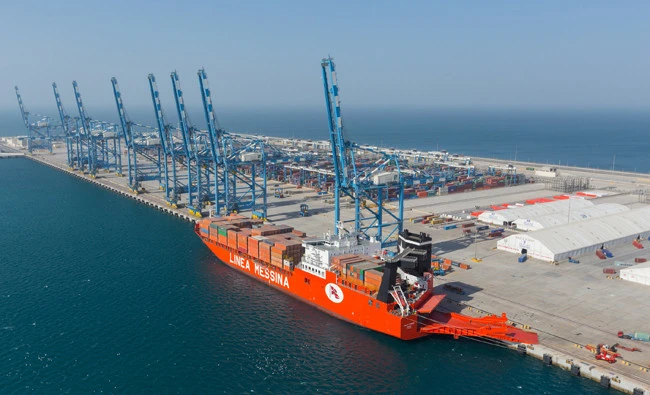
The undated photo shows a view of the Gwadar Sea Port in Pakistan's southwestern Balochistan province. (AFP/File)
Short Url
Updated 26 May 2023
Follow

UAE-based port terminal operator seeks direct shipping connection between Karachi and Sharjah

  • Gulftainer was launched in 1976 to operate the Middle East’s first container terminal at Sharjah’s Khor Fakkan
  • The company plans to hold roadshows in Pakistan, promoting fast transactions via Khor Fakkan for exporters

KARACHI: A United Arab Emirates-based port terminal operator plans to establish a direct connection between Pakistan’s Karachi and Khor Fakkan port in Sharjah through shipping lines using the fastest maritime route, said its top official on Thursday.

The Gulftainer company was launched in 1976 to operate the Middle East’s first container terminal in Sharjah. It has become a globally competitive port operator and third-party logistics provider, managing some of the most productive harbors in the world.

The Khor Fakkan Container Terminal itself is known to be one of the fastest facilities in the world.

“The thing about Khor Fakkan is that it’s only about 25 to 26 hours steaming distance at 20 knots from Karachi,” Andrew Hoad, the company’s group chief commercial officer, told Arab News while visiting Pakistan.

“We’re trying to hook up with shipping line services that are looking to directly connect the UAE with Pakistan, Karachi because Khor Fakkan is such a rational place to do it from, with a short steaming time, quick clearances, rather than going all the way through the Straits of Hormuz and further on up into the Gulf,” he added.

Hoad said his company was going to hold roadshows to introduce opportunities and expertise in Pakistan to attract exporters.

“We’re certainly going to be on a number of roadshows within Pakistan, talking to the exporting community for various commodities and trying to sell to them the benefits of that fast transaction into the UAE through Khor Fakkan,” he continued.

The port operator boasts of being one of the world’s leading international ports and logistics solution providers and the first and only operator from the Middle East to manage ports in the United States.

Gulftainer’s portfolio also encompasses seaports in Saudi Arabia and Iraq, along with freight forwarding, supply chain operations, and logistics cities through Momentum Logistics and Avalon Transport.

Hoad said the UAE had become a hub of expertise over the past 15 years that could be shared with Pakistan.

“The United Arab Emirates has a number of really good quality port operators,” he added. “DP World is one; Abu Dhabi Ports and Gulftainer are others. The UAE has become sort of a hub of expertise, I think, over the last ten or 15 years.”

“So hopefully we can share some of that expertise as Gulftainer if it is requested or required.”

IMF hails Pakistan privatization drive, calls PIA sale a ‘milestone’

Updated 10 January 2026
Follow

IMF hails Pakistan privatization drive, calls PIA sale a ‘milestone’

  • Fund backs sale of national airline as key step in divesting loss-making state firms
  • IMF has long urged Islamabad to reduce fiscal burden posed by state-owned entities

KARACHI: The International Monetary Fund (IMF) on Saturday welcomed Pakistan’s privatization efforts, describing the sale of the country’s national airline to a private consortium last month as a milestone that could help advance the divestment of loss-making state-owned enterprises (SOEs).

The comments follow the government’s sale of a 75 percent stake in Pakistan International Airlines (PIA) to a consortium led by the Arif Habib Group for Rs 135 billion ($486 million) after several rounds of bidding in a competitive process, marking Islamabad’s second attempt to privatize the carrier after a failed effort a year earlier.

Between the two privatization attempts, PIA resumed flight operations to several international destinations after aviation authorities in the European Union and Britain lifted restrictions nearly five years after the airline was grounded following a deadly Airbus A320 crash in Karachi in 2020 that killed 97 people.

“We welcome the authorities’ privatization efforts and the completion of the PIA privatization process, which was a commitment under the EFF,” Mahir Binici, the IMF’s resident representative in Pakistan, said in response to an Arab News query, referring to the $7 billion Extended Fund Facility.

“This privatization represents a milestone within the authorities’ reform agenda, aimed at decreasing governmental involvement in commercial sectors and attracting investments to promote economic growth in Pakistan,” he added.

The IMF has long urged Islamabad to reduce the fiscal burden posed by loss-making state firms, which have weighed public finances for years and required repeated government bailouts. Beyond PIA, the government has signaled plans to restructure or sell stakes in additional SOEs as part of broader reforms under the IMF program.

Privatization also remains politically sensitive in Pakistan, with critics warning of job losses and concerns over national assets, while supporters argue private sector management could improve efficiency and service delivery in chronically underperforming entities.

Pakistan’s Cabinet Committee on State-Owned Enterprises said on Friday that SOEs recorded a net loss of Rs 122.9 billion ($442 million) in the 2024–25 fiscal year, compared with a net loss of Rs 30.6 billion ($110 million) in the previous year.