Japan unveils new sanctions on Russia over Ukraine invasion

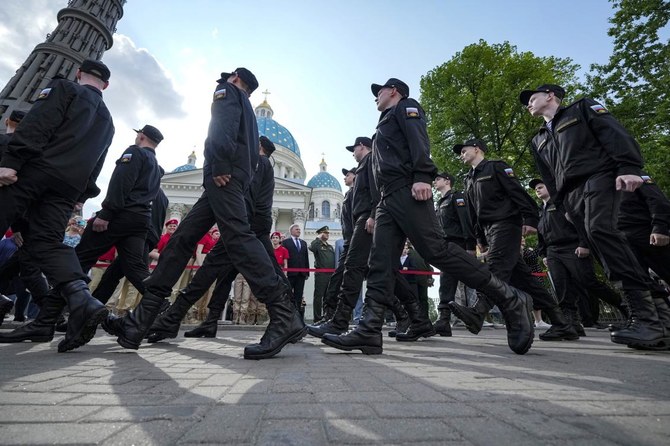
Japan’s latest sanctions targeted the Russian military as well as the construction and engineering sectors. Above, Russian conscripts march during a send-off event before they head to assigned military units for mandatory one-year military service. (AP)
Short Url
Updated 26 May 2023
Follow

Japan unveils new sanctions on Russia over Ukraine invasion

  • Russia was hit with a wave of sanctions after it sent forces into Ukraine in February last year
  • Latest embargo by Tokyo follows the Group of Seven summit Japan hosted last week

TOKYO: Japan announced fresh sanctions against Russia on Friday over its invasion of Ukraine, targeting its military as well as the construction and engineering sectors.
Russia was hit with a wave of sanctions after it sent forces into Ukraine in February last year, but calls have grown from Kyiv and its allies for tougher action against Moscow.
The latest embargo by Tokyo follows the Group of Seven summit Japan hosted last week in Hiroshima, where the bloc’s leaders agreed to “starve Russia of G7 technology, industrial equipment and services that support its war machine.”
The new Japanese sanctions include “an asset freeze of Russian individuals and groups, a ban on the export of goods to Russia’s military-related organizations, and a ban on the export of construction and engineering services to Russia,” top government spokesman Hirokazu Matsuno told reporters.
The asset freeze targets 17 individuals and 78 groups, including high-level military officials, while the 80 organizations hit with export restrictions include the Russian mobile phone operator MegaFon, according to the Japanese government.
The United States, Britain and the European Union have all announced fresh punishments against Moscow recently, as well as commitments of more military aid to Ukraine, including F-16 fighters.
Matsuno also condemned plans to deploy Russian tactical nuclear weapons to Belarus.
Belarusian leader Alexander Lukashenko said Thursday that Moscow had begun moving nukes to its territory.
Matsuno said this will “further escalate the situation.”
“As the only country to have suffered atomic bombings during wartime, Japan can never tolerate Russia’s threat of nuclear weapons, not to mention their use.”


Germany’s Merz visits India to push defense industry ties ahead of EU trade deal

Updated 12 sec ago
Follow

Germany’s Merz visits India to push defense industry ties ahead of EU trade deal

  • India, Germany make joint declarations on cooperation in defense, critical minerals, energy
  • Merz is accompanied by CEOs of top German companies such as Thyssen, Siemens, Bosch

NEW DELHI: German Chancellor Friedrich Merz met Indian Prime Minister Narendra Modi on Monday to push for defense industry cooperation ahead of India’s awaited free trade agreement with the EU.

Merz’s two-day trip is his first since taking office in May and he is accompanied by German business leaders.

The visit started in Ahmedabad in Gujarat, Modi’s home state, where they held a press conference after a delegation-level meeting and a series of joint declarations, including on strengthening bilateral cooperation in the defense industry, critical minerals, semiconductors, and energy.

“The growing cooperation in defense and security is a symbol of our mutual trust and shared vision,” Modi said, as he thanked Merz for “simplifying the processes” related to defense trade.

“We will also work on a roadmap to enhance cooperation between our defense industries, which will open up new opportunities for co-development and co-production.”

The roadmap would promote long-term industry-level collaboration, including technology partnerships, co-development and co-production of defense platforms and equipment, according to Prof. Ummu Salma Bava, chairperson of the Special Centre for National Security Studies at Jawaharlal Nehru University.

“This defense cooperation marks a transformational shift in the bilateral relations that had till now focused on economic cooperation, and inaugurates a new chapter on a scaled-up defense engagement,” she told Arab News.

“PM Modi indicated that both countries are entering the ‘limitless’ phase in expanding economic cooperation in strategic sectors.”

Germany is India’s most important trading partner in Europe and one of its top partners worldwide, with bilateral trade in goods and services estimated by the Indian Ministry of External Affairs at $50 billion.

In Merz’s delegation are 25 CEOs and industry leaders, including from Thyssen Krupp Maritime Systems, Siemens, DHL Group, Infineon Technologies, Uniper, Airbus Defence and Space.

German media reported that one of the key focuses of the visit is finalizing the details of an $8 billion deal to jointly build submarines in India.

The visit comes as India and the EU — of which Germany is the largest economy — are working on a free trade agreement. It also takes place ahead of an EU-India summit in New Delhi on Jan. 27, where parts of the pact are expected to be finalized.

“The visit of the large business delegation with 25 German CEOs is to tap into the growing economic potential and also further strengthen the bilateral economic relations,” Bava said.

“The signing of the India-EU FTA will further expand trade between India and Germany. Germany is the largest economy in the EU and has a strong base in automobiles, engineering, advanced manufacturing, chemicals and defense industry.”