Elon Musk’s Neuralink gets FDA approval for study of brain implants in humans

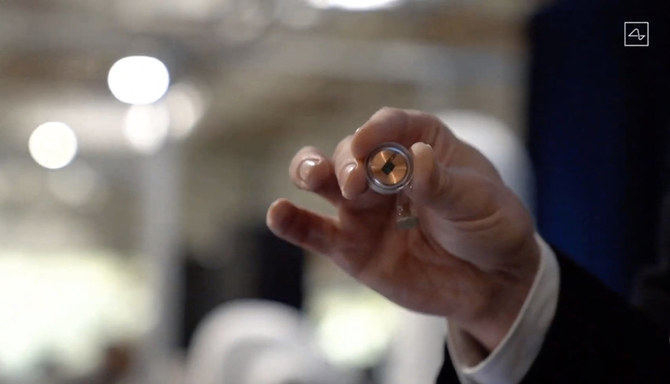
This video grab made from the online Neuralink livestream shows the Neuralink disk implant held by Elon Musk during the presentation on August 28, 2020. (Neuralink via AFP)
Short Url
Updated 26 May 2023
Follow

Elon Musk’s Neuralink gets FDA approval for study of brain implants in humans

  • Neuralink is developing a brain implant it hopes will help paralyzed people walk again and cure other neurological ailments

Elon Musk’s brain-implant company Neuralink on Thursday said it had received the US Food and Drug Administration’s (FDA) approval to launch its first-in-human clinical study.
On at least four occasions since 2019, Musk has predicted that his medical device company would soon start human trials of a brain implant to treat intractable conditions such as paralysis and blindness.
Yet the company, founded in 2016, did not seek permission from the FDA until early 2022 — and the agency rejected the application, seven current and former employees told Reuters in March.
The FDA approval comes as US lawmakers urged regulators earlier this month to investigate whether the make-up of a panel overseeing animal testing at Neuralink contributed to botched and rushed experiments. Neuralink has already been the subject of federal probes.
Reuters reported on Dec. 5 that the USDA’s Inspector General was investigating, at the request of a federal prosecutor, potential violations of the Animal Welfare Act, which governs how researchers treat and test certain types of animals.
The probe has also been looking at the USDA’s oversight of Neuralink.
In a tweet on Thursday, Neuralink said that the company is not yet open for a clinical trial.
“This is the result of incredible work by the Neuralink team in close collaboration with the FDA and represents an important first step that will one day allow our technology to help many people,” Neuralink said in a tweet on Thursday.
Neuralink is developing a brain implant it hopes will help paralyzed people walk again and cure other neurological ailments.
The FDA did not immediately respond to a Reuters request for comment.


Journalists in Bangladesh demand protection amid rising attacks

Updated 5 sec ago
Follow

Journalists in Bangladesh demand protection amid rising attacks

  • Media industry in the South Asian country is being systematically targeted
  • Interim government blamed for failing to adequately respond to the incidents
DHAKA: Journalists, editors and owners of media outlets in Bangladesh on Saturday demanded that authorities protect them following recent attacks on two leading national dailies by mobs.
They said the media industry in the South Asian country is being systematically targeted in the interim government headed by Nobel Peace Prize laureate Muhammad Yunus. They said the administration failed to prevent attacks on the Daily Star, the country’s leading English-language daily, and the Prothom Alo, the largest Bengali-language newspaper, both based in Dhaka, the capital.
In December, angry mobs stormed the offices of the two newspapers and set fire to the buildings, trapping journalists and other staff inside, shortly after the death of a prominent Islamist activist.
The newspaper authorities blamed the authorities under the interim government for failing to adequately respond to the incidents despite repeated requests for help to disperse the mobs. Hours later, the trapped journalists who took shelter on the roof of the Daily Star newspaper were rescued. The buildings were looted. A leader of the Editors Council, an independent body of newspaper editors, was manhandled by the attackers when he arrived at the scene.
On the same day, liberal cultural centers were also attacked in Dhaka.
It was not clear why the protesters attacked the newspapers, whose editors are known to be closely connected with Yunus. Protests had been organized in recent months outside the offices of the dailies by Islamists who accused the newspapers of links with India.
On Saturday, the Editors Council and the Newspapers Owners Association of Bangladesh jointly organized a conference where editors, journalist union leaders and journalists from across the country demanded that the authorities uphold the free press amid rising tensions ahead of elections in February.
Nurul Kabir, President of the Editors Council, said attempts to silence media and democratic institutions reflect a dangerous pattern.
Kabir, also the editor of the English-language New Age daily, said unity among journalists should be upheld to fight such a trend.
“Those who want to suppress institutions that act as vehicles of democratic aspirations are doing so through laws, force and intimidation,” he said.
After the attacks on the two dailies in December, an expert of the United Nations said that mob attacks on leading media outlets and cultural centers in Bangladesh were deeply alarming and must be investigated promptly and effectively.
“The weaponization of public anger against journalists and artists is dangerous at any time, and especially now as the country prepares for elections. It could have a chilling effect on media freedom, minority voices and dissenting views with serious consequences for democracy,” Irene Khan said in a statement.
Yunus came to power after former Prime Minister Sheikh Hasina fled the country amid a mass uprising in August, 2024. Yunus had promised stability in the country, but global human rights groups including Human Rights Watch and Amnesty International have blamed the government for its failure to uphold human and other civil rights. The Yunus-led regime has also been blamed for the rise of the radicals and Islamists.
Dozens of journalists are facing murder charges linked to the uprising on the grounds that they encouraged the government of Hasina to use lethal weapons against the protesters. Several journalists who are known to have close links with Hasina have been arrested and jailed under Yunus.